




Minnesota Uses New Bridge-Building Tech to Slash Road-Closure Time
The Minnesota Department of Transportation used a giant automated machine called a Self-Propelled Modular Transporter to move a finished bridge into position over the weekend, and reduced the overall road closure time by two months
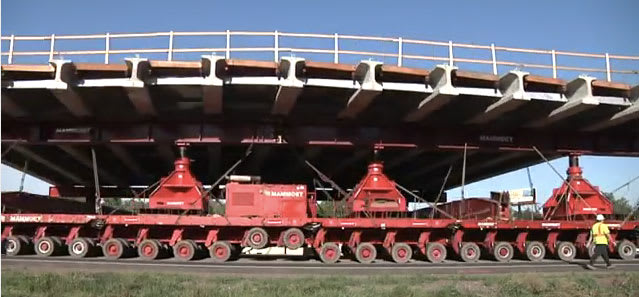
This Self-Propelled Modular Transporter was used to replace a bridge over I-35E in St. Paul with fewer road closures.
The Minnesota Department of Transportation used a giant automated machine called a Self-Propelled Modular Transporter to move a finished bridge into position over the weekend, and reduced the overall road closure time by two months.
A first for MnDOT, the move took place Aug. 18 over Interstate 35E in St. Paul at the Maryland Avenue Bridge site, where crews have been working all summer long building the bridge deck and structure on the west side of the roadway.
The two 105-foot spans that were built about 1,000 feet south of the crossing. The SPMT, with 352 wheels, took about two hours to move each span into place. Traffic was diverted beginning a few hours earlier.
Saturday's event was a pilot demonstration of SPMT technology that has cut the duration of highway construction-related road closures in Utah and Arizona nearly in half. As a result, MnDOT shaved about two months from road closures in St. Paul.
"With traditional construction methods, the Maryland Bridge would have been closed for twice as long, nearly four months," said MnDOT Commissioner Tom Sorel. "Instead, the closure will be reduced to about 60 days."
Crews have additional work to finish before the bridge is open to traffic in mid-September.
Watch a time-lapse video compressing the 12-hour process into just over a minute:
More information about the I-35E Maryland Avenue Bridge project is available at www.dot.state.mn.us/metro/projects/35estpaul/maryland.html.
Over the next three years, the three corridor projects on I-35E north of St. Paul will change the entrance to St. Paul from the north. In addition to replacing the Maryland Avenue Bridge, the Cayuga Bridge Project, as it's called, will reconstruct I-35E from University Avenue to Maryland Avenue, including replacement of the Cayuga Bridge, the Pennsylvania Avenue Bridge and the railroad bridges along I-35E.
The partial interchange at Pennsylvania Avenue will be replaced by a full interchange at Cayuga Street. The new I-35E roadway will have an auxiliary lane in each direction for added capacity in addition to extra room in the center to accommodate a proposed MnPASS lane. The project will be constructed between 2013 and 2015, with impacts to I-35E traffic in 2014 and 2015.
The I-35E MnPASS project proposes to reconstruct I-35E from Maryland Avenue to Little Canada Road, adding a MnPASS lane to the existing three lanes of traffic. The project will replace the Arlington, Wheelock and Larpenteur Bridges spanning I-35E and replace I-35E bridges spanning Roselawn Avenue, County Road B and Highway 36. This project is expected to be constructed between 2013 and 2015, with impacts to I-35E in 2014 and 2015.
More Drivers
Medical Cards, English Proficiency Reshape Roadcheck Violations
Medical-card violations jumped to the top of the driver out-of-service list during CVSA’s 2026 International Roadcheck, while English-language proficiency violations appeared among the leading violations for the first time.
Read More →
Driver Trust Can Make or Break the Success of Fleet Safety Technology
New Teletrac Navman research suggests that onboarding, transparency about driver data, and positive feedback can play a significant role in how commercial drivers respond to safety and coaching technology.
Read More →
EEOC Sues KLLM Over Alleged Sex Discrimination in Driver Training
KLLM is facing a federal sex-discrimination lawsuit over policies the EEOC alleges put female truck driver trainees at a disadvantage.
Read More →
FMCSA Moves to Codify English Language Requirements for Commercial Drivers
By changing regulations on English-language proficiency requirements for commercial drivers, rather than relying on a guidance memo, the FMCSA said future administrations won't be able to walk back the Trump administration's stricter enforcement with just a memo.
Read More →
Drivers Put Western Star Trucks to the Test at Star Nation Experience
Watch to get an inside look at the Western Star trucks, technology, and community behind the Star Nation Experience 2026!
Read More →
Trump Administration Looks to Put More Veterans Behind the Wheel
The Freedom Haulers program pulls together existing and expanded programs at several federal agencies to recruit veterans to drive commercial heavy-duty trucks and cut the red tape for them to get a CDL, training, and employment.
Read More →
Putting Mack’s Command Steer to the Test
A test drive of Mack’s Command Steer active steering system evaluates how it can make truck driving easier and less tiring.
Read More →
Competition Heating Up for Truck Drivers
New report reveals rising driver hiring costs, the return of sign-on bonuses, growing AI advantages, and the operational factors shaping driver retention.
Read More →
How Fraley & Schilling Improved Logbook Compliance by Over 50%
Fraley & Schilling needed a way to close a compliance workflow gap in its ELD system without adding more work from driver training, reminders, and back-office follow-ups. It found the answer in a custom driver app.
Read More →
Volvo Goes Gaming
Volvo has roared into American Truck Simulator with two new flagship trucks.
Read More →