




Meritor to Start Testing Electric Drivetrain Next Year
Meritor announced at the North American Commercial Vehicle Show that it is developing a platform of electric drive axles and suspensions as well as supporting systems “to position Meritor as a leader in electric solutions for the commercial vehicle market.”

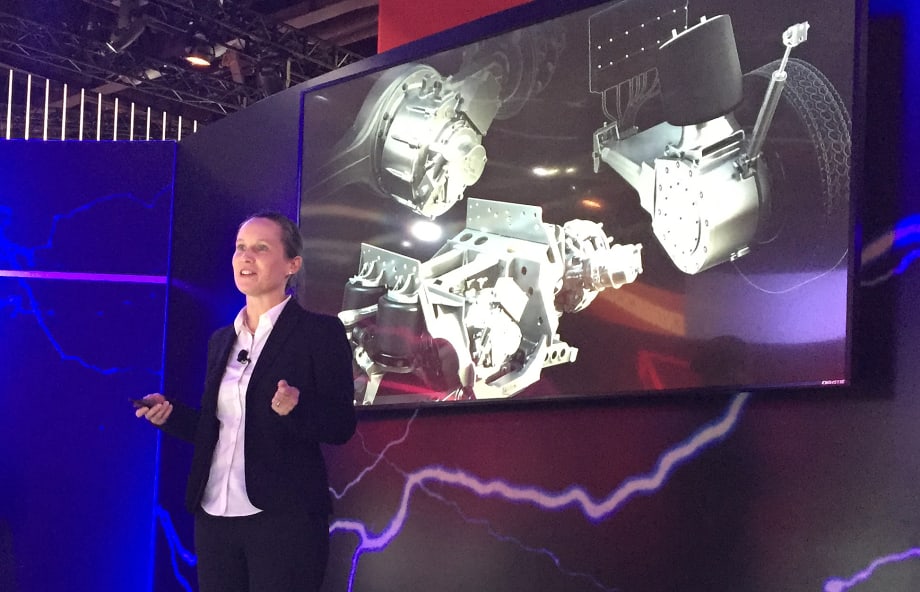
Meritor's Cheri Lantz explains that the e-carrier is an electric motor designed into a differential carrier. Photo: Deborah Lockridge
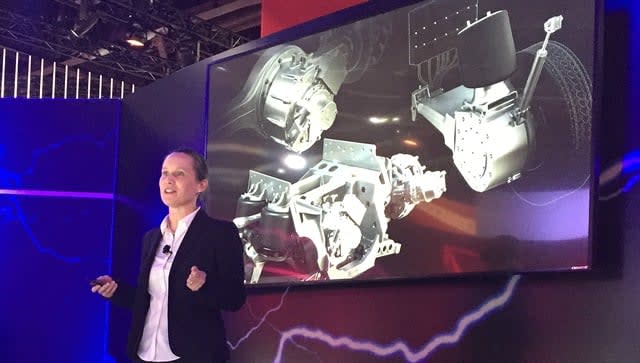
Meritor's Cheri Lantz explains that the e-carrier is an electric motor designed into a differential carrier.Photo: Deborah Lockridge
ATLANTA – As Meritor works to stay ahead in an industry facing the most rapid change CEO Jay Craig says he’s ever seen, the company announced it’s developing a new portfolio of electric drivetrains.
Meritor announced at the North American Commercial Vehicle Show that it is developing a platform of electric drive axles and suspensions as well as supporting systems “to position Meritor as a leader in electric solutions for the commercial vehicle market.”
It also announced an improved air disc brake and a new low-cost aftermarket brand.
“You’re seeing part of the Renaissance of Meritor,” Craig said. About a year into its three-year M2019 plan focusing on revenue growth, the company continues to press forward with its goal to roll out at least 20 new products during that three-year time frame.
“We're also committed to electrification,” Craig said. “We’ve had a lot of interest from OEs on how we can start to work with them to launch demonstrator and production vehicles as well. We have a product for every category of the commercial vehicle market,” he said, including trucks, buses, and delivery vans. “We offer the complete portfolio and our plan is to continue to be the drivetrains leader – no matter where the industry evolves.”
The electric drivetrains address several trends in the industry, said Cheri Lantz, vice president and chief strategy officer: the increasing quest for efficiency, global emissions regulations, and the advancement of electrification as technology improves and battery costs come down.
Essentially, Meritor is focusing on integrating an electric motor into the differential carrier. The flexible e-carrier design will be the foundation for various drivetrain configurations, including full electric, hybrid, single or tandem axles with various options based on application. Designed for city-delivery, medium-duty and transit bus, as well as off-road and severe-duty applications, the electrified, lightweight carrier offers several benefits over remote-mounted electric motor configurations.
Meritor designed the e-carrier as a drop-in replacement of a conventional mechanical carrier that does not disrupt axle or suspension packaging. Because the electric motor is integrated into the axle, space is freed up for batteries and other electrical components, offering easier packaging and installation and a safer, more protected location inside the frame rails to mount the batteries. The design also eliminates cost and weight associated with a driveline and mounting a remote motor with brackets.
The following near-term electrified product solutions are under development by Meritor:
• Integrated two-speed electric carrier platform capable of delivering 150-200 kilowatts of continuous power for mounting on existing axle platforms, fitting a wide variety of applications on rigid and independent suspensions
• 13Xe rigid axle, capable of 200 kilowatts of continuous power and featuring customizable gearing to cover linehaul, school bus, refuse, pickup and delivery, utility and other applications
• Electric-driving independent suspension for applications such as military, emergency, off-highway and construction vehicles that will benefit from increased performance as well as better ride comfort and handling
• Electric eCorner module for low-floor applications such as medium-duty Class 4 and 5 pickup and delivery vehicles and transit buses.
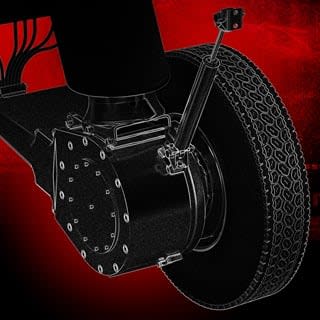
The Electric eCorner module is designed for low-floor applications such as medium-duty Class 4 and 5 pickup and delivery vehicles and transit buses.
Meritor says it’s taking an integrated approach to electrification, so it will also offer braking systems optimized for e-axles. The Next Generation Quadraulic brake and Next Generation Air Disc Brake have been designed for use on hybrid or electric vehicles with regenerative braking.
“Both take advantage of the lighter duty cycle in an electric vehicle,” explained Lantz. “You have regenerative braking so you don't use the brakes as much, so we have been able to reduce wearable content and save cost and weight on the braking systems.”
The components will be part of a demonstration vehicle to be built in 2018, with production beginning as early as 2019.
More Fuel Smarts

Geotab Links Fleet Card to Vehicle Data
The new card combines fuel discounts with telematics-based purchase controls. Geotab’s analysis also points to potential savings from choosing lower-priced fuel stops.
Read More →
Fleet Economics Shape Electric Truck Outlook
ACT Research expects costs, charging infrastructure, and technology improvements to drive zero-emission commercial vehicle adoption as federal regulations and incentives retreat.
Read More →
Wex Adds Cardless Fuel Payments for Over-the-Road Customers
A new fuel card feature for Wex customers offers convenience and security.
Read More →

New California Law Could Shed Light on Electric Truck Prices
Why do battery-electric Class 8 trucks remain so expensive? A California bill signed by Gov. Gavin Newsom would give fleets and state agencies more visibility into what manufacturers charge.
Read More →
How Volvo Updated Its D13 for EPA 2027 [Watch]
Volvo’s updated D13 promises lower emissions without sacrificing performance or fuel economy. Take a closer look at what changed inside the engine in this HDT Spotlight video.
Read More →
Diesel Price Spike Shortens Payback for Natural Gas Trucks, Report Says
Energy Vision estimates fleets could recover the higher purchase price of an RNG-fueled Class 8 tractor in 1.3 to 2.8 years under current fuel-price scenarios.
Read More →
Calstart Becomes Catalyst Mobility, Reflecting Broader Focus
Calstart is now Catalyst Mobility, reflecting the nonprofit’s growing national role in clean transportation, including zero-emission trucks, infrastructure and incentive programs.
Read More →
Record Diesel Prices Squeeze Trucking Fleets
Average U.S. diesel prices have climbed to nearly $6 a gallon, surpassing the 2022 record as tight refinery capacity and Middle East disruptions keep fuel costs elevated.
Read More →
How Fuel Delivery Shapes Engine Performance
Fuel delivery depends on more than what happens at the injector. For fleet, maintenance and technical professionals, looking at the full path from pump to injector can provide useful context for understanding engine performance.
Read More →
East Coast Port Launches $45M Electric Truck Push
The Port Authority of New York and New Jersey announced millions in incentives for zero-emission drayage trucks, yard tractors, and new charging hubs near the port.
Read More →