




Mack to Evaluate Electric Powertrain for Refuse Trucks
Designed as an alternative to conventional piston-engine powertrains, the Wrightspeed Route is a range-extending electric system that propels the truck and helps reduce fuel consumption and vehicle maintenance costs, the companies said.
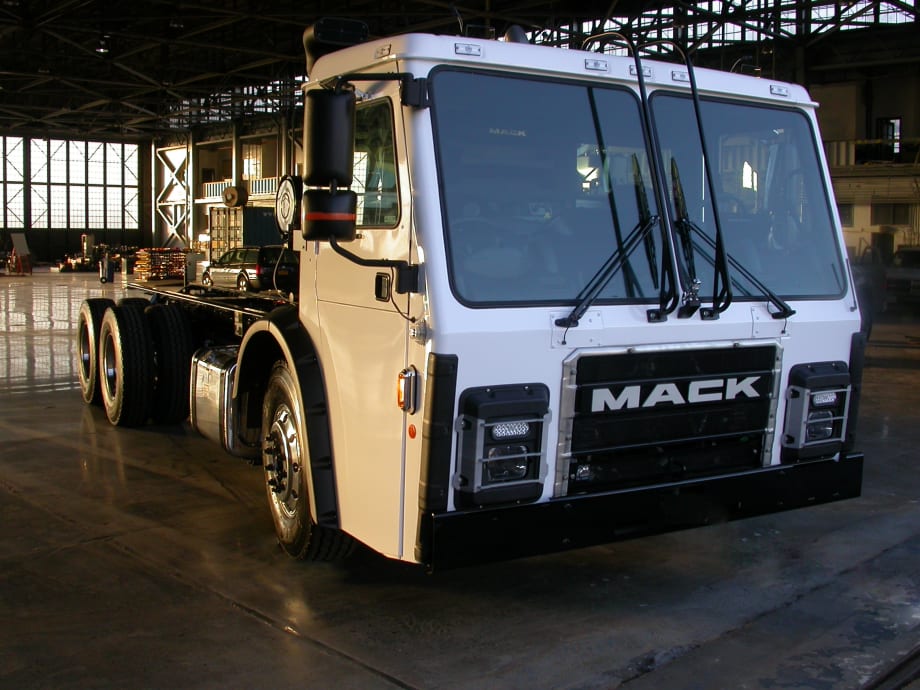
LR chassis has a retrofitted Wrightspeed Route turbine-electric system instead of a conventional diesel or natural gas engine and transmission. Photo: Mack Trucks Inc.
LR chassis has a retrofitted Wrightspeed Route turbine-electric system instead of a conventional diesel or natural gas engine and transmission. Photo: Mack Trucks Inc.
Mack Trucks is showcasing an LR low-cab-forward chassis retrofitted with a Wrightspeed Route 1000 turbine-electric powertrain this week at WasteExpo 2016 in Las Vegas, and said it will evaluate the system as an option in its refuse trucks.
Designed as an alternative to conventional engine-transmission powertrains, the Wrightspeed Route is a range-extending electric system that propels the truck and helps reduce fuel consumption and vehicle maintenance costs, the companies said.
The system features a plug-in-capable battery pack that enables a purely electric range of up to 24 miles. When the batteries’ charge runs low, an 80 kW Fulcrum Turbine Generator, which can operate on natural gas or diesel fuel, recharges the batteries, enabling unlimited range with refueling.
Additional recharging comes from the Route’s 730 kW regenerative braking system, which produces electricity as the vehicle comes to a stop. Regenerative braking also reduces maintenance costs, as brake wear is significantly decreased.
Electricity from the battery pack powers four Geared Traction Drive (GTD) electric motors, enabling the Route powertrain to power vehicles up to 66,000 pounds on grades as steep as 40%. With full torque available from zero rpm, the Route provides a driving experience comparable to diesel-powered trucks, the companies said.
“Mack is the refuse industry leader because we’re constantly seeking to pioneer new ideas and innovations,” said Dennis Slagle, president of Mack Trucks. “It’s something we’ve done throughout our 116-year history, and it’s something we will continue to do. Wrightspeed shares this pioneering spirit, which is why we’re eager to evaluate their Route powertrain technology.”
“At Wrightspeed, we’re focused on designing the best-performing powertrains for forward-looking OEMs and fleet operators,” said Ian Wright, CEO and founder of Wrightspeed. “Mack represents one of the most innovative manufacturers in the refuse industry, and we’re proud to showcase our technology alongside their Mack LR model. We thank them for recognizing our powertrain as a potential addition in their pursuit of innovation."
The Wrightspeed-equipped LR will be on display in Mack booth no. 1327 at WasteExpo 2016, which runs through June 9 at the Las Vegas Convention Center.
Related: Wrightspeed's Tantalizing Turbine-Electric Drivetrain
More Fuel Smarts

How Volvo Updated Its D13 for EPA 2027 [Watch]
Volvo’s updated D13 promises lower emissions without sacrificing performance or fuel economy. Take a closer look at what changed inside the engine in this HDT Spotlight video.
Read More →
Diesel Price Spike Shortens Payback for Natural Gas Trucks, Report Says
Energy Vision estimates fleets could recover the higher purchase price of an RNG-fueled Class 8 tractor in 1.3 to 2.8 years under current fuel-price scenarios.
Read More →
Calstart Becomes Catalyst Mobility, Reflecting Broader Focus
Calstart is now Catalyst Mobility, reflecting the nonprofit’s growing national role in clean transportation, including zero-emission trucks, infrastructure and incentive programs.
Read More →

Record Diesel Prices Squeeze Trucking Fleets
Average U.S. diesel prices have climbed to nearly $6 a gallon, surpassing the 2022 record as tight refinery capacity and Middle East disruptions keep fuel costs elevated.
Read More →
How Fuel Delivery Shapes Engine Performance
Fuel delivery depends on more than what happens at the injector. For fleet, maintenance and technical professionals, looking at the full path from pump to injector can provide useful context for understanding engine performance.
Read More →
East Coast Port Launches $45M Electric Truck Push
The Port Authority of New York and New Jersey announced millions in incentives for zero-emission drayage trucks, yard tractors, and new charging hubs near the port.
Read More →
California Bill Could Shed Light on Electric Truck Prices
Why do battery-electric Class 8 trucks remain so expensive? A California bill headed to Gov. Gavin Newsom would give fleets and state agencies more visibility into what manufacturers charge.
Read More →
Detroit Opens Orders for EPA 2027 Engines
Detroit isn’t starting from scratch to meet EPA 2027 diesel emissions standards. Its Gen 6 DD13 and DD15 engines keep much of today’s platform while updating the fuel and aftertreatment systems.
Read More →
Zero-Emission Truck Corridor Planned for West Coast
California, Oregon, Washington, British Columbia and Baja California are coordinating plans for truck charging and hydrogen fueling from Canada to Mexico.
Read More →
A Closer Look at Kenworth’s Electric T880E Vocational Truck [Video]
Learn more about Kenworth's T880E battery-electric vocational truck at the Paccar Technical Center, including its range, applications, upfitting considerations, and PTO options, in this HDT Spotlight video.
Read More →