




Kinetic Energy Technology Could Save Fleets Fuel
Volvo Trucks says it's developed technology that uses kinetic energy to help propel a truck. Volvo's I-See technology operates like an autopilot, taking over gearchanging and using gradients to save fuel. The technology will first be released in the European market in 2013, but could eventually be seen in North America
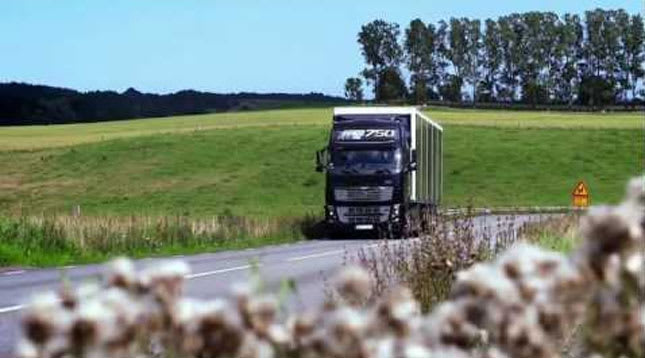
Volvo Trucks says it's developed technology that uses kinetic energy to help propel a truck. Volvo's I-See technology operates like an autopilot, taking over gearchanging and using gradients to save fuel. The technology will first be released in the European market in 2013, but could eventually be seen in North America.
Kinetic energy is the mechanical work needed to reduce an object's speed to zero. When an object in motion is slowed down, its kinetic energy has to be transformed into some other form of energy. When a vehicle brakes, its kinetic energy is converted into heat. Many manufacturers in the automotive world are now examining solutions for harnessing kinetic energy instead of releasing it as surplus heat.
"If kinetic energy can be exploited to a greater extent, it may help cut fuel consumption," says Anders Eriksson, product developer at Volvo Trucks. "This will benefit both the environment and the industry's economy, something that is very important today as fuel costs are becoming an increasingly heavy burden on many haulage firms."
Volvo Trucks says this is what it has developed with its new I-See solution. The system harnesses the truck's own kinetic energy to "push" the vehicle up hills. On downhill gradients the same energy is used for acceleration.
I-See is linked to the transmission's tilt sensor and obtains information about the topography digitally. The fact that the system is not dependent on maps makes it more dependable because it always obtains the very latest information, according to Volvo. I-See can recall about 4,000 gradients, corresponding to a distance of 5,000 kilometers (a little more than 3,100 miles).
"I-See is an autopilot linked to the truck's cruise control, taking over and handling gearchanges, throttle and brakes on gradients, ensuring they all operate in the most fuel-efficient way possible," explains Hayder Wokil, product manager at Volvo Trucks. "I-See freewheels as much as possible - so on certain stretches of road no fuel is used at all.
"In this way fuel consumption can be cut by up to 5%," Wokil says. "This figure is based on the results of simulations and tests on public roads. I-See requires use of the cruise control, and we know that on average drivers use cruise control about half the time. For a truck in normal operation, covering 140,000 kilometers (close to 87,000 miles) a year, the saving will be about 1,000 liters (about 265 gallons) of fuel annually. This makes a big difference to the haulage firm's profitability."
I-See carries out six different operations to use the kinetic energy to the maximum. For instance, I-See accelerates up hills, remains in a high gear for as long as possible and freewheels on descents to exploit the truck's weight as a propulsion motor.
"I-See works best in undulating terrain," says Eriksson, who was responsible for the development of I-See. "With moderately long and steep slopes, I-See ensures that you can freewheel for long distances without using the engine.
When the truck rolls freely, virtually no fuel is used. But in order to freewheel, a whole lot of data is required.
"It imposes high demands on precision," Eriksson says. "For instance, you have to know whether your speed will drop or increase over the next stretch of road. A gradient of just a few percent can be the decisive factor."
Other factors that make a difference are air resistance and the truck's weight. All told the system has to keep track of and process a lot of information. Many truck drivers who test I-See will recognize the driving style it adopts.
"I-See imitates the driving style of good drivers. They utilize the vehicle's kinetic energy, accelerate in time and avoid unnecessary gearchanging," Wokil says. "But unlike a driver, I-See never gets tired - it's like an autopilot."
This allows the driver to focus more on the surrounding traffic and other aspects of the journey. What is more, progress on the road is more relaxed.
"And an alert driver is a better driver," Wokil says. "That's something we know for sure."
Eriksson also points out that it is not only fuel that is saved. "I-See reduces brake and tire wear, for instance. And that naturally benefits the environment," he says.
Watch a video about I-See here.
More Drivers

Hours of Service Pilot Programs: FMCSA Readies for 2027 Rollout
Two pilot programs could eventually reshape hours-of-service rules, giving truck drivers options to pause their 14-hour clock or use longer split sleeper rest periods.
Read More →
Medical Cards, English Proficiency Reshape Roadcheck Violations
Medical-card violations jumped to the top of the driver out-of-service list during CVSA’s 2026 International Roadcheck, while English-language proficiency violations appeared among the leading violations for the first time.
Read More →
Driver Trust Can Make or Break the Success of Fleet Safety Technology
New Teletrac Navman research suggests that onboarding, transparency about driver data, and positive feedback can play a significant role in how commercial drivers respond to safety and coaching technology.
Read More →
EEOC Sues KLLM Over Alleged Sex Discrimination in Driver Training
KLLM is facing a federal sex-discrimination lawsuit over policies the EEOC alleges put female truck driver trainees at a disadvantage.
Read More →
FMCSA Moves to Codify English Language Requirements for Commercial Drivers
By changing regulations on English-language proficiency requirements for commercial drivers, rather than relying on a guidance memo, the FMCSA said future administrations won't be able to walk back the Trump administration's stricter enforcement with just a memo.
Read More →
Drivers Put Western Star Trucks to the Test at Star Nation Experience
Watch to get an inside look at the Western Star trucks, technology, and community behind the Star Nation Experience 2026!
Read More →
Trump Administration Looks to Put More Veterans Behind the Wheel
The Freedom Haulers program pulls together existing and expanded programs at several federal agencies to recruit veterans to drive commercial heavy-duty trucks and cut the red tape for them to get a CDL, training, and employment.
Read More →
Putting Mack’s Command Steer to the Test
A test drive of Mack’s Command Steer active steering system evaluates how it can make truck driving easier and less tiring.
Read More →
Competition Heating Up for Truck Drivers
New report reveals rising driver hiring costs, the return of sign-on bonuses, growing AI advantages, and the operational factors shaping driver retention.
Read More →
How Fraley & Schilling Improved Logbook Compliance by Over 50%
Fraley & Schilling needed a way to close a compliance workflow gap in its ELD system without adding more work from driver training, reminders, and back-office follow-ups. It found the answer in a custom driver app.
Read More →