




Keeping the Dirty Side Down
The highlight of last fall's meeting of The Maintenance Council was a day-long test-track demonstration of the latest braking and electronic stability-control technologies. The event showed trucking industry technical leaders the effectiveness of disc brakes and electronic braking control
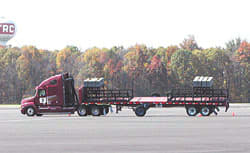
Without its prototype stability control system, this rig had only 10 of 18 wheels on the ground in a demonstration of a fast lane-change maneuver.
The highlight of last fall's meeting of The Maintenance Council was a day-long test-track demonstration of the latest braking and electronic stability-control technologies.
The event showed trucking industry technical leaders the effectiveness of disc brakes and electronic braking control.
It also introduced the concept of selective braking at different wheel positions for enhanced stability control, convincingly demonstrating enhanced long-combination safety and reduced rollover risk.
Before the group assembled at the test track, an informal introductory session explained the differences between conventional and electronically controlled braking systems, or EBS. Braking and test consultant Dick Radlinksi explained how the electronics module replaces the air signal lines, increasing the speed of response, since the signal travels by wires instead of air lines - hence the term "brake by wire" often used for EBS.
Although the system is used in Europe, currently North American braking regulations require EBS to sit on top of a dual air system, which makes EBS heavier and more costly. The National Highway Traffic Safety Administration is looking for a large-scale test to a number of fleets, similar to the two-year prove-out that was done with antilock brakes before the latest ABS regulations were introduced.
Few of the 400 or so TMC members who climbed aboard the buses for the trip had seen EBS in action before. At the track they would.
There, 14 different tractors and 13 trailers were driven by brake engineers from the major suppliers in a series of 40 different runs to show the value of enhanced braking and stability that comes from EBS combined with air disc brakes.
Some of these demonstration runs were out on the open handling area. Others were on the low-friction skid pad, where split friction could be demonstrated.
One of the trailers was a flatbed with a load rack that lifted concrete blocks to a high center of gravity to accentuate rollover tendencies. Fortunately, this outfit was equipped with outriggers to prevent an actual rollover.
An early demonstration clearly showed the enhanced stopping potential of the new braking technologies. A bobtail Volvo VN conventional with air disc brakes and EBS stopped extremely well alongside a Honda sedan from 75 mpg. However, with its EBS disabled, the truck took an additional 30 feet over the car to stop.
Even more dramatic was the high-center-of-gravity trailer with EBS coupled to a full EBS and disc-braked Freightliner Century Class tractor with a prototype electronic stability control system. In a fast lane-change maneuver with stability control disabled, the trailer and load lifted not only on the inside wheels, but it took the tractor as well, lifting the drive wheels so the combination had, for a considerable time, only 10 of its 18 wheels on the ground. Only the outrigger saved the combination from a full rollover.
On the next run, the stability control selectively braked wheels on the combination to make the lane-change at the same speed relatively uneventful.
Throughout the demonstration, it was clear that each level of technology brought an improvement in performance and stability: Disc brakes stopped better than drums; discs with EBS were better than discs with ABS; and trucks with EBS could handle dynamics like sudden lane changes much better than a driver could unaided.
For more details, see the February 2001 issue of RoadStar magazine.
More Safety & Compliance

FMCSA Pauses Biennial-Update Enforcement Amid Motus Transition
Carriers whose updates were due on or after June 1 have more time, while FMCSA works to stabilize its new registration system and warns of phishing sites impersonating its new carrier registration system, Motus.
Read More →
ZF Expands Commercial Vehicle Push in North America
ZF is expanding its North American commercial-vehicle presence with new transmission applications, electrification, trailer technology and autonomous-driving systems.
Read More →
Truck Drivers Need More Than Another Alert
Fleets have more visibility into truck health, safety events, and driver activity than ever. The next challenge is turning all that information into useful guidance for the person who has to decide what to do next.
Read More →
Tesla Wants a Self-Driving Semi. Are Cameras Enough?
Could Tesla’s camera-only autonomous driving technology work on an 80,000-pound Semi? In this commentary, HDT's Deborah Lockridge takes a look at Tesla, Cybercab, and how autonomous trucks see the road.
Read More →
What DOT’s Automated Vehicle Strategy Means for Trucking
The U.S. Department of Transportation issued a new automated-vehicle strategy that outlines plans for driverless-truck regulations, cross-state freight corridors, and federal safety standards.
Read More →
NYC Expands Speed, Pedestrian Safety Tech Across Fleet
New York City is expanding intelligent speed assistance and pedestrian-alert systems across its municipal fleet, moving the technologies from pilot programs into vehicle procurement and retrofit requirements.
Read More →
FMCSA Removes 110 Truck Driver Training Schools from Certified ELDT List
Federal regulators also are targeting more than 160 additional training providers and launching a nationwide audit of third-party CDL skills testers as part of a broader crackdown on trucking fraud.
Read More →
Beyond DOT Compliance: What Makes a Trucking Fleet Truly Safe?
A trucking fleet can follow every rule and still make unsafe decisions. The real test comes when safety conflicts with freight, productivity, or cost.
Read More →
Hours of Service Pilot Programs: FMCSA Readies for 2027 Rollout
Two pilot programs could eventually reshape hours-of-service rules, giving truck drivers options to pause their 14-hour clock or use longer split sleeper rest periods.
Read More →
New Guide Offers Pet Safety Tips for Truck Drivers
Hundreds of thousands of pets travel in truck cabs. A new safety guide from Volvo Trucks and the Center for Pet Safety offers practical advice for truck drivers who bring dogs and cats along for the ride.
Read More →