




IdleAir Continuing Growth with Truckstop, Dedicated Terminal Facilities
Truckstop electrification services provider IdleAir reports it continues to grow its number of locations since reopening under a new owner about four years ago.
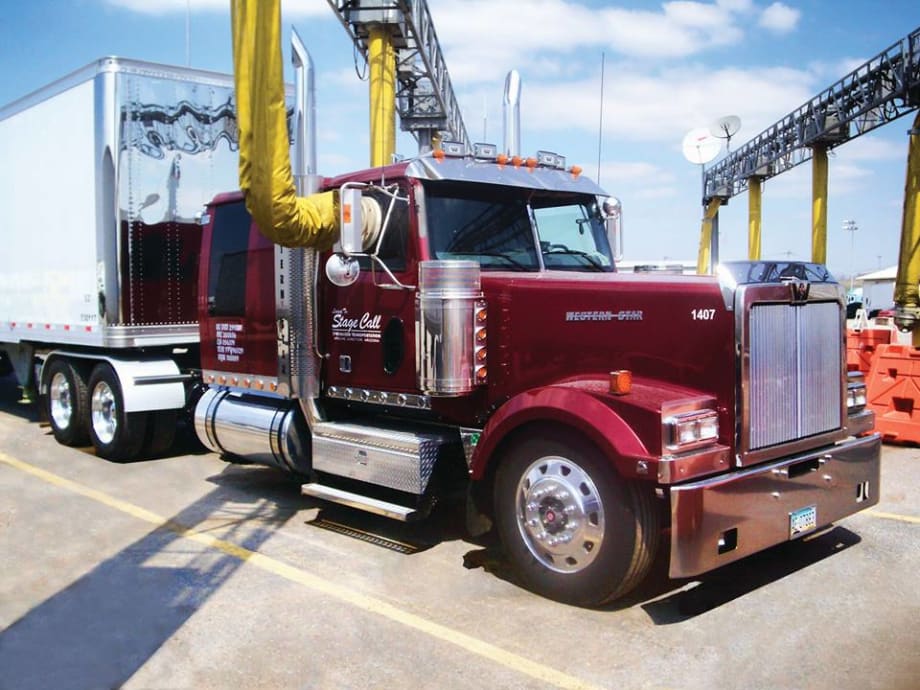
Photo: IdleAir Facebook page
Photo: IdleAir Facebook page
Truckstop electrification services provider IdleAir reports it continues to grow its number of locations since reopening under a new owner about four years ago.
It currently operates more than 30 travel center locations in 15 states and had increased its dedicated fleet terminal installations to five facilities since its launch in late 2013. It currently has terminal installations with the trucking companies C.R. England, Con-way Truckload, CalArk, Werner Enterprises and TSI/Panamex.
Terminal results in 2014 have exceeded expectations, with summertime usage at multiple locations exceeding 15 hours per day for each IdleAir space, according to the company.
“The success of IdleAir's terminal initiative has added three more major carriers to our growing list of companies that see IdleAir terminals as part of their fuel savings plans,” the company said in a release. “IdleAir expects to launch five more terminals by early 2015, with demand accelerating for multiple locations within our carrier partners' footprints.”
In the first half of 2014, IdleAir also completed construction of four additional Pilot Flying J installations in Laredo and Robinson Texas; Pearl, Mississippi, and Beaverdam, Ohio. It expects all to begin full operations this quarter. The company also has construction plans under way for Pilot Flying J locations in Seville and Austintown, Ohio, and Latta, South Carolina.
By early 2015, IdleAir expects to launch eight more travel center locations, including locations in Kentucky and Alabama.
“The strong performance of IdleAir's new dedicated fleet terminals has validated our ‘dual-path’ strategy,” said Ethan Garber, CEO. “We are creating a scalable hub-and-spoke network of major travel center hub locations paired with terminal spokes along high-traffic corridors. By realizing operational efficiencies while providing a high-level of support to our customers, we are able to deliver robust air conditioning savings at half the price of APUs.”
IdleAir is a division of Convoy Solutions, which purchased and then reopened the company in 2010, following failures by previous owners. Before the purchase by Convoy Solutions (then known as IdleAire), the company at one time boasted more than 100 locations, but reportedly never made a profit. The only indication of IdleAir's current financial state is a comment in the release that it "maintained a steady pace of adding profitable locations" in the first half of 2014.
In addition to helping truck drivers eliminate engine idling or running auxiliary power units while getting in-cab air conditioning or heating, the company also provides electricity, high-speed Internet, and DirecTV to trucks when parked at IdleAir-equipped facilities.
More Fuel Smarts

How Volvo Updated Its D13 for EPA 2027 [Watch]
Volvo’s updated D13 promises lower emissions without sacrificing performance or fuel economy. Take a closer look at what changed inside the engine in this HDT Spotlight video.
Read More →
Diesel Price Spike Shortens Payback for Natural Gas Trucks, Report Says
Energy Vision estimates fleets could recover the higher purchase price of an RNG-fueled Class 8 tractor in 1.3 to 2.8 years under current fuel-price scenarios.
Read More →
Calstart Becomes Catalyst Mobility, Reflecting Broader Focus
Calstart is now Catalyst Mobility, reflecting the nonprofit’s growing national role in clean transportation, including zero-emission trucks, infrastructure and incentive programs.
Read More →

Record Diesel Prices Squeeze Trucking Fleets
Average U.S. diesel prices have climbed to nearly $6 a gallon, surpassing the 2022 record as tight refinery capacity and Middle East disruptions keep fuel costs elevated.
Read More →
How Fuel Delivery Shapes Engine Performance
Fuel delivery depends on more than what happens at the injector. For fleet, maintenance and technical professionals, looking at the full path from pump to injector can provide useful context for understanding engine performance.
Read More →
East Coast Port Launches $45M Electric Truck Push
The Port Authority of New York and New Jersey announced millions in incentives for zero-emission drayage trucks, yard tractors, and new charging hubs near the port.
Read More →
California Bill Could Shed Light on Electric Truck Prices
Why do battery-electric Class 8 trucks remain so expensive? A California bill headed to Gov. Gavin Newsom would give fleets and state agencies more visibility into what manufacturers charge.
Read More →
Detroit Opens Orders for EPA 2027 Engines
Detroit isn’t starting from scratch to meet EPA 2027 diesel emissions standards. Its Gen 6 DD13 and DD15 engines keep much of today’s platform while updating the fuel and aftertreatment systems.
Read More →
Zero-Emission Truck Corridor Planned for West Coast
California, Oregon, Washington, British Columbia and Baja California are coordinating plans for truck charging and hydrogen fueling from Canada to Mexico.
Read More →
A Closer Look at Kenworth’s Electric T880E Vocational Truck [Video]
Learn more about Kenworth's T880E battery-electric vocational truck at the Paccar Technical Center, including its range, applications, upfitting considerations, and PTO options, in this HDT Spotlight video.
Read More →