





Walking the Fine Line on Truck Owner-Operator Classification
House Bill Would Ban Predatory Lease-Purchase Programs in Trucking
A bill introduced in the U.S. House of Representatives would ban predatory lease-purchase programs between motor carriers and truck drivers, which a federal Truck Leasing Task Force called “irredeemable tools of fraud and driver oppression.”
September 23, 2025
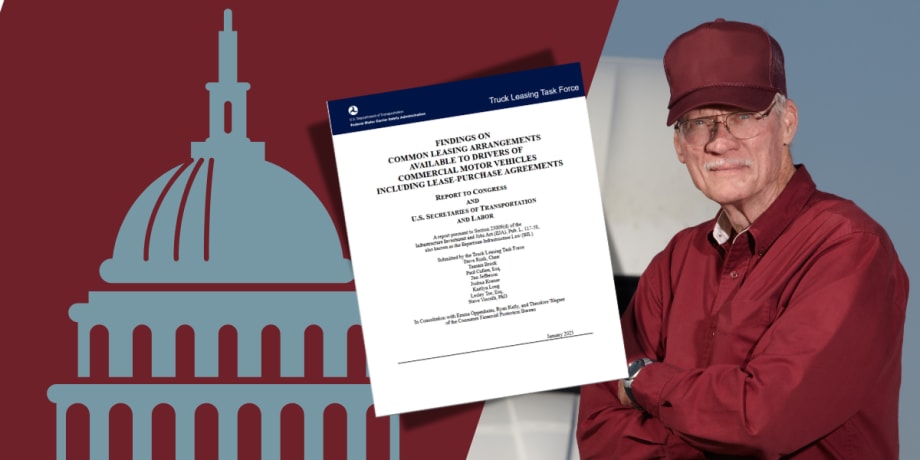
Truck drivers have long accused some motor carriers of creating lease-purchase programs "designed to fail."
HDT Graphic
4 min to read
U.S. Rep. Julia Brownley has introduced legislation in the House of Representatives that would crack down on truck leasing programs between motor carriers and truck drivers that are seen as exploitative of owner-operator drivers.
Brownley, a California Democrat, explained in a news release that “far too many drivers are trapped in crushing debt, denied fair pay, and prevented from ever owning their trucks.”
The Predatory Truck Leasing Prevention Act (H.R. 5423) would implement recommendations from the Truck Leasing Task Force, a group assembled by the Federal Motor Carrier Safety Administration under the Biden administration to investigate motor carrier lease-purchase programs with drivers.
That task force issued a report in January recommending that Congress pass a law to ban such programs, or at least create more significant oversight, calling these programs “irredeemable tools of fraud and driver oppression.”
TLTF submitted its findings to the U.S. Department of Transportation, the U.S. Department of Labor, and Congress. The final report found that inequitable lease-purchase programs negatively affect individual drivers (especially new drivers), the trucking workforce, the health of the industry, and roadway safety.
Why Are These Lease-Purchase Programs a Problem?
According to the news release from Rep. Brownley, while traditional lease agreements can allow truckers to operate as independent small businesses, many lease-purchase or “lease-to-own” arrangements are structured in ways that exploit drivers.
Under these agreements, a motor carrier (or related entity) owns a truck and leases it to a driver, who makes payments in hopes of eventually owning the vehicle and agrees to operate it exclusively for the motor carrier. In these schemes, the lessor and motor carrier are effectively the same entity.
Companies offering these agreements, Brownley’s announcement said, often offer false promises of fair compensation, future ownership of the truck, and independence from employer-employee requirements.
“While the supposed goal of these agreements is for the driver to become a full-fledged owner-operator at the end of the lease, these schemes rarely work out that way. Instead, drivers are often paid pennies on the dollar and have their work limited by the motor carrier to prevent them from ever securing ownership of the truck. They are also provided with no independence to seek better compensation or more steady work with other motor carriers.”
These programs also may run afoul of the definition of independent contractor vs. employee and result in allegations of “employee misclassification” — that the drivers under the predatory lease-purchase programs are in reality employees, but without any of the benefits of being an employee, such as overtime pay, workers compensation, and so on.
What Does Brownley’s Bill Do?
Brownley’s bill, just three pages long, would require the U.S. Department of Transportation to write new regulations to prohibit the use of predatory commercial motor vehicle lease-purchase programs by motor carriers. It calls for the department to do so within one year of enactment.
The bill defines “lease-purchase agreement” as a financial contract by which a driver leases a commercial motor vehicle from a motor carrier (or a firm affiliated with the motor carrier) to haul freight while driving for the same motor carrier under a separate contract.
It defines “predatory commercial motor vehicle lease-purchase agreement program” as “the framework of motor carrier-driver relationship, including the lease-purchase agreement, the contract for the driver’s work for the motor carrier, and the motor carrier’s practices in implementing the contracts that are not provided in the contract, including the motor carrier’s recruitment practices, operational practices, and tax and finance practices, whereby the motor carrier controls the work, compensation, and debts of the driver, and the driver accrues no equity or is forced to give up equity accrued in the contracted truck.”
Options Beyond a Ban
In its report, the Truck Leasing Task Force recommended that if Congress does not ban predatory leasing programs altogether, then it should fund programs to regulate and oversee truck leasing at the Federal Motor Carrier Safety Administration, the Department of Labor, the Consumer Financial Protection Bureau, and others.
How much appetite there will be for such actions in the current deregulatory environment is questionable. The Consumer Financial Protection Bureau, for instance, has been under attack by the Trump Administration and is a shadow of its former self.
Endorsed by Driver Groups
The Predatory Truck Leasing Prevention Act is endorsed by the Owner-Operator Independent Drivers Association and the Teamsters union, both of which had representatives on the Truck Leasing Task Force.
These “predatory lease-purchase schemes … have fleeced truck drivers for decades,” said OOIDA President Todd Spencer in a news release.
“These scams dangle the promise of ownership but leave drivers broke, trapped in debt, and kicked to the curb with nothing to show for it.”
Teamsters General President Sean M. O’Brien stated, “Predatory truck leasing arrangements target decent hardworking people looking for careers in the trucking industry only to lead them to financial ruin.”
More Drivers

From One Generation to the Next: How Mentorship Builds Safer Truck Drivers
After three decades in trucking, Harold Perry shares what he's learned about driver safety, mentorship, and helping the next generation build confidence behind the wheel.
Read More →
Truck Drivers Need More Than Another Alert
Fleets have more visibility into truck health, safety events, and driver activity than ever. The next challenge is turning all that information into useful guidance for the person who has to decide what to do next.
Read More →
FMCSA Removes 110 Truck Driver Training Schools from Certified ELDT List
Federal regulators also are targeting more than 160 additional training providers and launching a nationwide audit of third-party CDL skills testers as part of a broader crackdown on trucking fraud.
Read More →
Hours of Service Pilot Programs: FMCSA Readies for 2027 Rollout
Two pilot programs could eventually reshape hours-of-service rules, giving truck drivers options to pause their 14-hour clock or use longer split sleeper rest periods.
Read More →
Medical Cards, English Proficiency Reshape Roadcheck Violations
Medical-card violations jumped to the top of the driver out-of-service list during CVSA’s 2026 International Roadcheck, while English-language proficiency violations appeared among the leading violations for the first time.
Read More →
Driver Trust Can Make or Break the Success of Fleet Safety Technology
New Teletrac Navman research suggests that onboarding, transparency about driver data, and positive feedback can play a significant role in how commercial drivers respond to safety and coaching technology.
Read More →
EEOC Sues KLLM Over Alleged Sex Discrimination in Driver Training
KLLM is facing a federal sex-discrimination lawsuit over policies the EEOC alleges put female truck driver trainees at a disadvantage.
Read More →
FMCSA Moves to Codify English Language Requirements for Commercial Drivers
By changing regulations on English-language proficiency requirements for commercial drivers, rather than relying on a guidance memo, the FMCSA said future administrations won't be able to walk back the Trump administration's stricter enforcement with just a memo.
Read More →
Drivers Put Western Star Trucks to the Test at Star Nation Experience
Watch to get an inside look at the Western Star trucks, technology, and community behind the Star Nation Experience 2026!
Read More →
Trump Administration Looks to Put More Veterans Behind the Wheel
The Freedom Haulers program pulls together existing and expanded programs at several federal agencies to recruit veterans to drive commercial heavy-duty trucks and cut the red tape for them to get a CDL, training, and employment.
Read More →