




Related: Great Dane Adds Nevada Service Provider to AdvantEdge Network
Great Dane Brings New Safety Features to Everest Reefer Trailers
Great Dane is introducing several new features designed to improve the safety of drivers, pedestrians, and the food transported in its Everest refrigerated trailers.
by Staff
October 18, 2016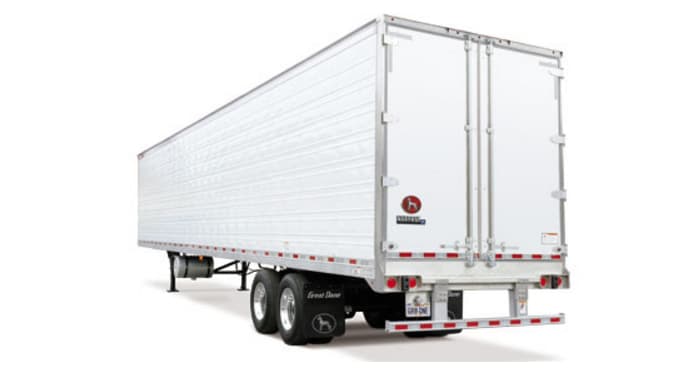
Photo: Great Dane
3 min to read
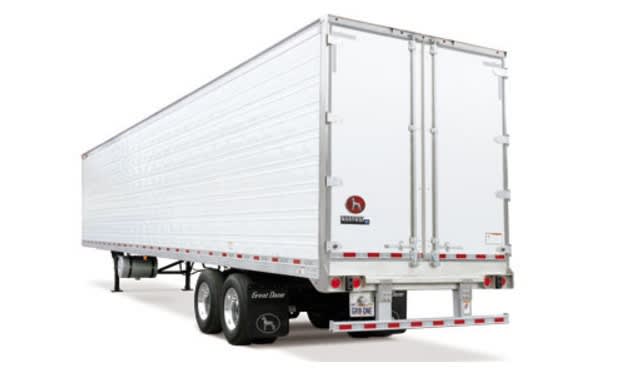
Photo: Great Dane
Great Dane is introducing several new features designed to improve the safety of drivers, pedestrians, and the food transported in its Everest refrigerated trailers.
The Everest reefer features a void-free insulation foaming process, premium liners, and modular panel construction with no wood in the trailer. These features provide improved thermal efficiency and a safer, more sanitary cargo container.
Great Dane’s ThermoGuard– made with a proprietary barrier layer to reduce cooling run time and help maintain excess cooling capacity – helps maintain insulation performance for the life of the trailer. ThermoGuard helps reduce fuel consumption and is more efficient at maintaining the right cargo temperature.
The Everest roof system is constructed of lightweight features connected through a bonded process to provide durability and better thermal efficiency. An aluminum roof sheet is supported by extruded aluminum roof bows and is secured to the top rail using a rolled edge design to seal the perimeter against moisture intrusion.
The floor design protects cargo from underneath and helps ensure proper temperatures. The 16,000-pound-rated aluminum duct floor is automatically welded to seal out moisture, and the composite floor sills are engineered for better durability and defense against moisture intrusion.
The Everest is available with multiple side door heights, widths and locations. Great Dane’s unique blade lock side door design holds the door securely closed so cold air stays in. The blade lock exerts constant pressure along the full height of the door, ensuring that the efficient dual-compression seals prevent air loss around the perimeter of the door.
Great Dane and ASA Electronics have also introduced a small wireless camera system powered by auto-pairing technology. The rear-mounted camera features an embedded microphone and gives drivers increased awareness of the action behind their rigs on the road, in parking lots, and during docking maneuvers.
Drivers see detailed images for a minimum of 22 feet behind the trailer with this system. Additionally, the camera adds eight and a half feet of visibility in each lane adjacent to the trailer, creating a path of rearward sight that is a full 26 feet wide.
ASA’s patented wireless auto-pairing technology requires no wired connector when hooking the truck to the trailer. The wireless technology allows the video and audio from the paired camera to be played through the in-cab monitor.
Great Dane and Grote have for years partnered on exterior perimeter lights featuring the latest LED technology for a safe and productive workplace. The perimeter lights are made with TIR lens optics to maximize the efficiency of the LEDs and ensure every lumen possible is projected in the workspace in and around the trailer.
Grote motion sensor dome lights have a passive infrared (PIR) sensor that shuts off the light to save energy when no one is working around it, and then automatically turns them on when movement is detected. It is designed to create a safer workspace that provides light as needed immediately when someone enters the area.
More Safety & Compliance

FMCSA Pauses Biennial-Update Enforcement Amid Motus Transition
Carriers whose updates were due on or after June 1 have more time, while FMCSA works to stabilize its new registration system and warns of phishing sites impersonating its new carrier registration system, Motus.
Read More →
ZF Expands Commercial Vehicle Push in North America
ZF is expanding its North American commercial-vehicle presence with new transmission applications, electrification, trailer technology and autonomous-driving systems.
Read More →
Truck Drivers Need More Than Another Alert
Fleets have more visibility into truck health, safety events, and driver activity than ever. The next challenge is turning all that information into useful guidance for the person who has to decide what to do next.
Read More →
Tesla Wants a Self-Driving Semi. Are Cameras Enough?
Could Tesla’s camera-only autonomous driving technology work on an 80,000-pound Semi? In this commentary, HDT's Deborah Lockridge takes a look at Tesla, Cybercab, and how autonomous trucks see the road.
Read More →
What DOT’s Automated Vehicle Strategy Means for Trucking
The U.S. Department of Transportation issued a new automated-vehicle strategy that outlines plans for driverless-truck regulations, cross-state freight corridors, and federal safety standards.
Read More →
NYC Expands Speed, Pedestrian Safety Tech Across Fleet
New York City is expanding intelligent speed assistance and pedestrian-alert systems across its municipal fleet, moving the technologies from pilot programs into vehicle procurement and retrofit requirements.
Read More →
FMCSA Removes 110 Truck Driver Training Schools from Certified ELDT List
Federal regulators also are targeting more than 160 additional training providers and launching a nationwide audit of third-party CDL skills testers as part of a broader crackdown on trucking fraud.
Read More →
Beyond DOT Compliance: What Makes a Trucking Fleet Truly Safe?
A trucking fleet can follow every rule and still make unsafe decisions. The real test comes when safety conflicts with freight, productivity, or cost.
Read More →
Hours of Service Pilot Programs: FMCSA Readies for 2027 Rollout
Two pilot programs could eventually reshape hours-of-service rules, giving truck drivers options to pause their 14-hour clock or use longer split sleeper rest periods.
Read More →
New Guide Offers Pet Safety Tips for Truck Drivers
Hundreds of thousands of pets travel in truck cabs. A new safety guide from Volvo Trucks and the Center for Pet Safety offers practical advice for truck drivers who bring dogs and cats along for the ride.
Read More →