




GE, Clean Energy Fuels Partner to Expand 'Natural Gas Highway'
GE and Clean Energy Fuels announced a collaboration to expand the infrastructure for natural gas transportation in the United States. The agreement supports Clean Energy's efforts in developing America's Natural Gas Highway, a fueling network that will enable trucks to operate on liquefied natural gas coast to coast and border to border
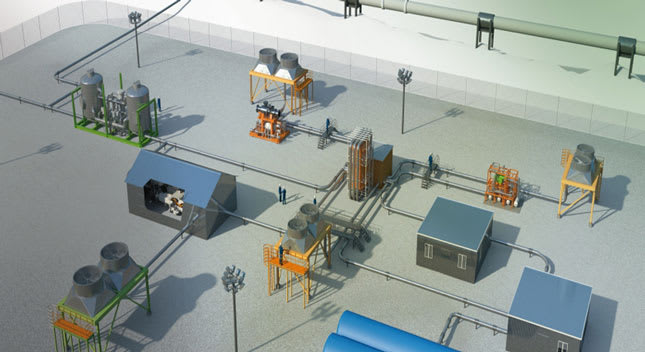
Clean Energy will use GE's MicroLNG technology to offer liquified natural gas at truckstops.
GE and Clean Energy Fuels announced a collaboration to expand the infrastructure for natural gas transportation in the United States.
The agreement supports Clean Energy's efforts in developing America's Natural Gas Highway, a fueling network that will enable trucks to operate on liquefied natural gas coast to coast and border to border.
Clean Energy Fuels will initially purchase two ecomagination-qualified MicroLNG plants from GE Oil & Gas. The plug-and-play modular units, which are designed to rapidly liquefy natural gas while minimizing a site's physical footprint, will support fueling stations along critical transportation corridors that run across the U.S.
GE Energy Financial Services is providing up to $200 million in financing for the two GE MicroLNG plants.
"GE is proud to be partnering with Clean Energy Fuels to develop natural gas infrastructure in the U.S.," said GE Chairman and CEO Jeff Immelt. "With an abundance of cleaner, more affordable natural gas here in the U.S., this is an important opportunity for GE to join Clean Energy in changing the way America drives. Its also a critical step in developing a natural gas-for-transportation fuel model that can be easily exported to other countries interested in exactly these kinds of breakthrough projects."
Clean Energy expects to complete approximately 70 LNG stations by the end of 2012, with more planned for next year to serve the movement of goods along major transportation corridors throughout the U.S.
While CNG, or compressed natural gas, is primarily used in cars, buses and smaller trucks, the LNG fueling being rolled out at Clean Energy's stations is targeted at long-haul, heavy-duty trucks, which will have the advantage of longer driving ranges while not impacting tractor weight and incremental costs.
In 2013, four major manufacturers will introduce the Cummins Westport ISX 12 G, a 12-liter LNG engine, a size that works well for long-haul Class 8 trucks.
Clean Energy plans to use a standardized design of the new GE MicroLNG plants to build additional MicroLNG plants. The LNG produced by the MicroLNG plants will be used primarily at Pilot-Flying J truckstops.
These first two MicroLNG plants will produce up to 250,000 gallons per day.
The plant is designed to be expanded up to 1 million gallons per day as adoption and demand increases. The two GE MicroLNG plants are targeted to begin operation in 2015. The two companies are currently assessing the best locations for these first two LNG plants.
"As the long-haul trucking industry begins its transition to natural gas, it will be critical to have a reliable supply of LNG," said Andrew J. Littlefair, president and CEO of Clean Energy Fuels.
"GE is committed to natural gas," said Dan Heintzelman, president and CEO of GE Oil & Gas. "Our ecomagination-qualified MicroLNG plant was born from the same turbomachinery technology that has made GE a success in large LNG compression such as in the world-scale plants in Qatar and Australia. By taking this technology and reengineering it so that its modular and highly efficient, we are able to help customers such as Clean Energy deliver this abundant and cleaner fuel source to the market."
The new GE MicroLNG system that will be used by Clean Energy will produce 250,000 gallons of LNG per day, or about 54 million DGEs (diesel gallon equivalents) per year with the built-in capability for further expansion. This is a 67% increase over the capacity of the breakthrough MicroLNG plant that GE Oil & Gas first introduced in January of 2012.
LNG produced with this MicroLNG system can be used to fuel approximately 28,000 heavy trucks, replacing diesel-powered trucks with equivalent fuel economy. This could enable fleet operators to avoid more than 139,000 metric tons of CO2 emissions per year, equivalent to the annual greenhouse gas emissions of approximately 27,000 cars using gasoline or 7,000 trucks using diesel on U.S. roads, assuming an average truck travels approximately 14,000 miles per year.
GE also is providing turnkey process/plant construction and consultations on the optimal plant location and power partner. The scope of the agreement also includes project installation. It entails not only the liquefaction but also the complete process design from the pre-treatment of the gas to the storage system.
More Drivers

Driver Trust Can Make or Break the Success of Fleet Safety Technology
New Teletrac Navman research suggests that onboarding, transparency about driver data, and positive feedback can play a significant role in how commercial drivers respond to safety and coaching technology.
Read More →
EEOC Sues KLLM Over Alleged Sex Discrimination in Driver Training
KLLM is facing a federal sex-discrimination lawsuit over policies the EEOC alleges put female truck driver trainees at a disadvantage.
Read More →
FMCSA Moves to Codify English Language Requirements for Commercial Drivers
By changing regulations on English-language proficiency requirements for commercial drivers, rather than relying on a guidance memo, the FMCSA said future administrations won't be able to walk back the Trump administration's stricter enforcement with just a memo.
Read More →
Drivers Put Western Star Trucks to the Test at Star Nation Experience
Watch to get an inside look at the Western Star trucks, technology, and community behind the Star Nation Experience 2026!
Read More →
Trump Administration Looks to Put More Veterans Behind the Wheel
The Freedom Haulers program pulls together existing and expanded programs at several federal agencies to recruit veterans to drive commercial heavy-duty trucks and cut the red tape for them to get a CDL, training, and employment.
Read More →
Putting Mack’s Command Steer to the Test
A test drive of Mack’s Command Steer active steering system evaluates how it can make truck driving easier and less tiring.
Read More →
Competition Heating Up for Truck Drivers
New report reveals rising driver hiring costs, the return of sign-on bonuses, growing AI advantages, and the operational factors shaping driver retention.
Read More →
How Fraley & Schilling Improved Logbook Compliance by Over 50%
Fraley & Schilling needed a way to close a compliance workflow gap in its ELD system without adding more work from driver training, reminders, and back-office follow-ups. It found the answer in a custom driver app.
Read More →
Volvo Goes Gaming
Volvo has roared into American Truck Simulator with two new flagship trucks.
Read More →
What the Best Fleets to Drive For Teach About Driver Retention
Survey fatigue, AI-powered routing, owner-operator expectations, and the decline of social media all emerged as themes from this year's Best Fleets to Drive For program.
Read More →