




FMCSA’s Mexico Decision Draws Opposition, Support
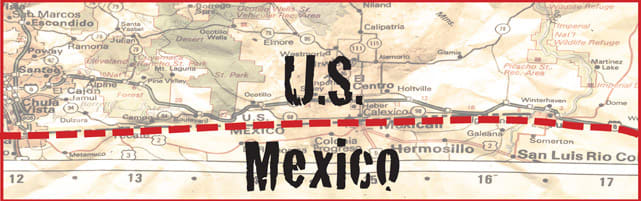
Owner-operator and labor groups registered their objections to the decision this week by the Federal Motor Carrier Safety Administration to grant normal status to Mexican carriers that had been operating under a pilot program.


Owner-operator and labor groups registered their objections to the decision this week by the Federal Motor Carrier Safety Administration to grant normal status to Mexican carriers that had been operating under a pilot program.
“It really smacks of arrogance” for the agency to act before the Department of Transportation’s Inspector General posts his audit of the program, said Todd Spencer, executive director of the Owner-Operator Independent Drivers Association.
By law, the three-year program ended October 14. The Inspector General’s audit is expected in December. In the interim, FMCSA converted the 13 Mexican carriers from pilot to regular status.
In an earlier audit the IG found that the Mexican carriers are safe but there were too few of them to prove that the regulatory system would work in the long run. Since then, FMCSA says, it has conducted enough inspections to show that the system works.
Spencer said that the sample size was too small.
“To extrapolate the results to all of trucking in Mexico is a tremendous leap of faith on the part of the agency,” he said in an email response to a query.
OOIDA has for years fought in court and in Congress against giving Mexican carriers rights to operate long-distance into the U.S., as is required under the North American Free Trade Agreement.
Asked if OOIDA plans to challenge this decision in court, Spencer said, “We always assess options.” He also noted that some in Congress are likely to weigh in against the decision.
The Teamsters union joined in opposition to the decision.
“Despite claiming this cross-border program would be thoroughly analyzed to ensure the safety of our driving public, the execution of the program has fallen short on multiple levels,” said Teamsters General President Jim Hoffa in a statement.
“How can we trust the findings of a study with such a small sample size and inspections that only occurred at the border when Mexican carriers knew they would fall under the most scrutiny?”
Other trucking interests support the FMCSA move.
“American Trucking Associations supports free trade, and believes in the free movement of goods across the Mexican border,” said ATA spokesman Sean McNally in response to an email query.
“Trucks move more than 65% of all transnational trade between the U.S. and Mexico and in order to keep our economies efficient and growing, we support our government’s efforts under NAFTA to ensure safe, secure and efficient trucking across a largely seamless border.”
Another factor in play is a report on the effectiveness of the pilot program by the agency’s Motor Carrier Safety Advisory Committee. A MCSAC subcommittee has been studying the issue and is scheduled to meet again October 28.
More Safety & Compliance
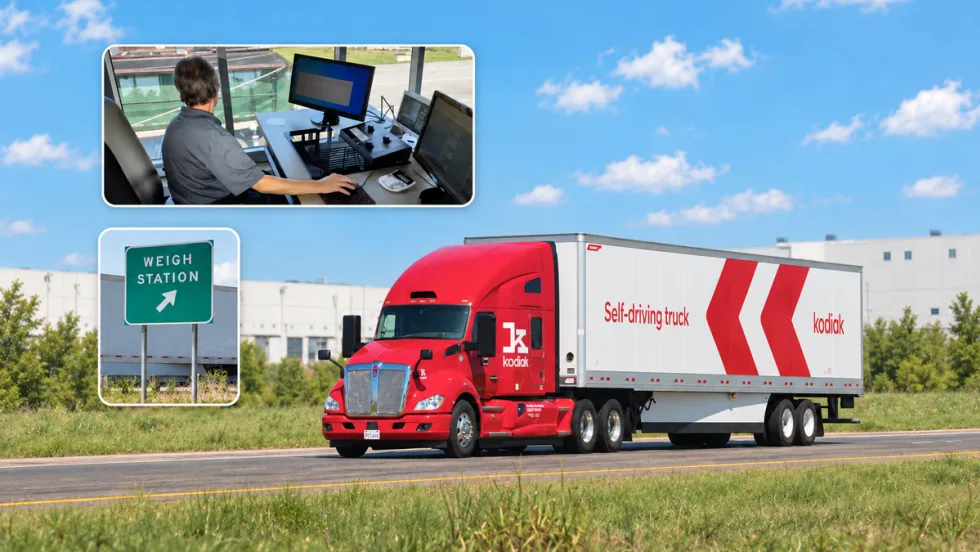
PrePass, Kodiak Connect Driverless Trucks to Roadside Enforcement
The system will allow enforcement agencies to verify Enhanced Inspection information and decide whether Kodiak’s autonomous trucks can bypass roadside screening sites.
Read More →
From One Generation to the Next: How Mentorship Builds Safer Truck Drivers
After three decades in trucking, Harold Perry shares what he's learned about driver safety, mentorship, and helping the next generation build confidence behind the wheel.
Read More →
FMCSA Pauses Biennial-Update Enforcement Amid Motus Transition
Carriers whose updates were due on or after June 1 have more time, while FMCSA works to stabilize its new registration system and warns of phishing sites impersonating its new carrier registration system, Motus.
Read More →
ZF Expands Commercial Vehicle Push in North America
ZF is expanding its North American commercial-vehicle presence with new transmission applications, electrification, trailer technology and autonomous-driving systems.
Read More →
Truck Drivers Need More Than Another Alert
Fleets have more visibility into truck health, safety events, and driver activity than ever. The next challenge is turning all that information into useful guidance for the person who has to decide what to do next.
Read More →
Tesla Wants a Self-Driving Semi. Are Cameras Enough?
Could Tesla’s camera-only autonomous driving technology work on an 80,000-pound Semi? In this commentary, HDT's Deborah Lockridge takes a look at Tesla, Cybercab, and how autonomous trucks see the road.
Read More →
What DOT’s Automated Vehicle Strategy Means for Trucking
The U.S. Department of Transportation issued a new automated-vehicle strategy that outlines plans for driverless-truck regulations, cross-state freight corridors, and federal safety standards.
Read More →
NYC Expands Speed, Pedestrian Safety Tech Across Fleet
New York City is expanding intelligent speed assistance and pedestrian-alert systems across its municipal fleet, moving the technologies from pilot programs into vehicle procurement and retrofit requirements.
Read More →
FMCSA Removes 110 Truck Driver Training Schools from Certified ELDT List
Federal regulators also are targeting more than 160 additional training providers and launching a nationwide audit of third-party CDL skills testers as part of a broader crackdown on trucking fraud.
Read More →
Beyond DOT Compliance: What Makes a Trucking Fleet Truly Safe?
A trucking fleet can follow every rule and still make unsafe decisions. The real test comes when safety conflicts with freight, productivity, or cost.
Read More →