




FMCSA Launches Program to Combat Human Trafficking
The Federal Motor Carrier Safety Administration launched a new human trafficking awareness campaign, “Your Roads, Their Freedom.”

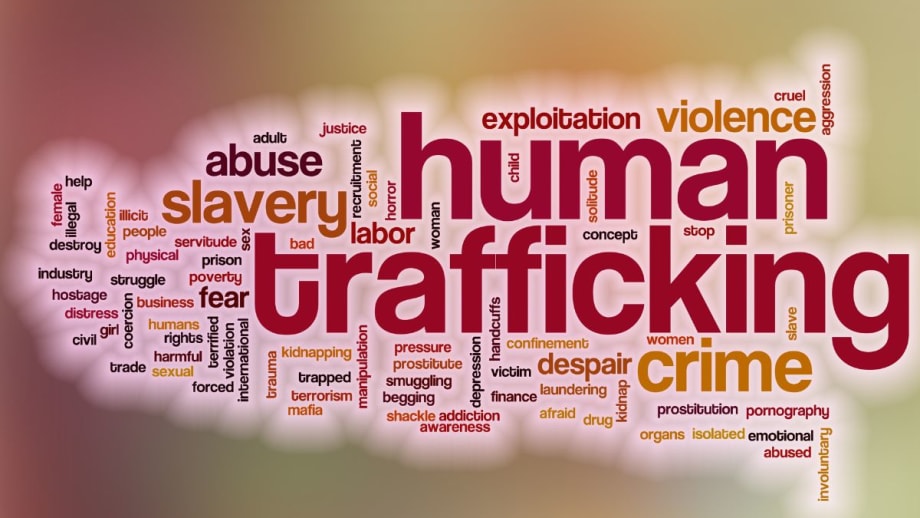
FMCSA has launched a new program to combat human trafficking.
Image: Canva
The Federal Motor Carrier Safety Administration recently launched its new human trafficking awareness campaign, “Your Roads, Their Freedom.” The campaign seeks to give the nation’s 8.7 million commercial motor vehicle drivers the information needed to identify and report suspected human trafficking.
“Human trafficking is a heinous crime, and it has no place in the transportation industry,” said FMCSA Administrator Robin Hutcheson. “But the hard-hitting reality is that our nation’s transportation systems are exploited by human traffickers every day, and FMCSA is working to help stop it.”
Because human trafficking poses a threat to transportation safety, FMCSA, part of the U.S. Department of Transportation, said it is uniquely positioned to educate commercial vehicle drivers on ways to protect U.S. roadways against criminals perpetrating this crime.
Additionally, FMCSA requires states and the District of Columbia to permanently ban drivers convicted of human trafficking from operating a commercial motor vehicle, which requires a commercial driver’s license or commercial learner’s permit.
Scope of Human Trafficking
Globally, according to FMCSA, an estimated 28 million people are currently subjected to human trafficking and the crime occurs in every state of the U.S. As part of the Department of Transportation Leaders Against Human Trafficking awareness campaign, the “Your Roads, Their Freedom” campaign will build on other federal efforts against human trafficking, including the Department of Homeland Security’s Blue Campaign and FMCSA’s grant programs, which awarded millions in funding to support state counter-trafficking efforts.
Transportation Secretary Pete Buttigieg, speaking to the President’s Interagency Task Force on Human Trafficking earlier this year, said with the “Your Roads, Their Freedom” campaign, DOT aims “to empower America’s transportation workforce, which is millions strong, to be the eyes and ears of our collective effort.”
The new program is part of the Biden administration's overall National Action Plan to Combat Human Trafficking.
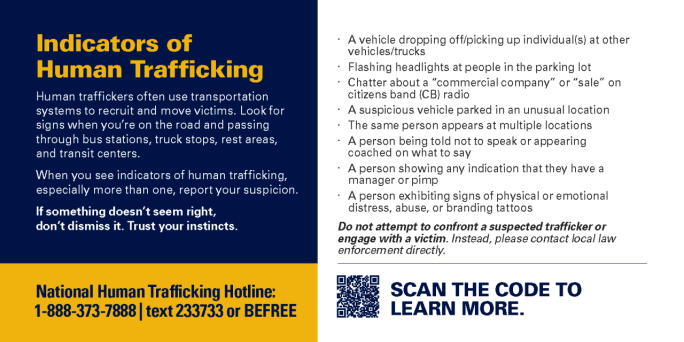
A downloadable visor card on human trafficking gives drivers tips on what to look for.
Source: FMCSA
Hotline Reporting
Truckers made over 1,400 calls to the U.S. National Human Trafficking Hotline from December 2007 through June 2016, and 452 potential human trafficking cases were identified. Truckers reported this information in real-time, enabling quicker responses by law enforcement, FMCSA said in a press release.
The agency's new program includes information on signs of possible human trafficking that truckers should watch for
While the “Your Roads, Their Freedom” campaign will be conducted nationwide, there will be a heightened emphasis across states with the highest reported number of human trafficking cases or a high volume of driver traffic, such as California, Florida, Michigan, New York, and North Carolina.
One group, Truckers Against Trafficking, has been raising awareness of human trafficking and offering training programs to help drivers spot signs of trafficking for more than a decade.
Updated 8/18/2023 to add information on what drivers should look for.
More Drivers

Truck Drivers Need More Than Another Alert
Fleets have more visibility into truck health, safety events, and driver activity than ever. The next challenge is turning all that information into useful guidance for the person who has to decide what to do next.
Read More →
FMCSA Removes 110 Truck Driver Training Schools from Certified ELDT List
Federal regulators also are targeting more than 160 additional training providers and launching a nationwide audit of third-party CDL skills testers as part of a broader crackdown on trucking fraud.
Read More →
Hours of Service Pilot Programs: FMCSA Readies for 2027 Rollout
Two pilot programs could eventually reshape hours-of-service rules, giving truck drivers options to pause their 14-hour clock or use longer split sleeper rest periods.
Read More →
Medical Cards, English Proficiency Reshape Roadcheck Violations
Medical-card violations jumped to the top of the driver out-of-service list during CVSA’s 2026 International Roadcheck, while English-language proficiency violations appeared among the leading violations for the first time.
Read More →
Driver Trust Can Make or Break the Success of Fleet Safety Technology
New Teletrac Navman research suggests that onboarding, transparency about driver data, and positive feedback can play a significant role in how commercial drivers respond to safety and coaching technology.
Read More →
EEOC Sues KLLM Over Alleged Sex Discrimination in Driver Training
KLLM is facing a federal sex-discrimination lawsuit over policies the EEOC alleges put female truck driver trainees at a disadvantage.
Read More →
FMCSA Moves to Codify English Language Requirements for Commercial Drivers
By changing regulations on English-language proficiency requirements for commercial drivers, rather than relying on a guidance memo, the FMCSA said future administrations won't be able to walk back the Trump administration's stricter enforcement with just a memo.
Read More →
Drivers Put Western Star Trucks to the Test at Star Nation Experience
Watch to get an inside look at the Western Star trucks, technology, and community behind the Star Nation Experience 2026!
Read More →
Trump Administration Looks to Put More Veterans Behind the Wheel
The Freedom Haulers program pulls together existing and expanded programs at several federal agencies to recruit veterans to drive commercial heavy-duty trucks and cut the red tape for them to get a CDL, training, and employment.
Read More →
Putting Mack’s Command Steer to the Test
A test drive of Mack’s Command Steer active steering system evaluates how it can make truck driving easier and less tiring.
Read More →