




Fleet Breakdown Frequency Improving; Parts, Labor Costs Increasing
Two benchmarking reports show fleets are running more miles between breakdowns or unscheduled repairs, while the cost of parts and labor for those repairs is up.

The greatest disparity between the vertical average and best-in-class fleet was the tank vertical.
Credit: FleetNet America
Two new benchmarking reports show fleets are running more miles between breakdowns or unscheduled repairs, while the cost of parts and labor for those repairs is up. The reports were released during the American Trucking Associations' Technology & Maintenance Council meeting in Cleveland, Ohio.
Fleets participating in the TMC/FleetNet America Vertical Benchmarking Program managed to put more miles behind them between breakdowns. The survey found that during the first quarter of 2021, fleets averaged 31,638 miles of operation between unscheduled road repairs – up 7.2% from 29,506 in the first quarter of 2020.
Those same groups also saw gains in mileage between breakdowns in the second quarter 2021 compared to the first quarter.
Truckload carriers averaged 23,769 miles between breakdowns, an 8.8% increase in miles from the previous quarter. The time between breakdowns for LTL carriers increased to 46,186 miles in the second quarter from 44,380 in the first quarter of 2021. The tank sector saw a smaller improvement, running 18,241 miles in the second quarter, up from 17,420 in the previous quarter.
Top 5 causes of roadside repairs in Q2 2021 — accounting for 70% of all breakdowns — were tires; brakes, power plant; lighting; cranking, says Paul Gildenhorn. Sharing latest data from @TMC4Trucks / @FleetNetAmerica’s Vertical Benchmarking Report. #TMCFall21pic.twitter.com/sOQebP1f4F
— Vesna Brajkovic (@VesnaBrajk) September 12, 2021
While all three sectors saw improvements, it’s useful to look at the performance of the best-in-class fleets compared to the average for each vertical. The greatest disparity between the vertical average and best-in-class fleet was the tank vertical.
The best-in-class tank fleet ran 35,838 miles between breakdowns, or 105% more than the vertical average of 17,420 miles.
The top-performing truckload fleet beat the vertical average by 89% (41,417 compared to 21,856), and the LTL vertical’s top performer had a 17% edge over the average (51,952 compared to 44,380).
“The data tells us that if, for example, the truckload carriers running the average miles between breakdowns could reach best-in-class performance, they would increase their miles between breakdowns by 64%,” said Emily Hurst, manager of data and analytics at FleetNet America. “That would result in overall lower costs.”
Top 5 Breakdown Triggers
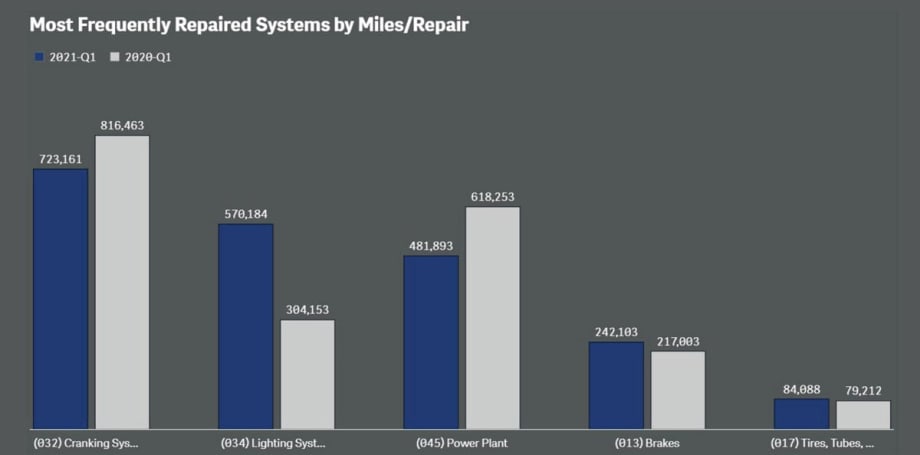
Items from the five most frequently repaired VMRS (Vehicle Maintenance Reporting System) systems accounted for 66% of the breakdown and unscheduled repairs reported by participating fleets. Lighting-related repairs produced the greatest gain, driven by the truckload cohort, which realized a significant improvement over the first quarter last year – 384,000 reported instances in the first quarter of this year, compared to 304,000 last year.
The miles run between cranking system repairs dropped 11.4% when compared to the first quarter of 2020 (816,000 compared to 723,000), meaning participating fleets experienced more cranking system repairs this year than last. Powerplant repairs dropped 22% when compared to the first quarter of 2020 (482,000 vs. 618,000).
Rounding out the top five, brakes and tires/tubes were responsible for the lowest overall numbers of breakdowns and were virtually unchanged from last year.
“Fleets are most likely to realize a better return on maintenance time invested by focusing on these five VMRS systems,” the survey notes.
Parts and Labor
Meanwhile, labor costs for repair and maintenance rose 2.6% between the first and second quarters in 2021 and overall parts costs increased by 2.8%. In that same period, parts costs for tires increased by 10.7% and transmission part costs rose 9%, according to the Decisiv/TMC North American Service Event Benchmark Report.
“The increases in costs for parts and labor reflect the changes taking place in the North American economy,” said Dick Hyatt, Decisiv president and CEO. “Ongoing economic growth has led to a rise in freight volume and demand for carrying capacity. That is also being driven higher by the need to replenish supply chains that have been depleted due to manufacturing and distribution shutdowns during the pandemic.”
Focusing on parts and labor pricing year over year revealed that the three most significant changes between the second quarter of 2020 and the second quarter of 2021 were:
lighting systems (up 17.4%)
transmissions costs rose ( up 16.4%)
brake costs (up 11.1%)
The report covers power unit parts and labor costs in the nine top VMRS level code categories, including brakes, steering, tires, transmissions, electrical, charging, lighting, exhaust and engines.
About the TMC Benchmarking Reports
The Decisiv/TMC North American Service Event Benchmark reports are made possible because of the rapidly growing amount of data being collected on service and repair events for the more than 7 million commercial assets operating across the U.S. and Canada that are being serviced on Decisiv’s SRM platform. The summaries are compiled from more than 600,000 monthly service maintenance and repair operations conducted across nearly 5,000 service locations.
The monthly benchmark reports provide a detailed profile of service costs monthly, quarterly and annually, and on a regional basis. The partnership between Decisiv and TMC to produce the North American Service Event Benchmark reports was announced earlier this year.
TMC fleet members will receive the report electronically via email.
The TMC/FleetNet Vertical Benchmarking Program is a strategic collaboration between TMC/ATA and FleetNet America and is open to TMC fleet executive level members and FleetNet customers. The analytics provided via the program will be cumulative and non-fleet specific.
In addition to the executive summary, which is available to TMC members, fleets that participate by sharing their data are provided an analytic tool that allows them to drill into their data, comparing it to the industry average.
More Maintenance

Color Match Smarter: Tools That Restore & Perform
For fleet managers and collision repair professionals keeping heavy-duty trucks on the road, getting the color right the first time isn't just about appearance — it's about efficiency, turnaround time, and bottom-line results. Discover how today's digital color tools are transforming the repair process from guesswork to precision.
Read More →
Wrong Repair Prompts Recall of Freightliner, Western Star 4x2 Trucks
DTNA is recalling more than 2,400 trucks that received an incompatible software fix instead of the hardware repair required to address brake valve corrosion.
Read More →
Truck Drivers Need More Than Another Alert
Fleets have more visibility into truck health, safety events, and driver activity than ever. The next challenge is turning all that information into useful guidance for the person who has to decide what to do next.
Read More →
The Maintenance Checks Trucking Fleets Should Prioritize Before Fall Freight Picks Up
Making it through August isn’t the same as being ready for the next several months of operation. Find out what systems may have suffered from summer heat and need to be checked out before fall.
Read More →
What Three Fleets Are Doing Differently When Buying Truck Parts in 2026
With freight improving but costs still climbing, fleet maintenance executives explain how they're balancing price, quality, and supplier relationships.
Read More →
Paccar Recalls 2027 Trucks Built This Summer for Possible Electrical Problem
The nearly 6,000 Kenworth and Peterbilt trucks in the recall could potentially lose engine power, among other things.
Read More →
Will API PC-12 Oil Change Trucking Fleet Maintenance?
The new API PC-12 heavy-duty engine oil category reflects the changing demands of modern diesel engines. But fleets like Foodliner are looking to getting their own data before making decisions on adopting the new oils and questions such as extending oil drain intervals.
Read More →
Brake Safety Week to Focus on Drums and Rotors
Commercial vehicle inspectors are focusing on truck brakes during CVSA's Brake Safety Week, August 23-29.
Read More →Possible Battery-Cable Fires Prompt Recall of 15,000+ International MV and HV Trucks
On the recalled vehicles, manufacturing variations can cause the battery interconnect cable to contact the auxiliary stud and hold down the bracket.
Read More →
Rush, MCT Team Up to Grow Refrigeration Service Network
The joint venture will operate MCT's network of Carrier Transicold dealerships and mobile service locations, with the companies promising greater service capacity and uptime for refrigerated fleets.
Read More →