




Drivers Key Focus of HDT Truck Fleet Innovators Panel
Spontaneous applause broke out following an impassioned answer to a question by HDT Truck Fleet Innovator Steve Rush during a panel discussion Wednesday.

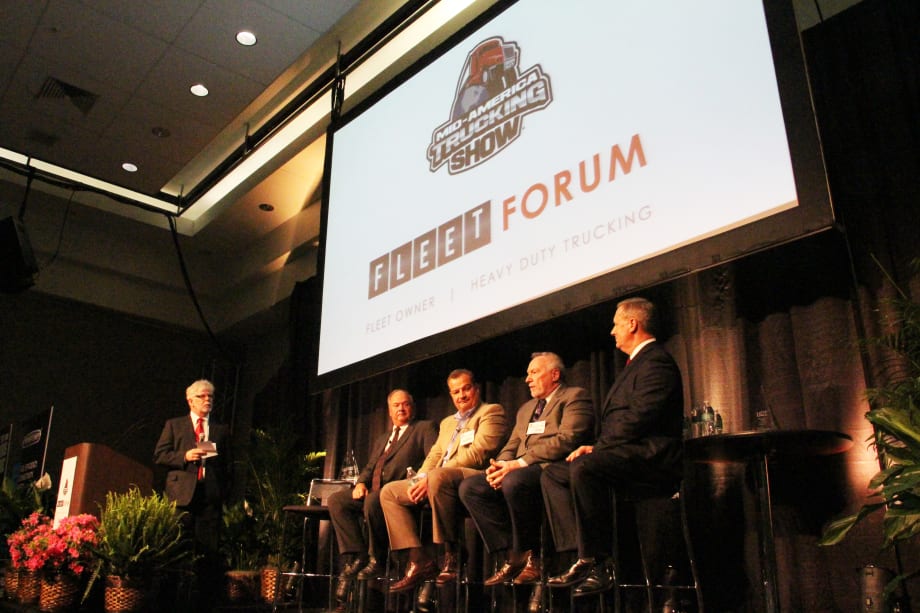
HDT's Truck Fleet Innovators panel at the MATS Fleet Forum. Photo: Evan Lockridge
HDT's Truck Fleet Innovators panel at the MATS Fleet Forum. Photo: Evan Lockridge
Spontaneous applause broke out following an impassioned answer to a question by HDT Truck Fleet Innovator Steve Rush during a panel discussion Wednesday.
At the Mid-America Trucking Show Fleet Forum in Louisville, Ky., Rush, the owner and president Carbon Express, a small New Jersey-based tanker fleet, was explaining his decision to stop using sleeper cabs and put drivers up in hotels. The result was the ability to haul more payload as well as happier drivers.
"My staff said to me, 'Why are we publishing this?' I love this industry and I love truck drivers and I love this country, and if we don't have enough truck drivers we're going to hurt our country," he said. "We've got to start treating these people with respect."
The Fleet Forum event is put on by MATS in cooperation with Heavy Duty Trucking and Fleet Owner magazines. This year drivers were a key focus of the discussion, led by HDT Equipment Editor Jim Park.
Rush said when he first talked to his staff about going strictly to day cabs, they thought he was crazy. However, he explained, "by the time you pay for the sleeper, for all the accessorial equipment we put in the sleepers, at the end of that [equipment] life you find the hotel bill is pretty comparable."
After getting drivers out of sleepers and into hotels – or their own beds – Rush said his drivers' "personal self feelings improved dramatically. They held their head high. … My turnover has gone out the window."
John Elliott, CEO of Detroit-area expedited fleet Load One, also got to experience the "my staff thinks I'm crazy" moment. In his case, it was an initiative for drivers to score the employees that interact with them, including dispatchers, technicians and more.
The staff, he said, was up in arms, but he said, "Why not? We do it to drivers every day with scorecards."
Load One worked with Staymetrics to do the surveys with drivers as well as exit interviews. When asked what they found surprising, Elliott explained that although everyone thinks the problem is pay, the number one issue with drivers was respect – or more accurately, a lack of respect.
"I think as an industry we're guilty, everyone loves to say our drivers are our partners, come be part of our family or part of our team. And you walk in the corporate office and the first thing you see is a 'no drivers past this point' sign. We contradict ourselves right out of the gate."
Part of what the surveys prompted them to do were facility improvements, but also helping the dispatch and administration staff better understand the needs of drivers, and how important relatively simple things such as making sure paychecks are correct and reducing inefficiencies and wasted time can be. "If someone asks you to work for free that's not very respectful," he noted.
For Rich DeBoer, executive vice president of Ozinga Brothers in Mokena, Ill., a decision to convert the readymix fleet to natural gas power also had benefits among drivers.
"The engines operate quite a bit quieter than what they've been accustomed to. Not only that, but when we added the natural gas engine we also went to automatic transmissions. That feature in the on-road vehicles made quite a difference."
In a typical diesel-powered ready-mix truck, he said, drivers can be constantly on and off the clutch, "and the noise is kind of overwhelming," DeBoer explained. "I've had guys come to me that said, 'I was thinking about retiring but I can work another five to 10 years.'"
Younger drivers
There also was general agreement among the Innovators that fleets are going to need to bring younger drivers into the industry.
The less-than-truckload industry typically has not had a big problem with driver turnover or finding drivers, said Braxton Vick, senior vice president of corporate planning and development for the regional LTL Southeastern Freight Lines.
Nevertheless, he said, "seven, eight years ago our strategic planning group made a special effort to develop a very aggressive dock-to-driver training. We bring in some young people who start out working on the docks at night to get through school, we'll take some of the brighter ones and say you're a very dedicated person, you work hard, how would you like to do a driver training program. It's been very successful and as a result not only do we know what kind of a driver we have, we know how they're trained."
Steve Rush, who admitted he started driving a truck at age 21 and rolled his first truck at age 23, recently relaxed a 25-year-old minimum age in his fleet. Within a fairly short period of time they hired four younger drivers and they're working out well. "If you find the right 23 year old, give them a shot, that's all they want," he said.
John Elliott said Load one has had mixed luck with the younger generation. "I think you've really got to screen them a little harder and 'off the paper' to get a feel for their personality," he said. Typically, he said, younger drivers expect nicer equipment and aren't usually mechanically inclined. "But they do tend to be much more technologically driven, things like electronic logs, in cab technology, they embrace, they push for it, they look for it."
Vick and Rush are big proponents of electronic logs. Under Vick's leadership, SEFL one of the first less-than-truckload carriers to implement e-logs.
Rush was an early adopter, as well. In response to a question about the survival of smaller fleets, he said, "I think the small carrier is in trouble, especially if they haven't adopted electronic logs."
Rush admitted cheating on his logs when he was a driver – but that was the rule, not the exception.
"In the end we cheated ourselves," he said. "That electronic mandate is the single best thing that’s hit this industry ever, and they keep delaying it. You can't just flip the switch when the mandate comes, it takes a lot of effort, a lot of hugging, a lot of coaching, but once drivers get it they never look back. It creates havoc with your dispatchers, because they have to do much better planning. It also helps you watch your costs. It's helped me as a business person and it's helped me as a person to take care of our drivers."
More Drivers

Truck Drivers Need More Than Another Alert
Fleets have more visibility into truck health, safety events, and driver activity than ever. The next challenge is turning all that information into useful guidance for the person who has to decide what to do next.
Read More →
FMCSA Removes 110 Truck Driver Training Schools from Certified ELDT List
Federal regulators also are targeting more than 160 additional training providers and launching a nationwide audit of third-party CDL skills testers as part of a broader crackdown on trucking fraud.
Read More →
Hours of Service Pilot Programs: FMCSA Readies for 2027 Rollout
Two pilot programs could eventually reshape hours-of-service rules, giving truck drivers options to pause their 14-hour clock or use longer split sleeper rest periods.
Read More →
Medical Cards, English Proficiency Reshape Roadcheck Violations
Medical-card violations jumped to the top of the driver out-of-service list during CVSA’s 2026 International Roadcheck, while English-language proficiency violations appeared among the leading violations for the first time.
Read More →
Driver Trust Can Make or Break the Success of Fleet Safety Technology
New Teletrac Navman research suggests that onboarding, transparency about driver data, and positive feedback can play a significant role in how commercial drivers respond to safety and coaching technology.
Read More →
EEOC Sues KLLM Over Alleged Sex Discrimination in Driver Training
KLLM is facing a federal sex-discrimination lawsuit over policies the EEOC alleges put female truck driver trainees at a disadvantage.
Read More →
FMCSA Moves to Codify English Language Requirements for Commercial Drivers
By changing regulations on English-language proficiency requirements for commercial drivers, rather than relying on a guidance memo, the FMCSA said future administrations won't be able to walk back the Trump administration's stricter enforcement with just a memo.
Read More →
Drivers Put Western Star Trucks to the Test at Star Nation Experience
Watch to get an inside look at the Western Star trucks, technology, and community behind the Star Nation Experience 2026!
Read More →
Trump Administration Looks to Put More Veterans Behind the Wheel
The Freedom Haulers program pulls together existing and expanded programs at several federal agencies to recruit veterans to drive commercial heavy-duty trucks and cut the red tape for them to get a CDL, training, and employment.
Read More →
Putting Mack’s Command Steer to the Test
A test drive of Mack’s Command Steer active steering system evaluates how it can make truck driving easier and less tiring.
Read More →