




Despite Success, California Ports' Clean Truck Programs Remain Contentious
By all accounts, the ports of Los Angeles and Long Beach have made great strides toward reducing air pollution caused by the trucks that serve their container facilities. At a hearing before the House Subcommittee on Highways and Transit yesterday, witnesses on all sides of the issue agreed that the ports' efforts to replace old, polluting trucks with cleaner ones have so far been remarkably successful
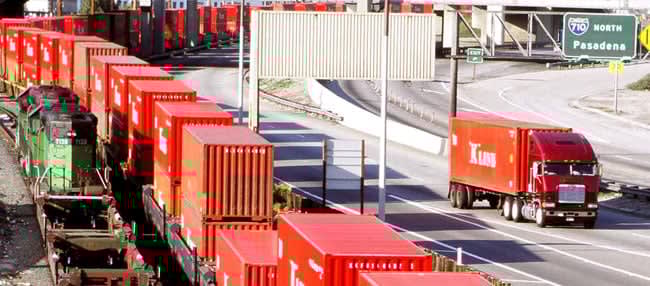
Officials from the Port of Long Beach allow owner-operators as well as company drivers under their Clean Truck Program. The Port of Los Angeles wants to ban owner-operators. (Photo courtesy Port of Long Beach.)
Photo: Port of Los Angeles
By all accounts, the ports of Los Angeles and Long Beach have made great strides toward reducing air pollution caused by the trucks that serve their container facilities. At a hearing before the House Subcommittee on Highways and Transit yesterday, witnesses on all sides of the issue agreed that the ports' efforts to replace old, polluting trucks with cleaner ones have so far been remarkably successful.
"The Port of Long Beach estimates that it has already achieved its goal of reducing pollution from port trucks by 80 percent by 2010, two years ahead of schedule," said Rep. James Oberstar, D-Minn. "The Port of Los Angeles estimates that to date, port truck air emissions have been reduced over 70 percent compared to 2007 levels."
Beyond that point, however, agreement was hard to find. Contention at the hearing reflected the ongoing litigation between the American Trucking Associations and the ports over details of their Clean Truck Programs, as well as concern about the fairness of current lease agreement practices between trucking companies and owner operators.
THE OWNER-OPERATOR QUESTION
The heart of the argument lies in the decision by the Port of Los Angeles to require all drayage drivers to be employees of trucking companies, rather than owner-operators.
The LA port believes that the owner-operator business model simply cannot produce enough revenue to ensure that the truck owner will be able to afford a modern engine that meets federal clean air standards without ongoing financial assistance, said John Holmes, deputy executive director of Operations. Under its program, the port provides grants of $20,000 to help truckers buy modern equipment, an outlay that is only partially offset by a $35 container fee.
"We believe that asset-based trucking companies are a sustainable model that will provide these companies with the ability to replace current trucks without public money," he said. "The employee requirement is key to the port's ability to manage transportation."
The Port of Long Beach has taken a different approach. Under a settlement agreement with ATA, it grants port access to owner-operators as well as drayage lines with employee drivers. Access is conditioned on a Registration Agreement that requires the carrier or owner-operator to abide by environmental, safety and security requirements.
The Long Beach port has seen no difference in performance between owner-operators and carriers under this regime, said Chris Lytle, deputy executive director. "There have been no complaints from drivers about their ability to meet the requirements," he said.
WAIT TIMES AND OTHER ISSUES
Witnesses at the hearing touched on a host of issues related to the structure of the Clean Trucks Programs.
Rep. Peter DeFazio, D-Ore., the chairman of the subcommittee, wanted to know what the ports are doing to relieve long wait times for entering trucks.
Holmes and Lytle agreed that this is a significant problem, and said they are looking into using an appointment system to help spread the traffic out.
DeFazio also is concerned that the subsidies the ports provide to support the purchase of cleaner engines get passed through to an owner-operator if that's appropriate. Lytle said the Long Beach port does not discriminate between carriers and owner-operators when it awards its grants. If a company wins the grant it must use it for an employee-driven truck and cannot sublease to an owner-operator, he said.
Oberstar, among others, asked whether incentive grants for clean trucks can be challenged in court. The programs are commendable and forward-looking, he said, but the funding mechanism - the fee on containers - has been successfully challenged in the past.
Holmes of the Los Angeles port replied that any part of the program can be contested and there's no way to say that the fee mechanism won't be contested. That is why, he said, the Los Angeles port prefers the concession approach to port access over the registration approach adopted by the Long Beach port.
"I don't think that without the ability to legally and confidently set our own standards we can sustain the program," he said. "The concession agreement is the way to make it sustainable in long term."
Oberstar replied, however, that he's not sure that the Los Angeles labor structure is essential to the clean air program.
Rep. Gary Miller, R-Calif., weighed in here, saying he thinks the issue is whether or not the truck meets the emission standard set by the port, regardless of the status of the driver.
"Lease agreements are not an air quality issue for me," Miller said. "How an owner-operator borrows money is his own business. It does not make sense to discriminate against those who want to work for themselves rather than for a company."
THE LARGER LEASING ISSUE
During subsequent testimony by other witnesses, including ATA, port drayage carriers, the National Resources Defense Council, the Teamsters and the Owner-Operator Independent Drivers Association, the discussion veered onto the nature and practice of lease agreements in the trucking industry.
It is a subject that has captured DeFazio's attention. "There are good operators out there but we are looking for sustainability and compliance with laws governing lease agreements," he said. "There is a question as to whether these people are in fact independent contractors."
DeFazio said he has spoken with colleagues in the House about legislation addressing what he said are "troubling contradictions" in current industry leasing practices. "The system's got to get better, it really does," he said. "This is not the last time this committee is going to be dealing with this issue."
This story has been updated as of 9 a.m. EDT 5/6/2010 to clarify name and title of the LA Port official quoted.
More Drivers

Truck Drivers Need More Than Another Alert
Fleets have more visibility into truck health, safety events, and driver activity than ever. The next challenge is turning all that information into useful guidance for the person who has to decide what to do next.
Read More →
FMCSA Removes 110 Truck Driver Training Schools from Certified ELDT List
Federal regulators also are targeting more than 160 additional training providers and launching a nationwide audit of third-party CDL skills testers as part of a broader crackdown on trucking fraud.
Read More →
Hours of Service Pilot Programs: FMCSA Readies for 2027 Rollout
Two pilot programs could eventually reshape hours-of-service rules, giving truck drivers options to pause their 14-hour clock or use longer split sleeper rest periods.
Read More →
Medical Cards, English Proficiency Reshape Roadcheck Violations
Medical-card violations jumped to the top of the driver out-of-service list during CVSA’s 2026 International Roadcheck, while English-language proficiency violations appeared among the leading violations for the first time.
Read More →
Driver Trust Can Make or Break the Success of Fleet Safety Technology
New Teletrac Navman research suggests that onboarding, transparency about driver data, and positive feedback can play a significant role in how commercial drivers respond to safety and coaching technology.
Read More →
EEOC Sues KLLM Over Alleged Sex Discrimination in Driver Training
KLLM is facing a federal sex-discrimination lawsuit over policies the EEOC alleges put female truck driver trainees at a disadvantage.
Read More →
FMCSA Moves to Codify English Language Requirements for Commercial Drivers
By changing regulations on English-language proficiency requirements for commercial drivers, rather than relying on a guidance memo, the FMCSA said future administrations won't be able to walk back the Trump administration's stricter enforcement with just a memo.
Read More →
Drivers Put Western Star Trucks to the Test at Star Nation Experience
Watch to get an inside look at the Western Star trucks, technology, and community behind the Star Nation Experience 2026!
Read More →
Trump Administration Looks to Put More Veterans Behind the Wheel
The Freedom Haulers program pulls together existing and expanded programs at several federal agencies to recruit veterans to drive commercial heavy-duty trucks and cut the red tape for them to get a CDL, training, and employment.
Read More →
Putting Mack’s Command Steer to the Test
A test drive of Mack’s Command Steer active steering system evaluates how it can make truck driving easier and less tiring.
Read More →