




CVSA's Roadcheck 2008 Shows Lowest Vehicle Out-of-Service Rate in Decades
CVSA's recent check on the industry shows the lowest rate of out-of-service vehicles in two decades, despite concerns that a weakening economy with ever-increasing fuel prices would push safety to the bottom of the list for commercial motor vehicle fleets
CVSA's recent check on the industry shows the lowest rate of out-of-service vehicles in two decades, despite concerns that a weakening economy with ever-increasing fuel prices would push safety to the bottom of the list for commercial motor vehicle fleets.
"This rate (23.9 percent vehicle out-of-service rate for Level I Inspections) is the principal barometer used to measure compliance and it is the lowest we've seen in the 21-year history of Roadcheck," said Stephen F. Campbell, CVSA's executive director. "It is clear the safety message is being heard and that the increased enforcement presence is making a difference. We appreciate the industry's continued commitment to make safety its top priority not just during Roadcheck, but throughout the entire year."
From June 3-5, 9,148 CVSA and FMCSA certified inspectors at 1,683 locations across North America performed 67,931 truck and bus inspections. 52,345 of the total were North American Standard Level I inspections, the most comprehensive roadside inspection. Both the total number of inspections and Level I inspections were records for the annual Roadcheck event. 2008 saw significant positive gains in out of service rates for most vehicle and driver types.
CVSA sponsors Roadcheck each year with the Federal Motor Carrier Safety Administration (FMCSA) Canadian Council of Motor Transport Administrators, Transport Canada, and the Secretariat of Communications and Transportation (Mexico).
For drivers, the 5.3 percent overall out-of-service rate was a 14.5 percent improvement over last year's rate. In 2007, 66.3 of drivers placed out of service were done so for hours of service violations. In 2008, this number was 55.6 percent. 3.8 percent of all drivers inspected in 2008 were placed out of service for a hours of service violation, down from 4.9 percent last year.
Despite some positive trends, the number of safety belt violations rose significantly- from 829 in 2007 to 1,226 this year. Safety belt enforcement continues to be a primary focus each year. Brakes continue to be the dominating vehicle out of service defect, comprising 52.6 percent of the total vehicle defects. The percentage of vehicle out of service defects that were brake related has declined noticeably over the last few years, down from a high of 56.6 percent in 2004.
"It's critical that everyone pulls together to make our highways and roads continually safer," said John H. Hill, FMCSA administrator. "The annual Roadcheck event provides a great focus on commercial vehicle safety. It is also important that the public do its part by driving safely in the vicinity of large trucks and buses. Let's all of us continue to make safety the highest priority of every day."
"We appreciate CVSA's annual Roadcheck effort, which helps ensure that education and enforcement are having a positive impact on safety,"said Bill Graves, president and CEO of the American Trucking Associations. "CVSA's annual effort underscores the effectiveness of industrywide efforts to educate drivers about truck safety and implement safety measures."
ROADCHECK 2008 FACT SHEET
Driver results for the vehicle types were as follows:
• All vehicles: 94.7 percent of drivers passed the inspection, and 5.3 percent were placed out of service (6.2 percent were out of service in 2007).
• Hazmat: 97.6 percent of drivers passed the inspection, and 2.4 percent were placed out of service (3.5 percent were out of service in 2007).
• Passenger carrying vehicles: 95.5 percent of drivers passed the inspection, and 4.5 percent were placed out of service (3.8 percent were out of service in 2007).
Vehicle results were as follows:
• All vehicles: 79.2 percent of vehicles passed the inspection, and 20.8 percent were placed out of service (21.5 percent were out of service in 2007).
• HAZMAT: 82.4 percent of vehicles passed the inspection, and 17.6 percent were placed out of service (17.7 percent were out of service in 2007).
• Passenger carrying vehicles: 87.8 percent of vehicles passed the inspection, and 12.2 percent were placed out of service (12.3 percent were out of service in 2007).
More info: www.cvsa.org
More Safety & Compliance
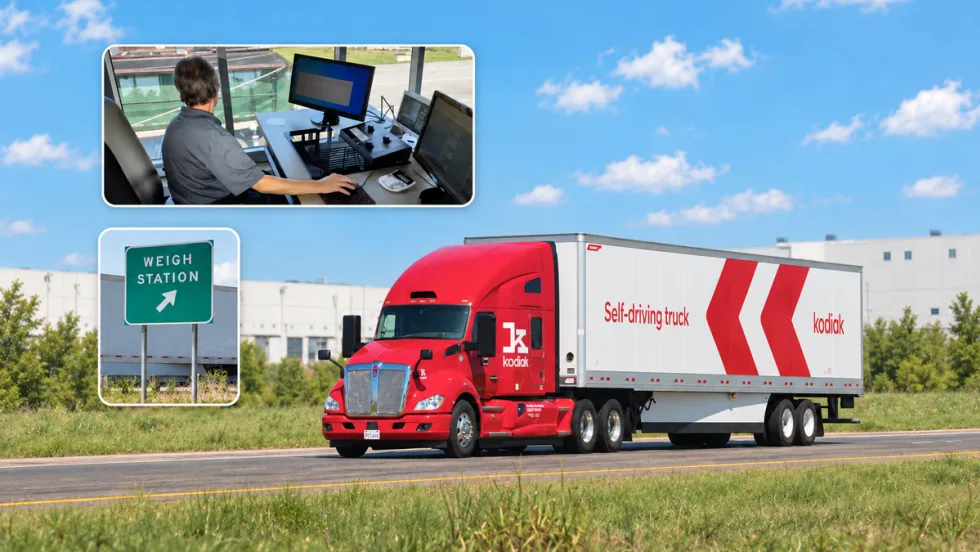
PrePass, Kodiak Connect Driverless Trucks to Roadside Enforcement
The system will allow enforcement agencies to verify Enhanced Inspection information and decide whether Kodiak’s autonomous trucks can bypass roadside screening sites.
Read More →
From One Generation to the Next: How Mentorship Builds Safer Truck Drivers
After three decades in trucking, Harold Perry shares what he's learned about driver safety, mentorship, and helping the next generation build confidence behind the wheel.
Read More →
FMCSA Pauses Biennial-Update Enforcement Amid Motus Transition
Carriers whose updates were due on or after June 1 have more time, while FMCSA works to stabilize its new registration system and warns of phishing sites impersonating its new carrier registration system, Motus.
Read More →
ZF Expands Commercial Vehicle Push in North America
ZF is expanding its North American commercial-vehicle presence with new transmission applications, electrification, trailer technology and autonomous-driving systems.
Read More →
Truck Drivers Need More Than Another Alert
Fleets have more visibility into truck health, safety events, and driver activity than ever. The next challenge is turning all that information into useful guidance for the person who has to decide what to do next.
Read More →
Tesla Wants a Self-Driving Semi. Are Cameras Enough?
Could Tesla’s camera-only autonomous driving technology work on an 80,000-pound Semi? In this commentary, HDT's Deborah Lockridge takes a look at Tesla, Cybercab, and how autonomous trucks see the road.
Read More →
What DOT’s Automated Vehicle Strategy Means for Trucking
The U.S. Department of Transportation issued a new automated-vehicle strategy that outlines plans for driverless-truck regulations, cross-state freight corridors, and federal safety standards.
Read More →
NYC Expands Speed, Pedestrian Safety Tech Across Fleet
New York City is expanding intelligent speed assistance and pedestrian-alert systems across its municipal fleet, moving the technologies from pilot programs into vehicle procurement and retrofit requirements.
Read More →
FMCSA Removes 110 Truck Driver Training Schools from Certified ELDT List
Federal regulators also are targeting more than 160 additional training providers and launching a nationwide audit of third-party CDL skills testers as part of a broader crackdown on trucking fraud.
Read More →
Beyond DOT Compliance: What Makes a Trucking Fleet Truly Safe?
A trucking fleet can follow every rule and still make unsafe decisions. The real test comes when safety conflicts with freight, productivity, or cost.
Read More →