




Columbus to Build Second Publicly Accessible CNG Fueling Station
The City of Columbus plans to build a second compressed natural gas fueling station scheduled to open in March of 2014. The new station will service the City’s northern refuse fleet operation, which has more than 65 vehicles, its Planning & Operations Division, which has more than 45 vehicles, and other City divisions.
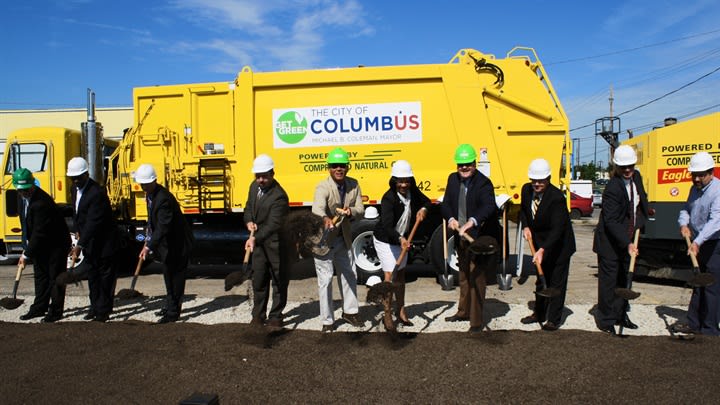
Officials from the City of Columbus and others break ground at the site of will be the City's second publicly accessible compressed natural gas fueling station.
The City of Columbus plans to build a second compressed natural gas fueling station scheduled to open in March of 2014. The new station will service the City’s northern refuse fleet operation, which has more than 65 vehicles, its Planning & Operations Division, which has more than 45 vehicles, and other City divisions. Construction on the station is set to begin in August 2013, according to Kelly Reagan, Fleet Administrator for the City. The new station will be built on a 1.3 acre parcel zoned to also permit publicly accessible fueling.
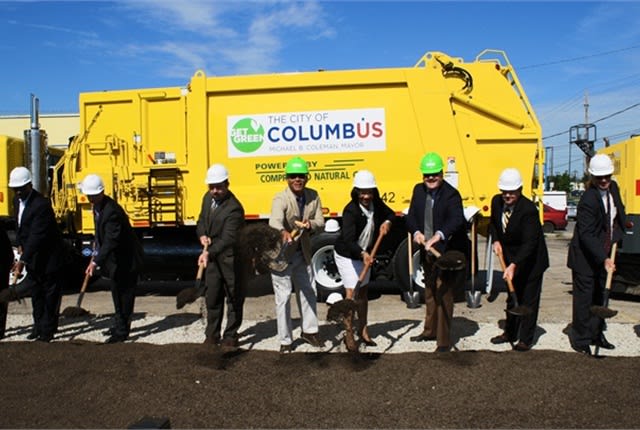
Officials from the City of Columbus and others break ground at the site of will be the City's second publicly accessible compressed natural gas fueling station.
Reagan told Government Fleet, a sister publication of HDT,that the Fleet Division’s role, as part of the Finance Department, is to meet the goals and targets outlined in Columbus Mayor Michael Coleman’s Green Fleet Action Plan, which is designed to reduce the City’s carbon footprint and save tax payers close to $2 million per year by 2020 (based on current diesel prices). The City of Columbus expects to be displacing over 1.1 million gallons of diesel annually by 2020.
Reagan explained the City is building the new “fast-fill” station in an effort to maximize throughput, creating enough CNG to fuel up to 50 refuse trucks each hour.
“This will easily accommodate all internal and external fueling for private fleets for some time to come,” Reagan said. “[It’s] primarily for City use at first, but then as private-sector business grows, we expect the throughput to increase. We are ready for it!”
The new fueling station builds on the City’s success with its first station, as a number of area fleets, including Frito Lay, AT&T, Foodliner, Home City Ice andWaste Management, among others, have fueled their vehicles there.
“The City’s first CNG station (with public access) has had remarkable success to date,” Reagan said. “Life to date this station has pumped over 160,000 gallons of CNG (gasoline gallon equivalents).”
The City’s CNG stations currently provide fuel to approximately 46 CNG-fueled vehicles. By the end of 2013, the City expects to have 93 vehicles fueled by CNG. By the end of 2013, the City projects savings of $194,150 in fuel costs (compared with the price of diesel) and tax credits of $105,590, for total savings of $299,740.
On a regional basis, Reagan noted that Columbus is not alone when it comes to positioning itself to growing the use of CNG as a fuel.
“Both the City of Columbus and Dublin are leaders in the region for CNG. Each is making their sites available for public access,” Reagan said. “Dublin on the north west side of town is positioned as well for maximum throughput – their station is similar in size to our first station – and is able to fill about 50 trash trucks per hour. Both City of Columbus sites have and will have the ability to accommodate tractor trailer “over –the-road” trucks. We are poised for maximum throughput, encouraging CNG growth here in the Midwest!”
Reagan noted the important role that other public-sector fleet managers have played in helping the City of Columbus build, and successfully operate, its new regional CNG fueling stations and offered advice for other public-sector fleet managers interested in CNG.
“Do your homework,” Reagan said. “Talk to other successful operators already in the CNG business, like the No. 1 ‘100 Best Fleet’ this year, Mr. Paul Condran, from Culver City, Calif. He was instrumental in providing much-needed information and resources to shorten, by decades, our learning curve for operating our own CNG sites. He has been very successful in the CNG business over the last 20 years and provides a wealth of knowledge – and he is willing to help. Another great resource from Riverside, Calif., (the No. 1 Green Fleet for 2012), is Martin Bowman, who is a real pro in the business and knows his stuff as well – he is always willing to help others [who are] jumping into the CNG business.”
More Fuel Smarts

Wex Adds Cardless Fuel Payments for Over-the-Road Customers
A new fuel card feature for Wex customers offers convenience and security.
Read More →
New California Law Could Shed Light on Electric Truck Prices
Why do battery-electric Class 8 trucks remain so expensive? A California bill signed by Gov. Gavin Newsom would give fleets and state agencies more visibility into what manufacturers charge.
Read More →
How Volvo Updated Its D13 for EPA 2027 [Watch]
Volvo’s updated D13 promises lower emissions without sacrificing performance or fuel economy. Take a closer look at what changed inside the engine in this HDT Spotlight video.
Read More →

Diesel Price Spike Shortens Payback for Natural Gas Trucks, Report Says
Energy Vision estimates fleets could recover the higher purchase price of an RNG-fueled Class 8 tractor in 1.3 to 2.8 years under current fuel-price scenarios.
Read More →
Calstart Becomes Catalyst Mobility, Reflecting Broader Focus
Calstart is now Catalyst Mobility, reflecting the nonprofit’s growing national role in clean transportation, including zero-emission trucks, infrastructure and incentive programs.
Read More →
Record Diesel Prices Squeeze Trucking Fleets
Average U.S. diesel prices have climbed to nearly $6 a gallon, surpassing the 2022 record as tight refinery capacity and Middle East disruptions keep fuel costs elevated.
Read More →
How Fuel Delivery Shapes Engine Performance
Fuel delivery depends on more than what happens at the injector. For fleet, maintenance and technical professionals, looking at the full path from pump to injector can provide useful context for understanding engine performance.
Read More →
East Coast Port Launches $45M Electric Truck Push
The Port Authority of New York and New Jersey announced millions in incentives for zero-emission drayage trucks, yard tractors, and new charging hubs near the port.
Read More →
Detroit Opens Orders for EPA 2027 Engines
Detroit isn’t starting from scratch to meet EPA 2027 diesel emissions standards. Its Gen 6 DD13 and DD15 engines keep much of today’s platform while updating the fuel and aftertreatment systems.
Read More →
Zero-Emission Truck Corridor Planned for West Coast
California, Oregon, Washington, British Columbia and Baja California are coordinating plans for truck charging and hydrogen fueling from Canada to Mexico.
Read More →