





Related: Chevron Unveils New Delo 400 CK-4 and FA-4 Engine Oils
Chevron Unveils High-Tech Rolling Oil Education Lab
Chevron hasn’t been just resting on its laurels since it re-engineered its Delo 400 product line in 2016 to meet the new API CK-4 and FA-4 heavy-duty engine oil specifications, and it’s highlighting a new customer-driven focus with the Delo Traveling Technology Lab.
August 22, 2019
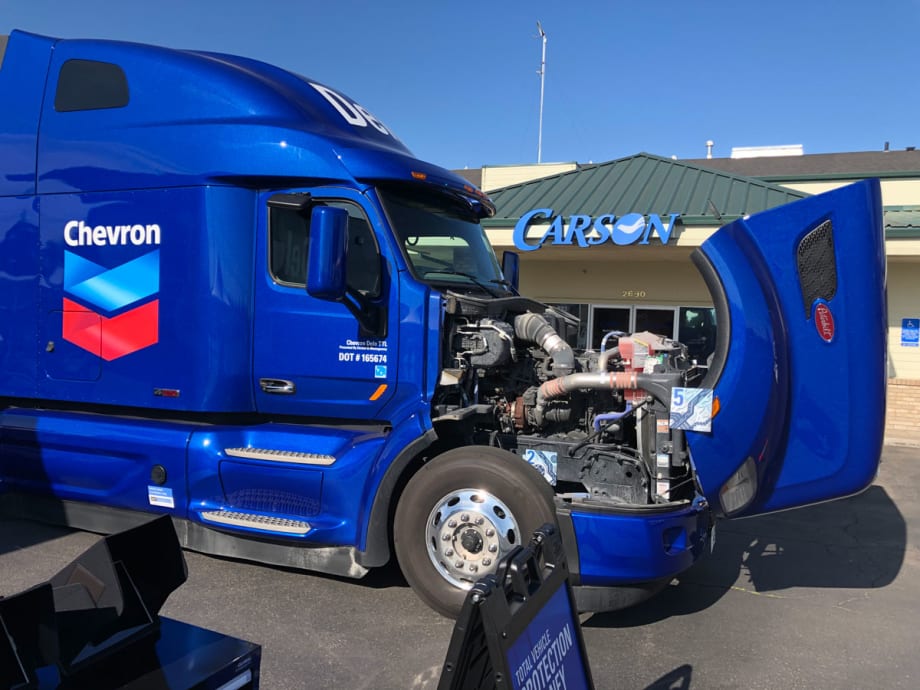
Part of a new customer-driven focus at Chevron is a revamp of the traveling mobile exhibit, which has been making the rounds since 1999 as the Delo truck.
Photo courtesy Chevron
4 min to read
Chevron hasn’t been just resting on its laurels since it re-engineered its Delo 400 product line in 2016 to meet the new API CK-4 and FA-4 heavy-duty engine oil specifications, and it’s highlighting a new customer-driven focus with the Delo Traveling Technology Lab.
Since the new oil standards were launched in late 2016, the industry has seen a lot of growth – and a lot of challenges, said James Booth, commercial sector manager, in a conference call. Economic growth and a strong labor market mean more freight but also shortages in drivers and skilled technicians. Truck operators are faced with regulatory changes in the forms of electronic logs and changing emissions requirements.
In this environment, Booth said, “what we hear in feedback from maintenance managers, operations managers, is the need for suppliers to help partner in terms of the application of technology” to help them solve their problems.
Booth said Chevron’s new customer-focused campaign “Engineered with Purpose,” is re-affirming its commitment to moving customers’ business forward through application of the most advanced technology. “We’ve really taken a leap in the last six to 12 months in pushing a customer-focused culture within our organization, in terms of the conversations we have with our customers, as well as the products and content and information we deliver.”
That push revolves around two areas: Products and information.
Protection Beyond API Standards
“It can be easy to get into the cycle of, a new industry specification comes up, you need to meet it, and then you’re waiting for the request from the industry to update the next specification,” Booth said. “We really didn’t sit on our laurels in this instance. We looked to see what else is in the pipeline in terms of [truck] hardware and technology, to make sure we are fully protecting and enabling the use of that hardware in the future.”
Chevron’s goal is to not only exceed API requirements, but also to solve customer issues not currently being addressed in the market. For instance, Booth said, just this year, Chevron has launched a number of products, including:
Greatest number of heavy-duty engine oil products with API SN Plus, protecting both heavy-duty vehicles and modern gasoline pick-up truck engines
Delo 400 XSP-FA 5W-30
Delo ELC Advanced Coolants, which the company said solve recent issues with nitrited coolants and new aluminum radiators.
By the end of the year, Booth said, Chevron will be introducing a “major breakthrough in oil technology” engineered to solve aftertreatment issues brought to light by its OEM partners and customers.
Delo Traveling Technology Lab
Chevron also unveiled a new take on its mobile education center, the Delo Traveling Technology Lab, with interactive technologies, including virtual (VR) and augmented (AR) reality exhibits.
As Booth said, in addition to products, the other piece of Chevron’s customer focus is knowledge sharing. “The relationship doesn’t finish at that transaction. It goes into how the end user can extract the most value out of it, and it’s helping with the training requirements for technicians, it’s thinking about how they may change their maintenance scheduling, and it’s also bringing forward information on what’s down the road and helping be better prepared for that. One area that we see a great way to deliver information is through the mobile exhibit.”
The Delo Truck, of course, is nothing new. Since its launch in 1999, this mobile educational center has traveled nearly three-quarters of a million miles in the United States and Canada, visiting thousands of people in the process.
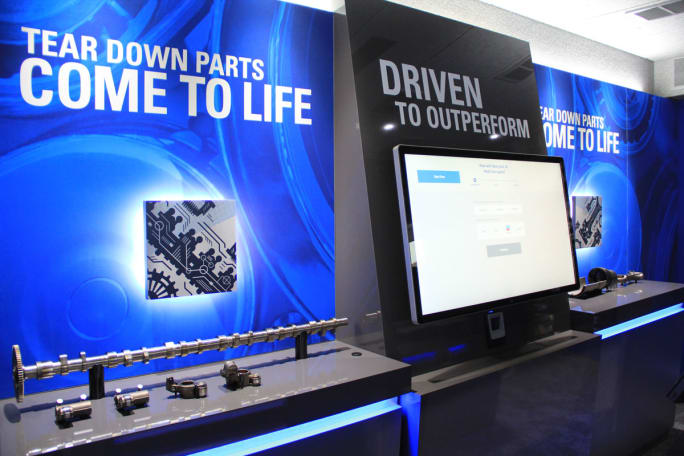
The exhibits in Chevron's rolling lab use technology such as virtual reality and augmented reality to help customers learn about engine oils.
Photo courtesy Chevron
Following 15 months of work with top agencies, Chevron’s Delo Traveling Technology Lab includes 11 exhibits, including state-of-the-art VR and AR equipment to allow customers an interactive experience to learn more about Chevron’s offerings from engine maintenance to proper lubrication practices. Some of the exhibits, Booth said, are “Delo-agnostic,” applying to engine and lubrication technology in a broader fashion.
Chevron is using virtual reality in this new rolling educational exhibit. For instance, a virtual engine fly-through gives users the opportunity to pause at various locations through the engine to understand what detrimental processes or conditions the lubricant can experience and why the specific formulation is important.
“The user has the option to be able to continue through in a passive manner, or can take control and act like a lubricant trying to prevent wear or contaminants and reacting with other molecules,” Booth said. “It’s an experience that’s really trying to drive that [message of] why a lubricant technology matters.”
More Maintenance

Sponsored•September 16, 2026
Color Match Smarter: Tools That Restore & Perform
For fleet managers and collision repair professionals keeping heavy-duty trucks on the road, getting the color right the first time isn't just about appearance — it's about efficiency, turnaround time, and bottom-line results. Discover how today's digital color tools are transforming the repair process from guesswork to precision.
Read More →
Wrong Repair Prompts Recall of Freightliner, Western Star 4x2 Trucks
DTNA is recalling more than 2,400 trucks that received an incompatible software fix instead of the hardware repair required to address brake valve corrosion.
Read More →
Truck Drivers Need More Than Another Alert
Fleets have more visibility into truck health, safety events, and driver activity than ever. The next challenge is turning all that information into useful guidance for the person who has to decide what to do next.
Read More →

The Maintenance Checks Trucking Fleets Should Prioritize Before Fall Freight Picks Up
Making it through August isn’t the same as being ready for the next several months of operation. Find out what systems may have suffered from summer heat and need to be checked out before fall.
Read More →
What Three Fleets Are Doing Differently When Buying Truck Parts in 2026
With freight improving but costs still climbing, fleet maintenance executives explain how they're balancing price, quality, and supplier relationships.
Read More →
Paccar Recalls 2027 Trucks Built This Summer for Possible Electrical Problem
The nearly 6,000 Kenworth and Peterbilt trucks in the recall could potentially lose engine power, among other things.
Read More →
Will API PC-12 Oil Change Trucking Fleet Maintenance?
The new API PC-12 heavy-duty engine oil category reflects the changing demands of modern diesel engines. But fleets like Foodliner are looking to getting their own data before making decisions on adopting the new oils and questions such as extending oil drain intervals.
Read More →
Brake Safety Week to Focus on Drums and Rotors
Commercial vehicle inspectors are focusing on truck brakes during CVSA's Brake Safety Week, August 23-29.
Read More →
Possible Battery-Cable Fires Prompt Recall of 15,000+ International MV and HV Trucks
On the recalled vehicles, manufacturing variations can cause the battery interconnect cable to contact the auxiliary stud and hold down the bracket.
Read More →
Rush, MCT Team Up to Grow Refrigeration Service Network
The joint venture will operate MCT's network of Carrier Transicold dealerships and mobile service locations, with the companies promising greater service capacity and uptime for refrigerated fleets.
Read More →