




Cargo Thefts Decline But Losses Increase Dramatically
A new report from the logistics security services provider, FreightWatch International, shows it recorded a total of 212 cargo thefts in the United States in August through September, with 76 thefts in August, 84 in September and 52 in October.
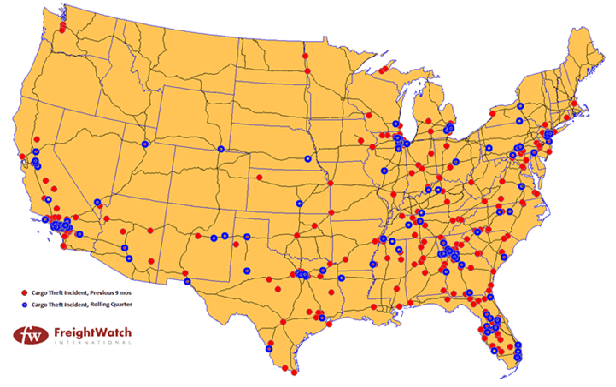
This graphic from FreightWatch International shows the locations of reported cargo thefts in August through September. Credit: FreightWatch International.
A new report from the logistics security services provider, FreightWatch International, shows it recorded a total of 212 cargo thefts in the United States in August through September, with 76 thefts in August, 84 in September and 52 in October.
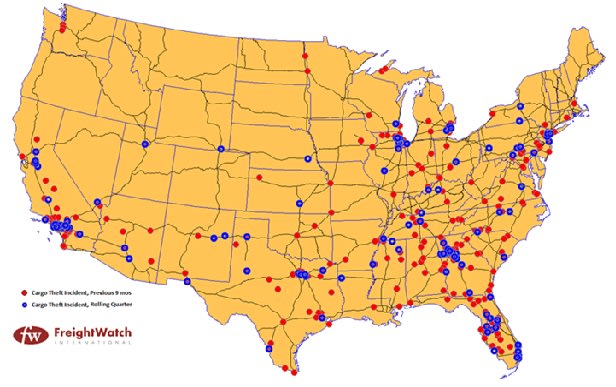
This graphic from FreightWatch International shows the locations of reported cargo thefts in August through September.
FreightWatch International.
The average loss value per incident during the period was $256,586. Compared with the previous three-months thefts decreased by 9%, while the average loss value increased by 58%.
The electronics sector had the highest average loss value this quarter at $1,100,130. This represents a 450% increase over the last rolling quarter’s average, largely due to a pair of very high-value incidents. Clothing/shoes, which experienced 14 thefts, averaged $302,776 in losses. Pharmaceuticals followed with an average loss value of $189,481 resulting from seven high-value thefts among its reported incidents. The average loss in the alcohol/tobacco product type dropped from $347,714 to $135,497 this rolling quarter, putting it in fourth place in this tracking sector.
Food/drinks, with 46 thefts, was the product type most often stolen in this rolling quarter. These thefts comprised 22% of all incidents during the three-month period. The Electronics industry experienced 29 thefts, or 14% of the total, mainly consisting of televisions, computers and computer accessories.
Seven of the 11 FreightWatch product types experienced fewer thefts this quarter than during the previous three months. The drop in theft numbers was significant in the building/industrial, alcohol/tobacco and metals categories, and less so in others. Meanwhile, recorded thefts increased in four of the product types, with miscellaneous and personal Care seeing the most significant gains.
California remained the state with the most thefts, with Texas having seen a slight decrease in incidents but continuing to follow in second. The 64 thefts in California accounted for 30% of all the incidents across the United States. Texas had 32 thefts, 15% of the total, while Florida reported 25 thefts, 12% of the total, placing it third on the list of most targeted states during the three-month period.
Of the incidents in which location types were recorded, unsecured parking was the most common, with 75% of thefts. Secured parking saw 13% of incidents, a slight increase from the last rolling quarter. Thefts at a facility dropped from 20 the last rolling quarter to five this period. The five thefts from a facility interior and four in-transit thefts together comprised about 6% of all incidents.
Following the usual trend, incidents involving theft of trailer/container, 157 in all, were most common during the rolling quarter, accounting for 74% of all thefts. Thefts from trailer/container increased from 12 the previous three months to 16, comprising 8% of the total. Driver theft increased slightly from 14 incidents during the May-July period to 15 this rolling quarter, with 7% of the total. Thefts of other types claimed 11% of the total this rolling quarter. These included deceptive pickup with eight incidents, last-mile courier theft with seven, facility burglary with five, hijacking with three and attempted hijacking with one reported incident.
More information is available on the FreightWatch International website. http://www.freightwatchintl.com
More Drivers

From One Generation to the Next: How Mentorship Builds Safer Truck Drivers
After three decades in trucking, Harold Perry shares what he's learned about driver safety, mentorship, and helping the next generation build confidence behind the wheel.
Read More →
Truck Drivers Need More Than Another Alert
Fleets have more visibility into truck health, safety events, and driver activity than ever. The next challenge is turning all that information into useful guidance for the person who has to decide what to do next.
Read More →
FMCSA Removes 110 Truck Driver Training Schools from Certified ELDT List
Federal regulators also are targeting more than 160 additional training providers and launching a nationwide audit of third-party CDL skills testers as part of a broader crackdown on trucking fraud.
Read More →
Hours of Service Pilot Programs: FMCSA Readies for 2027 Rollout
Two pilot programs could eventually reshape hours-of-service rules, giving truck drivers options to pause their 14-hour clock or use longer split sleeper rest periods.
Read More →
Medical Cards, English Proficiency Reshape Roadcheck Violations
Medical-card violations jumped to the top of the driver out-of-service list during CVSA’s 2026 International Roadcheck, while English-language proficiency violations appeared among the leading violations for the first time.
Read More →
Driver Trust Can Make or Break the Success of Fleet Safety Technology
New Teletrac Navman research suggests that onboarding, transparency about driver data, and positive feedback can play a significant role in how commercial drivers respond to safety and coaching technology.
Read More →
EEOC Sues KLLM Over Alleged Sex Discrimination in Driver Training
KLLM is facing a federal sex-discrimination lawsuit over policies the EEOC alleges put female truck driver trainees at a disadvantage.
Read More →
FMCSA Moves to Codify English Language Requirements for Commercial Drivers
By changing regulations on English-language proficiency requirements for commercial drivers, rather than relying on a guidance memo, the FMCSA said future administrations won't be able to walk back the Trump administration's stricter enforcement with just a memo.
Read More →
Drivers Put Western Star Trucks to the Test at Star Nation Experience
Watch to get an inside look at the Western Star trucks, technology, and community behind the Star Nation Experience 2026!
Read More →
Trump Administration Looks to Put More Veterans Behind the Wheel
The Freedom Haulers program pulls together existing and expanded programs at several federal agencies to recruit veterans to drive commercial heavy-duty trucks and cut the red tape for them to get a CDL, training, and employment.
Read More →