




April Spot Market Volume, Rates Down From a Year Ago
Spot market freight volumes reported by the DAT North American Freight Index declined 16% compared to the record April high in 2012. The year-over-year freight declines were seen across all equipment types: van load volume declined, refrigerated loads slipped 10% and flatbed freight dropped 15%.
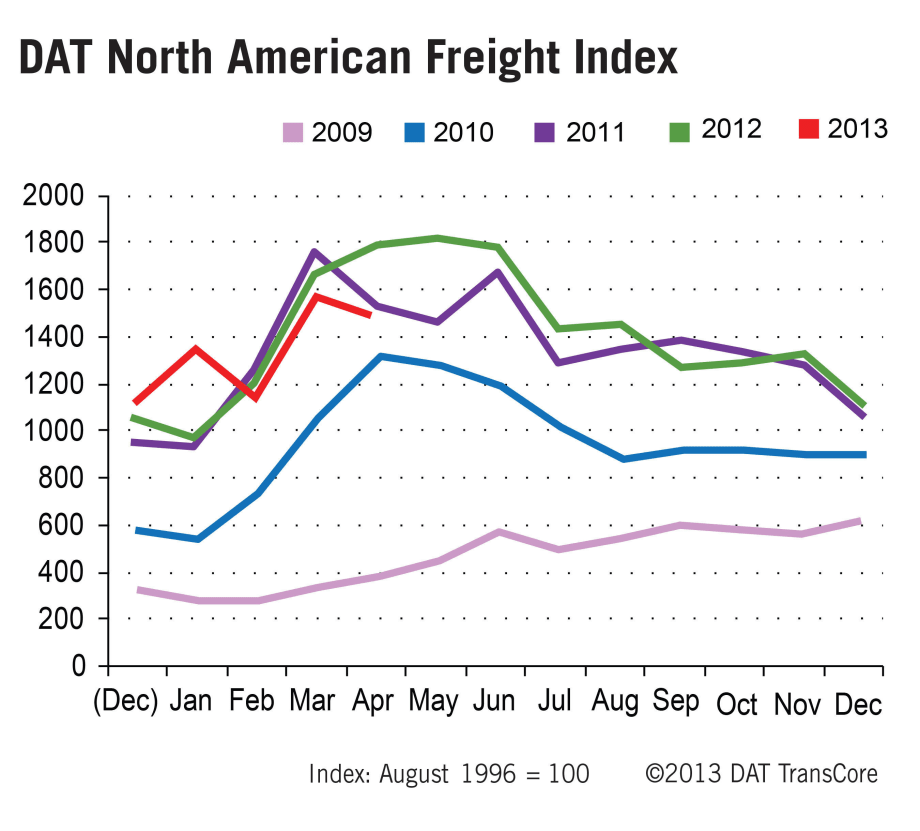
Spot market freight volumes reported by the DAT North American Freight Index declined 16% compared to the record April high in 2012. The year-over-year freight declines were seen across all equipment types: van load volume declined, refrigerated loads slipped 10% and flatbed freight dropped 15%.
At a time of year when a month-over-month increase in spot market freight volume is expected, the DAT Freight Index declined by 5.8%. Although atypical, freight volumes are reminiscent of those experienced in April of 2011. Unusually inclement weather, including floods in the upper Midwest, may have been a factor. Freight availability declined 14% for vans and 17% for reefers, but rose 6.6%, compared to March.
Compared to April 2012, spot market rates declined along with demand for vans and flatbeds, but reefer rates saw an increase. Van rates slipped 0.8% and flatbeds dropped 5.3% while reefer rates rose 2.0%.
Writing on the DAT Freight Talk blog, Mark Montague, analyst for the company, offered some possible reasons for what happened to van and flatbed loads compared to a year ago.
“The trucking industry added 11,700 jobs in April, after losing 6,300 in March. That brings the total number of trucking jobs to 45,300 in the past 12 months,” he wrote. “Compared with the lackluster jobs reports for the same period, our industry is booming, and is responsible for 7% of all the hiring nationwide. More drivers means more trucks on the road, or at least available. When capacity is looser, it puts downward pressure on rates.”
Despite the softness in spot market freight volumes, rates rose in April across all equipment types, compared to March. Van rates rose 0.8%, flatbed rates increased 4.5% and reefer rates climbed 5.5%.
The monthly DAT North American Freight Index reflects spot market freight availability on the Transcore DAT network of load boards in the United States and Canada.
More Drivers

Trucker Path Expands Reserved Parking Network
Trucker Path has added close to 6,000 more truck parking spaces to its Trucker Path Reserved Parking Network with the addition of Safe Truck Parking.
Read More →
EEOC Sues Texas Trucking Company Over Driver Age Limits
The agency says Trancasa USA rejected applicants over 65 and applied tougher driving-record standards to those over 60.
Read More →
Nussbaum, Roehl Announce Second Driver Pay Increase This Year
This year has seen a swath of major truck driver pay increases as freight capacity has tightened.
Read More →
From One Generation to the Next: How Mentorship Builds Safer Truck Drivers
After three decades in trucking, Harold Perry shares what he's learned about driver safety, mentorship, and helping the next generation build confidence behind the wheel.
Read More →
Truck Drivers Need More Than Another Alert
Fleets have more visibility into truck health, safety events, and driver activity than ever. The next challenge is turning all that information into useful guidance for the person who has to decide what to do next.
Read More →
FMCSA Removes 110 Truck Driver Training Schools from Certified ELDT List
Federal regulators also are targeting more than 160 additional training providers and launching a nationwide audit of third-party CDL skills testers as part of a broader crackdown on trucking fraud.
Read More →
Hours of Service Pilot Programs: FMCSA Readies for 2027 Rollout
Two pilot programs could eventually reshape hours-of-service rules, giving truck drivers options to pause their 14-hour clock or use longer split sleeper rest periods.
Read More →
Medical Cards, English Proficiency Reshape Roadcheck Violations
Medical-card violations jumped to the top of the driver out-of-service list during CVSA’s 2026 International Roadcheck, while English-language proficiency violations appeared among the leading violations for the first time.
Read More →
Driver Trust Can Make or Break the Success of Fleet Safety Technology
New Teletrac Navman research suggests that onboarding, transparency about driver data, and positive feedback can play a significant role in how commercial drivers respond to safety and coaching technology.
Read More →
EEOC Sues KLLM Over Alleged Sex Discrimination in Driver Training
KLLM is facing a federal sex-discrimination lawsuit over policies the EEOC alleges put female truck driver trainees at a disadvantage.
Read More →