




60 Trucks in DOT Test of 'Connected Vehicle' Crash Avoidance Technology
The Department of Transportation yesterday launched a year-long pilot project to test technology that lets cars, trucks and buses "talk" to each other and to infrastructure. The idea behind these Wi-Fi-like devices is to avoid crashes and improve traffic flow. If tests and other research go well, it could lead to regulations in the future

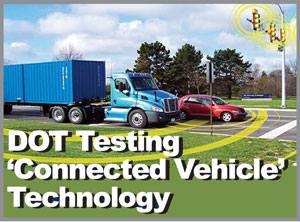
The Department of Transportation yesterday launched a year-long pilot project to test technology that lets cars, trucks and buses "talk" to each other and to infrastructure. The idea behind these Wi-Fi-like devices is to avoid crashes and improve traffic flow. If tests and other research go well, it could lead to regulations in the future.
Nearly 3,000 vehicles are taking part in the project in Ann Arbor, Mich., including 60 trucks. The trucks come from a variety of local companies, including Sysco Foods, Con-way Trucking, Arbor Springs and Metro Delivery.
U.S. Transportation Secretary Ray LaHood joined elected officials and industry and community leaders on the University of Michigan campus to launch the second phase of the Connected Vehicle Safety Pilot, the largest road test to date of connected vehicle crash avoidance technology.
"Today is a big moment for automotive safety," said Secretary LaHood. "This cutting-edge technology offers real promise for improving both the safety and efficiency of our roads."
Conducted by University of Michigan's Transportation Research Institute, the road test, or model deployment, is a first-of-its-kind test of connected vehicle technology in the real world. According to UMTRI's website, "The model deployment will find out how well connected vehicle safety technologies and systems work in a real-life environment-with real drivers and vehicles. It will test performance, usability, and collect data to better understand the safety benefit of a larger scale deployment."
The test cars, commercial trucks and buses, most of which have been supplied by volunteer participants, are equipped with vehicle-to-vehicle (V2V) and vehicle-to-infrastructure (V2I) communication devices. These will gather extensive data about system operability and its effectiveness at reducing crashes.
The technology that enables the vehicle systems to be connected is based on Dedicated Short Range Communications (DSRC), which is similar to Wi-Fi, but is not likely to be vulnerable to interference, according to a DOT fact sheet.
"Using either in-vehicle or aftermarket devices that continuously share important safety and mobility information, vehicles ranging from cars to trucks and buses to trains would be able to 'talk' to each other and to different types of roadway infrastructure" such as traffic signals or toll booths, it says.
All 60 trucks participating in the year-long study were equipped with a vehicle awareness device (VAD), which is an aftermarket electronic device installed in a vehicle without connection to vehicle systems. A VAD is not able to generate warnings to the driver, but can still transmit the vehicle's speed and location to other surrounding vehicles at a rate of 10 times per second.
There are also 16 trucks that have been retrofitted with a safety device. This device is connected to a vehicle's data bus and can provide highly accurate information from in-vehicle sensors. The integrated device has a working driver interface, broadcasts and receives safety messages, and can process the content of received messages to provide warnings to the driver of the vehicle.
According to the National Highway Traffic Safety Administration, V2V safety technology could help drivers avoid or reduce the severity of four out of five unimpaired vehicle crashes. To accomplish this, the model deployment vehicles will send electronic data messages, receive messages from other equipped vehicles, and translate the data into a warning to the driver during specific hazardous traffic scenarios. Such hazards include an impending collision at a blind intersection, a vehicle changing lanes in another vehicle's blind spot, or a rear collision with a vehicle stopped ahead, among others.
"Vehicle-to-vehicle communication has the potential to be the ultimate game-changer in roadway safety - but we need to understand how to apply the technology in an effective way in the real world," said NHTSA Administrator David Strickland. "NHTSA will use the valuable data from the 'model deployment' as it decides if and when these connected vehicle safety technologies should be incorporated into the fleet."
The model deployment is the second phase of DOT's Connected Vehicle Safety Pilot, a major research initiative managed by NHTSA and the Research and Innovative Technologies Administration (RITA) Intelligent Transportation Systems Joint Program Office.
Earlier this year, DOT released data from a series of "driver acceptance clinics" conducted during the first phase of the Safety Pilot. The study revealed that an overwhelming majority of drivers (9 out of 10) who have experienced V2V technology have a highly favorable opinion of its safety benefits and would like to have V2V safety features on their personal vehicle. (Read more about the first phase on LaHood's blog
NHTSA will use the information collected from both phases of the pilot, as well as other key research projects, to determine by 2013 whether to proceed with other activities involving connected vehicle technology, including a possible rulemaking.
For more information on DOT's connected vehicle research, visit www.safercar.gov/connectedvehicles.
More Safety & Compliance

FMCSA Pauses Biennial-Update Enforcement Amid Motus Transition
Carriers whose updates were due on or after June 1 have more time, while FMCSA works to stabilize its new registration system and warns of phishing sites impersonating its new carrier registration system, Motus.
Read More →
ZF Expands Commercial Vehicle Push in North America
ZF is expanding its North American commercial-vehicle presence with new transmission applications, electrification, trailer technology and autonomous-driving systems.
Read More →
Truck Drivers Need More Than Another Alert
Fleets have more visibility into truck health, safety events, and driver activity than ever. The next challenge is turning all that information into useful guidance for the person who has to decide what to do next.
Read More →
Tesla Wants a Self-Driving Semi. Are Cameras Enough?
Could Tesla’s camera-only autonomous driving technology work on an 80,000-pound Semi? In this commentary, HDT's Deborah Lockridge takes a look at Tesla, Cybercab, and how autonomous trucks see the road.
Read More →
What DOT’s Automated Vehicle Strategy Means for Trucking
The U.S. Department of Transportation issued a new automated-vehicle strategy that outlines plans for driverless-truck regulations, cross-state freight corridors, and federal safety standards.
Read More →
NYC Expands Speed, Pedestrian Safety Tech Across Fleet
New York City is expanding intelligent speed assistance and pedestrian-alert systems across its municipal fleet, moving the technologies from pilot programs into vehicle procurement and retrofit requirements.
Read More →
FMCSA Removes 110 Truck Driver Training Schools from Certified ELDT List
Federal regulators also are targeting more than 160 additional training providers and launching a nationwide audit of third-party CDL skills testers as part of a broader crackdown on trucking fraud.
Read More →
Beyond DOT Compliance: What Makes a Trucking Fleet Truly Safe?
A trucking fleet can follow every rule and still make unsafe decisions. The real test comes when safety conflicts with freight, productivity, or cost.
Read More →
Hours of Service Pilot Programs: FMCSA Readies for 2027 Rollout
Two pilot programs could eventually reshape hours-of-service rules, giving truck drivers options to pause their 14-hour clock or use longer split sleeper rest periods.
Read More →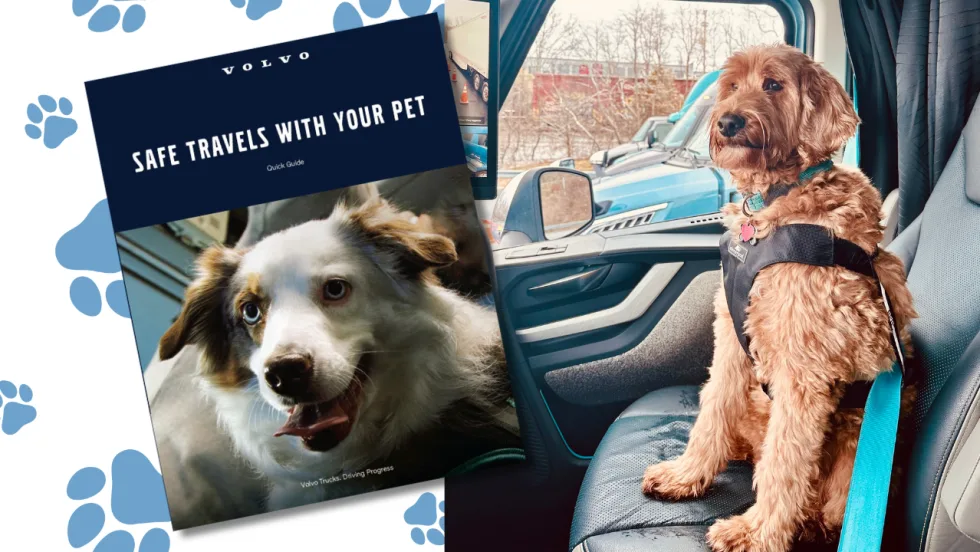
New Guide Offers Pet Safety Tips for Truck Drivers
Hundreds of thousands of pets travel in truck cabs. A new safety guide from Volvo Trucks and the Center for Pet Safety offers practical advice for truck drivers who bring dogs and cats along for the ride.
Read More →