





Related: Hybrid Electric-Drive Trailer Tandem Promises Quick Payback
Test Drive Shows the Hyliion Trailer Hybrid Works
Company execs say Initial assembly of fleet-test units will be later this year with full production a few months later.
August 19, 2016

Hyliion engineer Morgan Culbertson, who wrote the control program, here controls the tandem with sliding toggles. Production models will be automatic and not linked to the tractor.
2 min to read
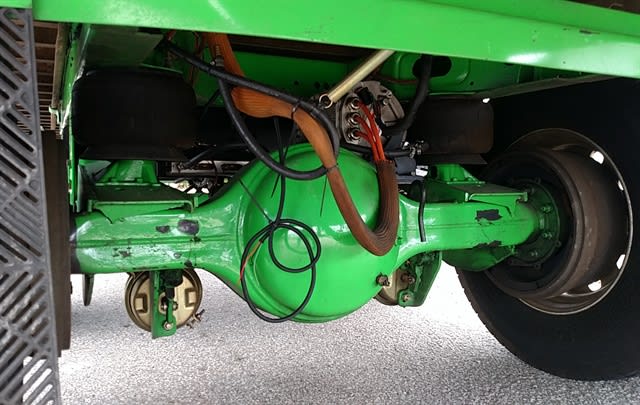
Hyliion tandem's rear axle is a truck-type with a differential. Motor is ahead and is linked to the diff like a driveshaft. Photos: Tom Berg
Yours truly has driven the Hyliion electric drive tandem for trailers and I've found that it seems to do what its developers say: It helps propel a trailer on the level and while climbing hills, and holds it back on downgrades, capturing braking energy in the process.
First reported on TInfo last March, the tandem's hybrid action saves 10 to 20% in fuel while on the move, and another 10% or more when its batteries are tapped to become an auxiliary power unit, according to Hyliion Inc's CEO, Thomas Healy. He rode along to supervise the demonstration and to answer questions.

Hyliion engineer Morgan Culbertson, who wrote the control program, here controls the tandem with sliding toggles. Production models will be automatic and not linked to the tractor.
This was on freeways in Pittsburgh, Pa., one of the hillier areas in the country and therefore a good testing ground for the concept. I'll write a more complete driving report soon, but for now, can relate that I didn't have to push very hard on the accelerator or brake pedals of the tractor to maintain speed or keep speed in check while rolling downhill.
Healy says only enough power is used to help move the trailer, and “it never pushes the tractor.” Except for an on/off switch, it operates on its own and requires no link to the tractor. Thus any tractor of whatever age can pull a Hyliion-equipped trailer and be aided by it.
A readout in the tractor's sleeper showed fuel usage was cut substantially compared to when the tandem was purposely cut out. That and the company's test data, which indicate savings from 10 to 30% or more, suggest that fleets wanting to save fuel just have to consider the product. Many are, Healy says, and have requested units to test.
The powered tandem replaces a trailer's standard tandem slider, and a truck-type drive axle with differential replaces one of the "dead" axles. Hyliion technicians can do a swap in under an hour, he says. Non-slider assemblies will also be available.
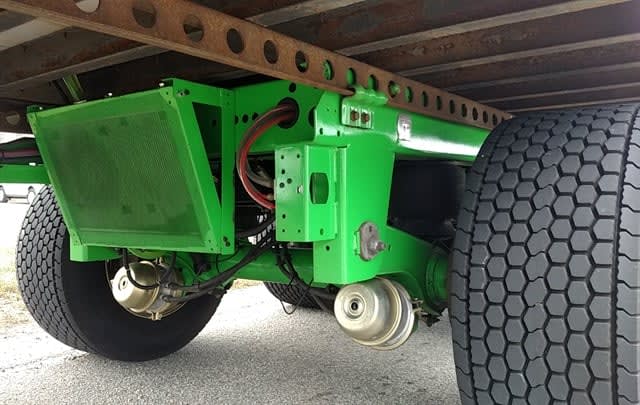
Control box and battery pack are toward the tandem's front. They're protected from flying debris by the sloping shield.
Hyliion engineers -- one of them Healy himself -- have also designed a single-axle system for use in Europe, where it would replace one of the three axles under a semitrailer, a common configuration over there.
Healy plans initial assembly in Hyliion's facility later this year, and anticipates full production, probably by a contract manufacturer, by late winter or spring of 2017.
Topics:Alternative Fuels & Hybrids
Subscribe to Our Newsletter
More Blog Posts

Pulsing Back-of-Trailer Lamps Aim to Prevent Crashes
Can the addition of a pulsing brake lamp on the back of a trailer prevent rear-end collisions? FMCSA seems to think so, if its exemptions are any indication.
Read More →
Designing a 14-Foot Trailer
Trailers are 13 feet, 6 inches high, right? Not for Hub Group, which developed a special 14-foot-high trailer spec for a dedicated customer based in California. Learn more in the Trailer Talk blog.
Read More →
CARB Comes for Reefer Trailers
A new round of emissions control regulations decreed by the California Air Resource Board will begin affecting refrigerated trailer and TRU design and operations next year.
Read More →
5 Ways Data Analysis Maximizes the Value of Trailer Telematics
Are you getting the most out of your trailer telematics investment?
Read More →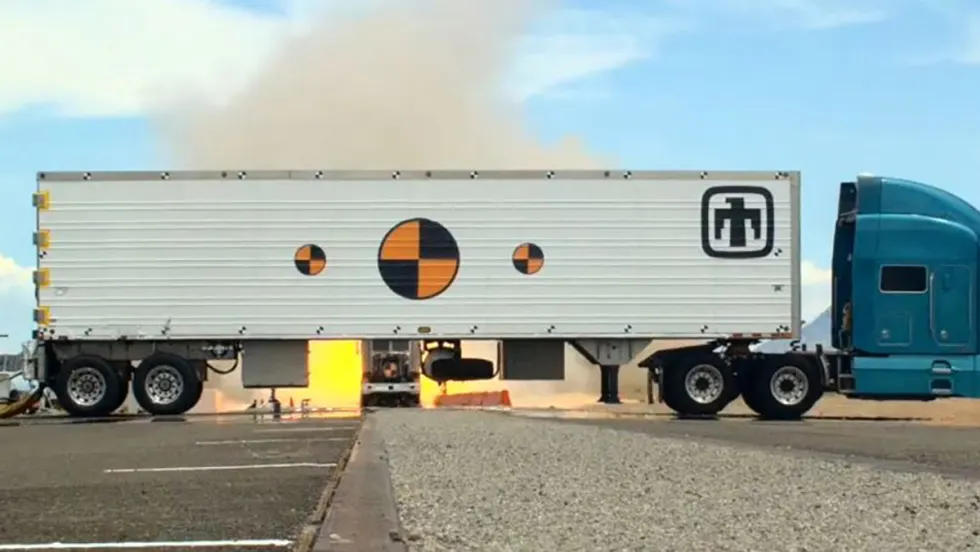
Can You Guess What's in That Trailer?
You don’t always know what’s in the trailers that pass you on the road. But some of those trailers are carrying something a little more dangerous that frozen food or new bedding…like, maybe, a nuclear weapon. But this isn’t an ordinary trailer; this is a trailer specifically made to not only carry this type of payload, but protect it at all costs.
Read More →
How Trailers Are Harnessing 'Free' Energy
Can trailers play a more active role in sustainable transport beyond aerodynamic add-ons or low-rolling-resistance tires? Some companies think so.
Read More →
Wrapping a Trailer for COVID’s Everyday Heroes
“We don’t only deliver freight. We deliver awareness.” That’s what Jim Barrett, president and CEO of Road Scholar Transport, likes to say about the Dunmore, Pennsylvania-based carrier’s “awareness fleet.” Its latest trailer wrap honors the everyday heroes of the pandemic.
Read More →
How a Tanker Fleet is Using Unorthodox Trailer Lighting to Fight Rear-End Collisions
Groendyke Transport watched the number of rear-end collisions with its trailers rise steadily until it tried an unorthodox and then unapproved method of alerting following drivers that its trucks were applying brakes and slowing down.
Read More →
The Role Trailers are Playing in COVID-19 Funerals
In places such as New York City and Detroit, overwhelmed hospitals and mortuaries are using refrigerated trailers to store the bodies of people killed by COVID-19.
Read More →
Reefer Trailer Aims to Help Reach Zero Emissions
Wabash National is partnering with C&S Wholesale Grocers to test a new type of zero-emissions refrigerated trailer.
Read More →