




Simulation Shows Eco Flaps Reduce Drag on Tanker Rigs
An analysis of four tanker configurations showed drag reduction of more than 2%. But Senior Contributing Editor Tom Berg suggests another way to cut drag – eliminating tanker fenders, which act like sails and pull backwards on the trailer.

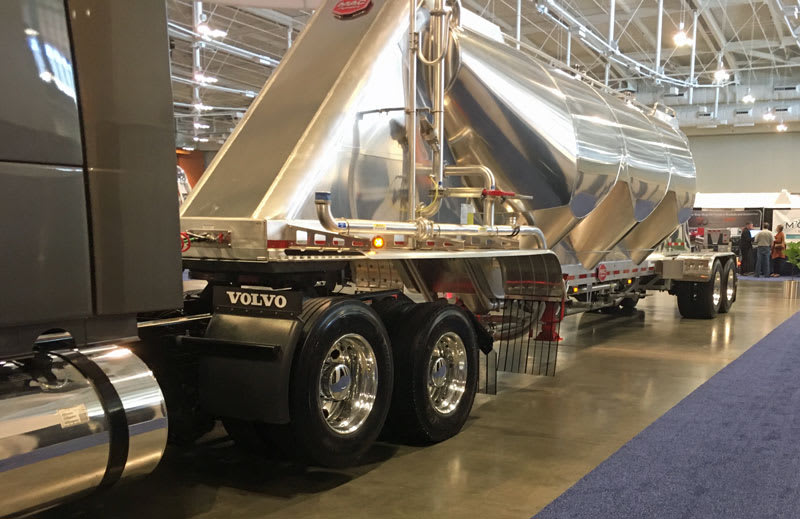
Regular mud flaps add drag to a typical tank trailer, but specially perforated Eco Flaps reduce it and save fuel, the company says. However, note the long fender, with a downswept rear that acts as a drag-producing sail.
Photo: Eco Flaps
Tank trailers seldom get aerodynamic treatment. Is it because their basic cylindrical shapes look like they move smoothly through the air? That might not be correct, as there’s still a lot of surface area to grab at air molecules, and ladders, walkways, and the tank’s blunt rear end all add to the drag. So do the fenders positioned above a tractor’s drive wheels (more on this in a bit).
Nonetheless, the makers of Eco Flaps, the perforated guards that allow air to pass through but still control splash and spray, thought their devices could be useful on tankers. So, in April the company commissioned a study with Exa Corporation, a developer and distributor of computer-aided engineering (CAE) software.
Exa engineers used computational fluid dynamic simulations to analyze air flow over a typical tanker surface, along with the effects of Eco’s “fly swatter” mud flaps compared to regular flaps.
The study concluded that Eco Flaps could indeed reduce drag and save fuel, said Bren Marshell, vice president of sales. The analysis simulated four different configurations in order to understand how the Eco Flaps splash guards performed when installed on a day cab tractor and tanker trailer. They were:
Baseline with conventional mud flaps on the tractor, tanker trailer, and fender
Eco Flaps splash guards on the tractor, trailer, and fender
Eco Flaps installed on the tractor and trailer, but conventional mud flaps on the fender
An equipment setup with no flaps used
The results showed a 2% improvement in drag at highway speeds when Eco Flaps were on the tractor and trailer, but conventional mud flaps remained on the fender. The use of Eco Flaps on the tractor, trailer, and fenders indicated a 2.8% improvement in drag. The total fuel savings from the full swap out is estimated at 1.4%.
“This analysis from Exa Corporation shows that utilizing Eco Flaps on all sections of the tanker truck provides drivers with the greatest fuel savings,” said Marshell. “At these numbers, drivers can achieve ROI within just three months.”
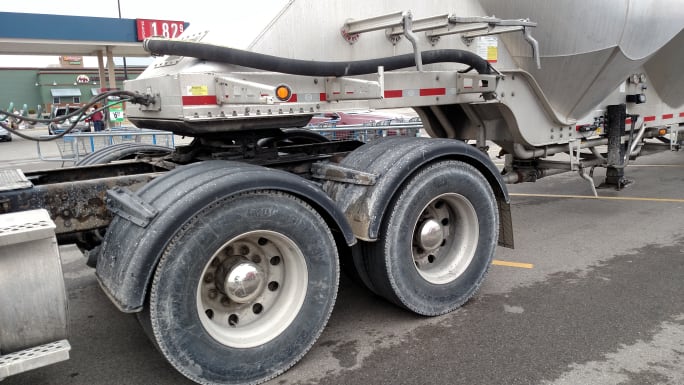
Owner of this dry-bulk tanker removed its fenders to cut drag, and relies on the tractor-mounted fenders to protect the tank from splash and spray.
Photo: Tom Berg
OK, but regarding tanker fenders: Doing away with them makes sense because they act as sails, catching high-speed air and pulling backwards on the trailer. That was the finding of fleet managers at Air Products & Chemicals, based in Pennsylvania. They removed the fenders and installed tractor-mounted polyurethane fenders over the drive wheels. These protected the tank above from splash and spray, and also weighed less than the metal fenders.
There was a fuel saving and while I can’t recall the percentage, it was enough to make the equipment change worthwhile. Building tank trailers without fenders also saved a few bucks.
Anyway, for more information about Eco Flaps, go to www.ecoflaps.com.
More Blog Posts

Pulsing Back-of-Trailer Lamps Aim to Prevent Crashes
Can the addition of a pulsing brake lamp on the back of a trailer prevent rear-end collisions? FMCSA seems to think so, if its exemptions are any indication.
Read More →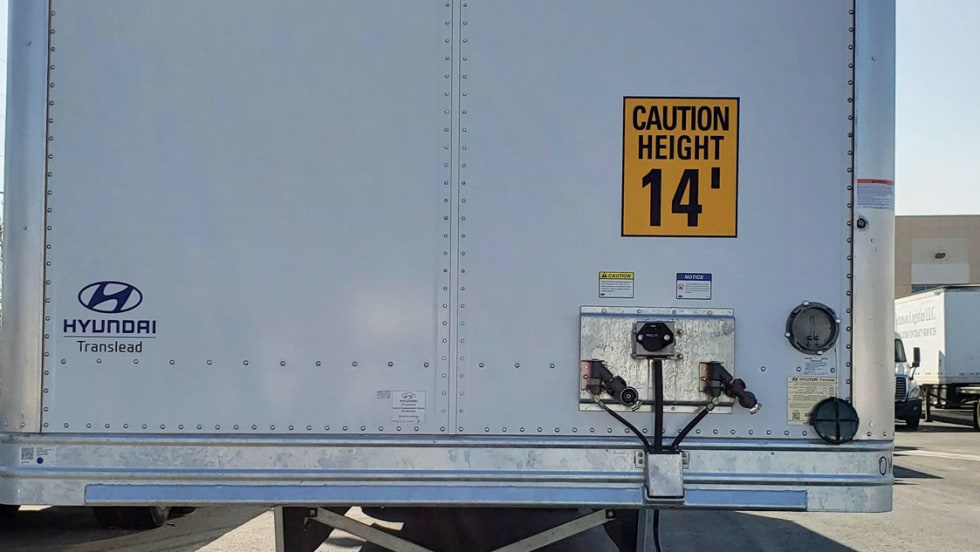
Designing a 14-Foot Trailer
Trailers are 13 feet, 6 inches high, right? Not for Hub Group, which developed a special 14-foot-high trailer spec for a dedicated customer based in California. Learn more in the Trailer Talk blog.
Read More →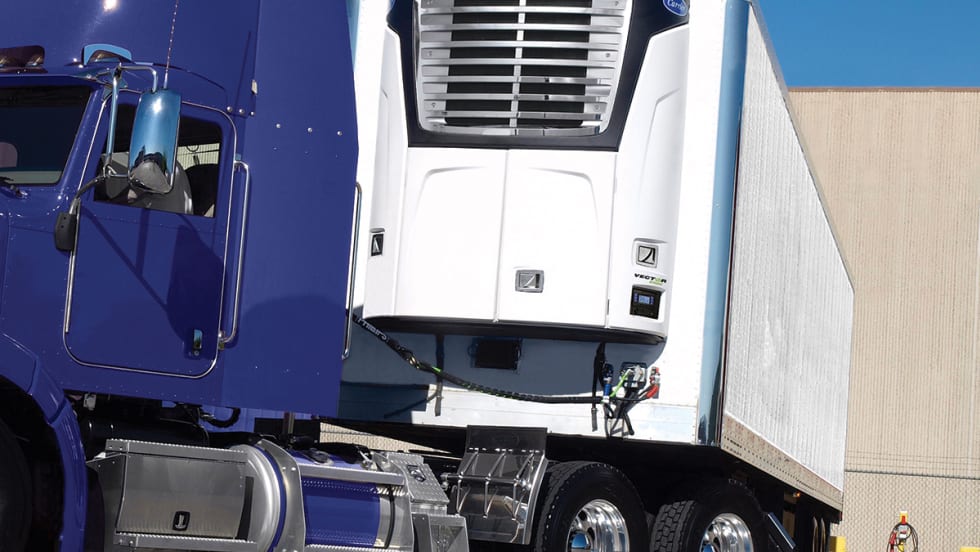
CARB Comes for Reefer Trailers
A new round of emissions control regulations decreed by the California Air Resource Board will begin affecting refrigerated trailer and TRU design and operations next year.
Read More →
5 Ways Data Analysis Maximizes the Value of Trailer Telematics
Are you getting the most out of your trailer telematics investment?
Read More →
Can You Guess What's in That Trailer?
You don’t always know what’s in the trailers that pass you on the road. But some of those trailers are carrying something a little more dangerous that frozen food or new bedding…like, maybe, a nuclear weapon. But this isn’t an ordinary trailer; this is a trailer specifically made to not only carry this type of payload, but protect it at all costs.
Read More →
How Trailers Are Harnessing 'Free' Energy
Can trailers play a more active role in sustainable transport beyond aerodynamic add-ons or low-rolling-resistance tires? Some companies think so.
Read More →
Wrapping a Trailer for COVID’s Everyday Heroes
“We don’t only deliver freight. We deliver awareness.” That’s what Jim Barrett, president and CEO of Road Scholar Transport, likes to say about the Dunmore, Pennsylvania-based carrier’s “awareness fleet.” Its latest trailer wrap honors the everyday heroes of the pandemic.
Read More →
How a Tanker Fleet is Using Unorthodox Trailer Lighting to Fight Rear-End Collisions
Groendyke Transport watched the number of rear-end collisions with its trailers rise steadily until it tried an unorthodox and then unapproved method of alerting following drivers that its trucks were applying brakes and slowing down.
Read More →
The Role Trailers are Playing in COVID-19 Funerals
In places such as New York City and Detroit, overwhelmed hospitals and mortuaries are using refrigerated trailers to store the bodies of people killed by COVID-19.
Read More →
Reefer Trailer Aims to Help Reach Zero Emissions
Wabash National is partnering with C&S Wholesale Grocers to test a new type of zero-emissions refrigerated trailer.
Read More →