




Passing Thru Zanesville: Forlorn Trailers, the ‘Y-Bridge’ and a ‘Telltale’ Warning
Tom Berg see items of trucker interest in old Zanesville, Ohio, along the historic National Road.

The other day my wife and I drove over to Zanesville, Ohio, about an hour east of Columbus by way of Interstate 70. And as I usually do when I get over there, I exited the freeway at U.S. 40, which follows some of the path of the old National Road, the USA’s first federally funded highway. Forty cuts right through downtown in this old and once important city.
Just as we approached town from the west, we came upon a graveyard of old trailers, parked haphazardly and in neat rows, just sitting there in the snow and cold. Some still proclaimed their one-time owners’
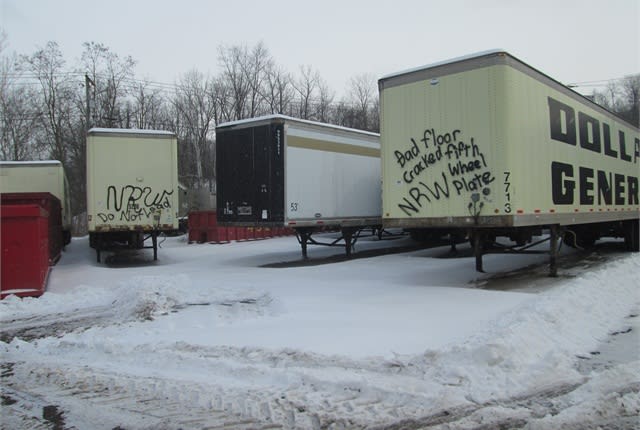
names, but most were anonymous, like homeless men of undeterminable age you see sadly sprawled on sidewalks and in doorways in otherwise prosperous metro areas.
I got to thinking, what did these forlorn vans and reefers once haul, for how many miles behind what kind of smoke-spewing dee-zel trucks driven by how many squinty eyed, cigarette-puffin’, grizzled ol’ gearheads?
And why were all those trailers – maybe 20 of ‘em here and another 10 or so just down the road – parked here? Did an eccentric entrepreneuer think there was still some use to be gotten from these things, in spite of the spray painted warnings of serious damage on some of them?
Did someone harbor some vague plan to repair and resell them, or believe as only a hoarder could, “Lookit all that iron an’ aluminum, that’s worth somethin’” ? It appears no one ever got far with any schemes he might’ve had for them, because the hulks seemed to be exactly as they were when they were dropped there, who knows how many years ago. There was no one around to ask on this Sunday afternoon, and I kinda doubt anyone’s been there in a while.
We continued on into town, where I turned left at the fork in the famous – around here, anyway – “Y-Bridge” over the confluence of the Licking and Muskingum Rivers. Pioneers built the first one in 1814 to carry the National Road over the wide waterway; subsequent covered wooden spans were washed away in floods, and the current steel-and-concrete
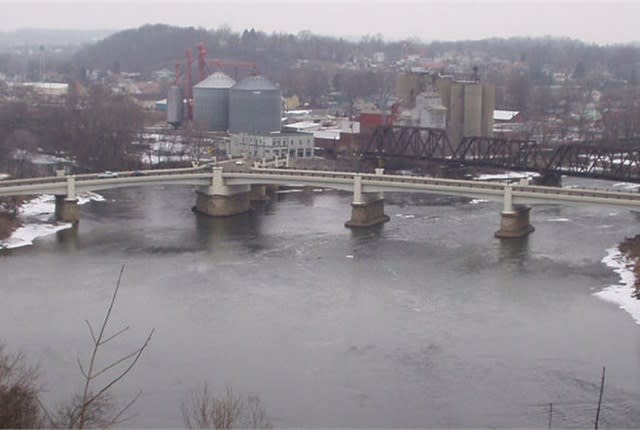
structure from 1984 is on the National Register of Historic Places. There might be other Y-bridges in the world, but I don’t know where.
We were now northbound on Linden Avenue and headed for something no trucker ever wants to suddenly see: a low overpass. I mean really low – 9 feet, 7 inches over the main lanes, and a more generous 12 feet, 5 inches above a bypass that seems to have been cut into the earth and paved years after the original roadway was built.
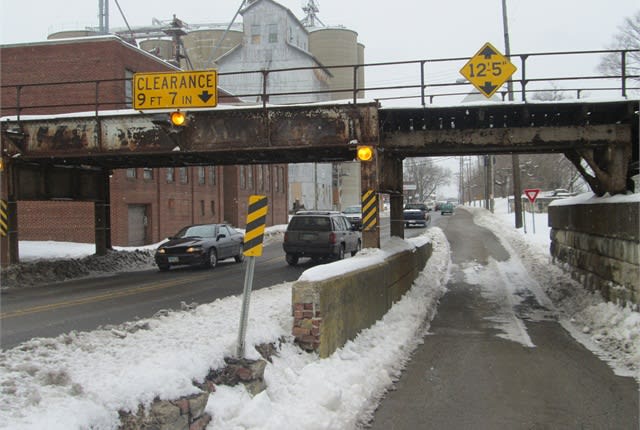
A flatbed, tanker or grain trailer would fit through the bypass, but no modern 13-6 van or reefer would. If a guy is confronted by this, there’s only one thing to do (after hitting the brakes): Turn on the flashers, shift into reverse, and hope that motorists will move out of his way. Chances are somebody would call the cops who’d help, and then maybe write him up for not observing the warning sign up the street.
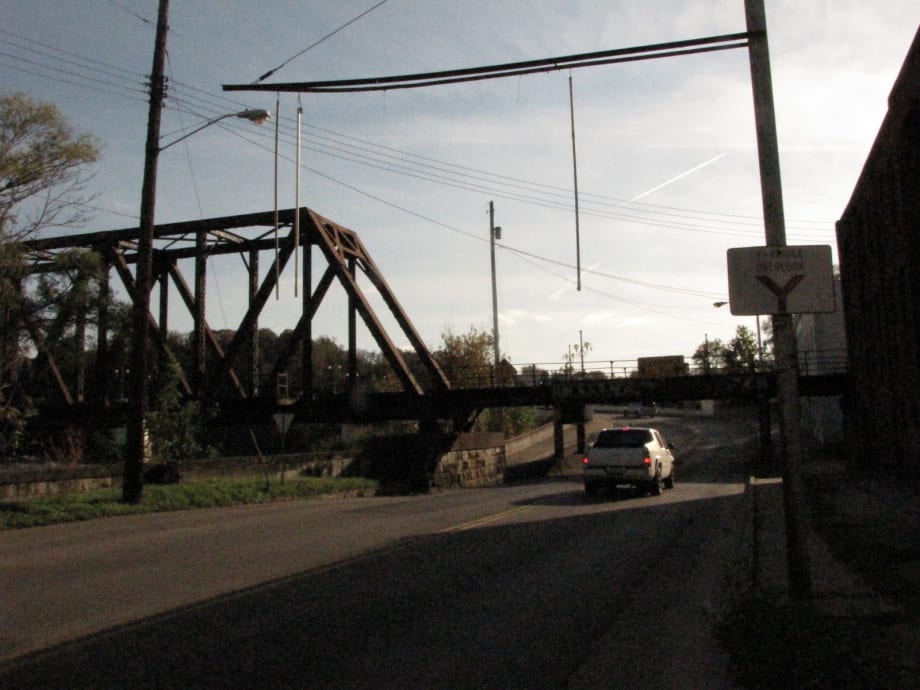
Southbound traffic on Linden Avenue has no bypass, so the 9-4-high (or low) steel girders that carry a rail line overhead must be contended with. In the afternoon sun, more than one trucker must’ve rammed into the bridge, so, aside from the usual yellow signs on the structure itself, maybe 60 feet ahead of it, is what's left of a set of hanging poles.
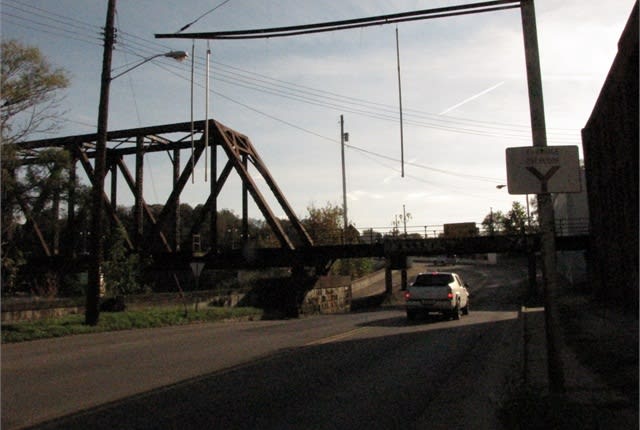
I shot this photo on one of the last nice days of autumn, just a few weeks beforer the snow started coming (it's been a rough winter).
The poles look like PVC pipe, and they’ll smack the roof fairing of any long-and-tall sleeper-cab tractor whose driver has blundered onto this street. And if the tractor or truck is short enough, they’ll bang on the nose of any tall trailer. They'll get his attention and whoops – on the binders, buddy!
I’ve never seen one of these devices on any roadway anywhere else, and know it by only one name: a “telltale.” That’s a railroad term for a similar warning device placed ahead of tunnels and other low-overhead obstructions.
In the old days before air brakes, brakemen had to run along the roofs of boxcars, hand-setting or releasing brakes; if they weren’t watching where the train was headed and got slapped by the ropes or leather straps of a telltale, they knew to lay right down or lose their heads.
And there this thing is, hanging over a street in old Zanesville, just a couple of blocks from the Y-Bridge. If you pass through town, you’ll probably be on I-70 and will never see it. But I thought you’d like to.
More Blog Posts

Pulsing Back-of-Trailer Lamps Aim to Prevent Crashes
Can the addition of a pulsing brake lamp on the back of a trailer prevent rear-end collisions? FMCSA seems to think so, if its exemptions are any indication.
Read More →
Designing a 14-Foot Trailer
Trailers are 13 feet, 6 inches high, right? Not for Hub Group, which developed a special 14-foot-high trailer spec for a dedicated customer based in California. Learn more in the Trailer Talk blog.
Read More →
CARB Comes for Reefer Trailers
A new round of emissions control regulations decreed by the California Air Resource Board will begin affecting refrigerated trailer and TRU design and operations next year.
Read More →
5 Ways Data Analysis Maximizes the Value of Trailer Telematics
Are you getting the most out of your trailer telematics investment?
Read More →
Can You Guess What's in That Trailer?
You don’t always know what’s in the trailers that pass you on the road. But some of those trailers are carrying something a little more dangerous that frozen food or new bedding…like, maybe, a nuclear weapon. But this isn’t an ordinary trailer; this is a trailer specifically made to not only carry this type of payload, but protect it at all costs.
Read More →
How Trailers Are Harnessing 'Free' Energy
Can trailers play a more active role in sustainable transport beyond aerodynamic add-ons or low-rolling-resistance tires? Some companies think so.
Read More →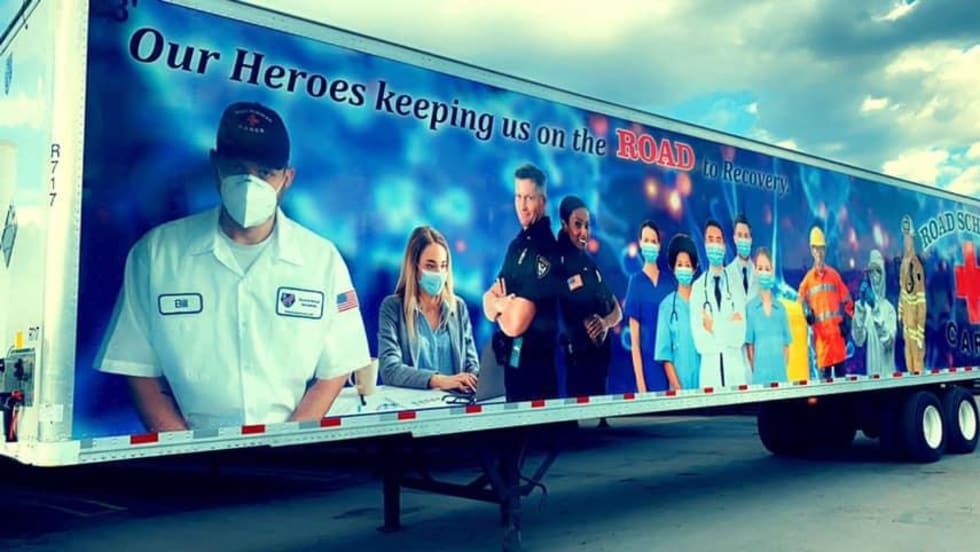
Wrapping a Trailer for COVID’s Everyday Heroes
“We don’t only deliver freight. We deliver awareness.” That’s what Jim Barrett, president and CEO of Road Scholar Transport, likes to say about the Dunmore, Pennsylvania-based carrier’s “awareness fleet.” Its latest trailer wrap honors the everyday heroes of the pandemic.
Read More →
How a Tanker Fleet is Using Unorthodox Trailer Lighting to Fight Rear-End Collisions
Groendyke Transport watched the number of rear-end collisions with its trailers rise steadily until it tried an unorthodox and then unapproved method of alerting following drivers that its trucks were applying brakes and slowing down.
Read More →
The Role Trailers are Playing in COVID-19 Funerals
In places such as New York City and Detroit, overwhelmed hospitals and mortuaries are using refrigerated trailers to store the bodies of people killed by COVID-19.
Read More →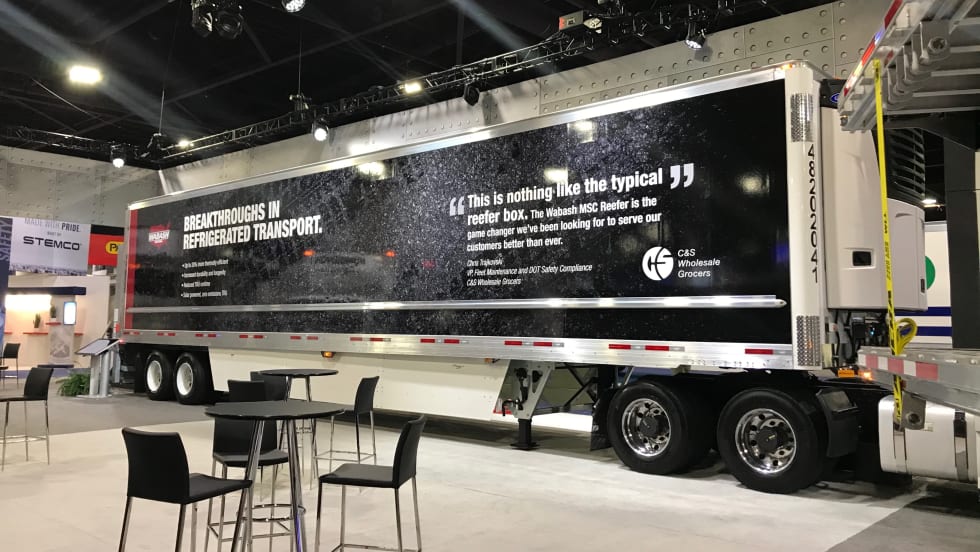
Reefer Trailer Aims to Help Reach Zero Emissions
Wabash National is partnering with C&S Wholesale Grocers to test a new type of zero-emissions refrigerated trailer.
Read More →