




How Important are Claims About Towing Capacity?
Senior Editor Tom Berg branches out a bit in his Trailer Talk blog this week to talk about how much trailer load heavy pickups can haul. In a demonstration a couple of weeks ago, Ford pitted a pair of Power Stroke-powered F-450 pickups against a Ram 3500 dually pickup with a Cummins Turbo Diesel to demonstrate towing capacity.

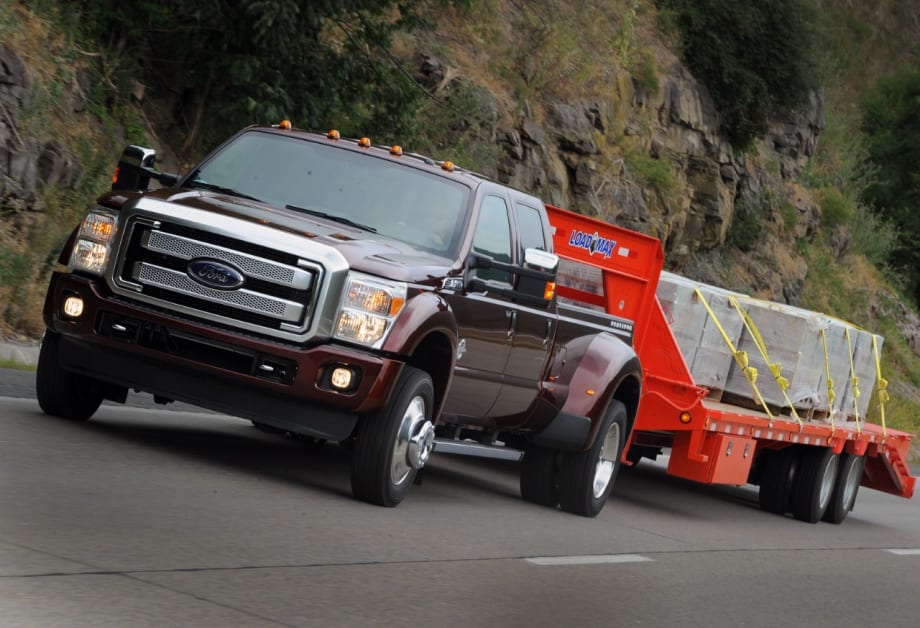
The latest truck maker to claim towing capacity superiority is Ford, which has upped the horsepower and torque of its Power Stroke V-8 diesel to propel an F-450 pickup and a trailer as heavy as 31,200 pounds.
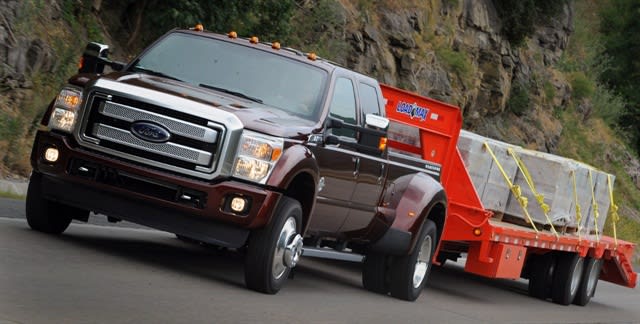
The latest truck maker to claim towing capacity superiority is Ford, which has upped the horsepower and torque of its Power Stroke V-8 diesel to propel an F-450 pickup and a trailer as heavy as 31,200 pounds.
UPDATED -- How much does trailer-towing capacity mean to buyers of heavy pickup trucks? Over the years, the Big Three domestic auto and truck makers have made big-poundage claims that indicate it’s pretty important to them. They believe that many customers consider towing as one of their most important considerations in picking a pickup.
The latest one to claim superiority is Ford, which has upped the horsepower and torque of its Power Stroke V-8 diesel, to 440 horses and 860 pounds-feet, to propel an F-450 pickup and a gooseneck trailer as heavy as 31,200 pounds. Ford marketers proclaim that this is “best in class.”
What class is it? In a specs box on Ford’s media website last week, an F-450 diesel dually’s gross vehicle weight rating was listed as 14,500 pounds, which put it in Class 4. That’s what I reported in an earlier version of this blog.
In a demonstration a couple of weeks ago, Ford pitted a pair of F-450 pickups against a Ram 3500 dually pickup with a high-output Cummins Turbo Diesel, which had a GVW of 14,000 pounds, or Class 3. That caused Ram people to protest Ford’s claim, arguing that their 3500 should’ve been compared to an F-350.
After the original version of the blog was posted, a Ford spokesman called to say the 14,500 figure was a typo, that the correct GVW rating is 14,000. (It's been fixed on the Ford website.) Fourteen thousand is what the F-450’s been certified and registered as with government officials, he said.
But 14,000 is also an F-350’s GVWR. Why is that? Because the F-350 emphasizes payload while the F-450 pickup emphasizes towing, he explained. The F-450 pickup’s frame is the same as the F-350’s, with bowed frame rails, but the 450 has axle, suspension, brake and wheel upgrades. (The F-450 cab-chassis truck has straight frame rails and higher GVW ratings).
Anyway, the point is the tow rating, and the Ram is close at 30,000 pounds. For that and other reasons it’s a fair matchup, the spokesman said, and Ford wins with 1,200 more pounds of towing ability.
Ram people also say Ram’s 3500 competes against Ford’s F-350, not the F-450. (Looking at the model badges, that seems to make sense.) And the F-350’s tow rating is 26,700 pounds, or 3,300 less than the Ram 3500’s. Ram further notes that it uses a Society of Automotive Engineers procedure to arrive at tow ratings, while Ford does not.
Not yet in the SuperDuty pickups, the Ford spokesman said, but it will use the SAE procedure when they are redesigned. Ford began phasing in the procedure with lighter-duty products, and used it in setting the tow rating of the F-150.
Meanwhile, General Motors chooses not to get involved in this latest spat because, a spokesman told Automotive News, the argument is “meaningless to 99.9% of customers.”
I tend to agree, but would put the percentage lower because customers loyal to one make or another might care a lot about those numbers, in pounds or horsepower. The numbers are things to brag about, even if customers seldom pull trailers that heavy.
Extra power allows a guy to blow by slower traffic on a long upgrade, whether it’s a really heavy semi or a chump with an inferior pickup. That’s fun, even if it’s a little silly.
Regarding the number claims, shouldn’t a customer simply determine his towing needs, then buy the make and model that will handle the job and otherwise make him happy? If there’s a manufacturers’ dispute over numbers, look at the specifications rather than the model badge.
And check to be sure there are no typos.
More Blog Posts
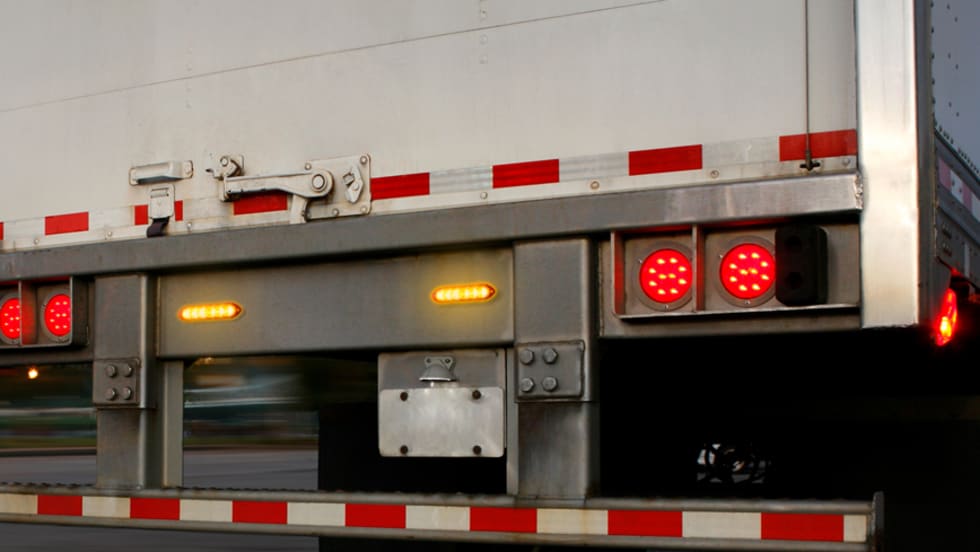
Pulsing Back-of-Trailer Lamps Aim to Prevent Crashes
Can the addition of a pulsing brake lamp on the back of a trailer prevent rear-end collisions? FMCSA seems to think so, if its exemptions are any indication.
Read More →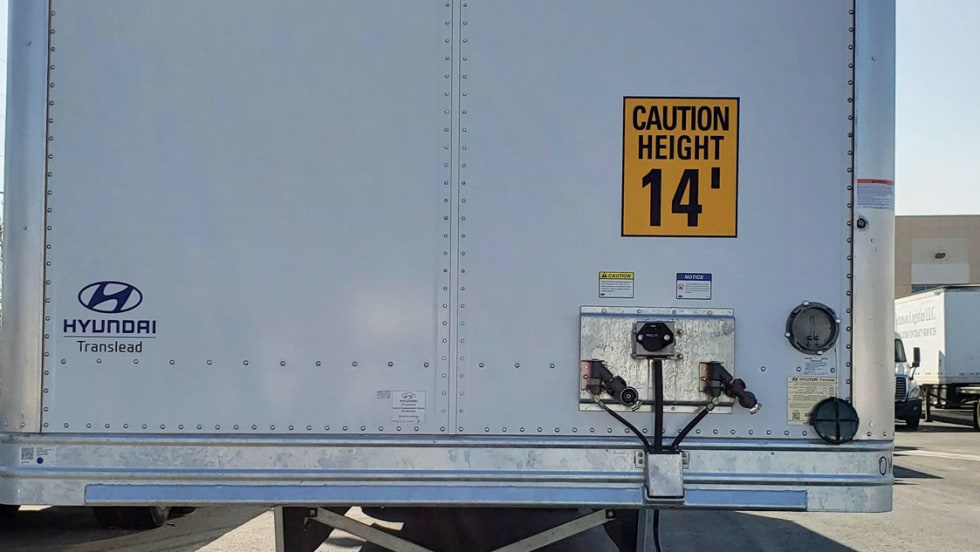
Designing a 14-Foot Trailer
Trailers are 13 feet, 6 inches high, right? Not for Hub Group, which developed a special 14-foot-high trailer spec for a dedicated customer based in California. Learn more in the Trailer Talk blog.
Read More →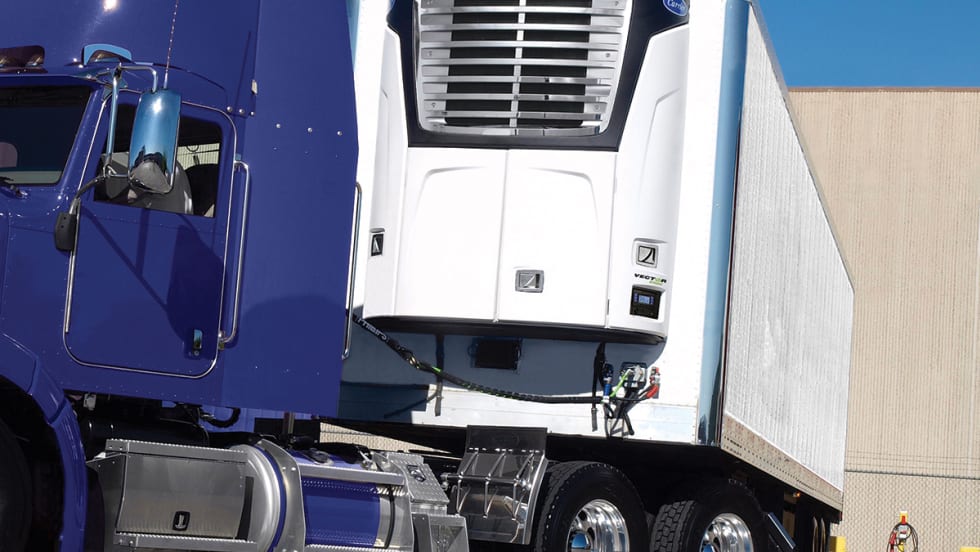
CARB Comes for Reefer Trailers
A new round of emissions control regulations decreed by the California Air Resource Board will begin affecting refrigerated trailer and TRU design and operations next year.
Read More →
5 Ways Data Analysis Maximizes the Value of Trailer Telematics
Are you getting the most out of your trailer telematics investment?
Read More →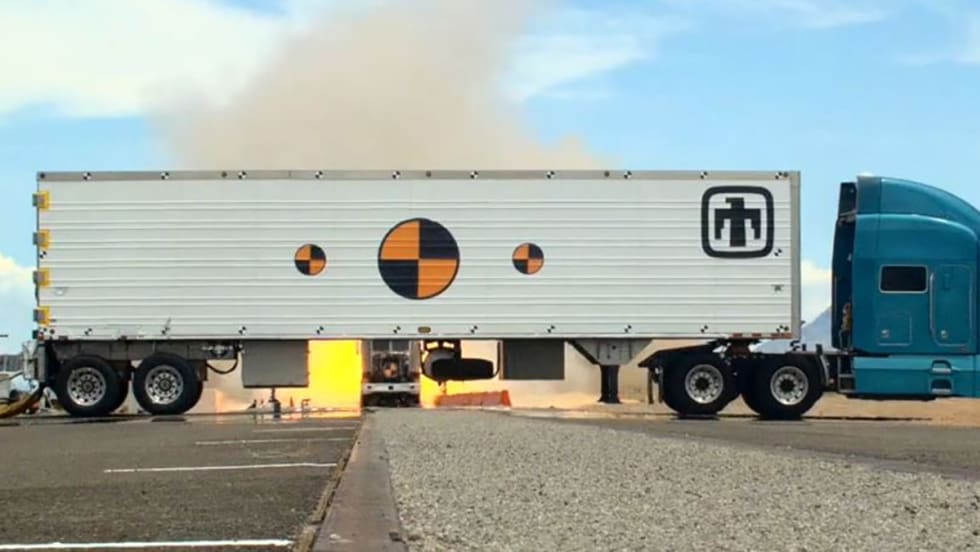
Can You Guess What's in That Trailer?
You don’t always know what’s in the trailers that pass you on the road. But some of those trailers are carrying something a little more dangerous that frozen food or new bedding…like, maybe, a nuclear weapon. But this isn’t an ordinary trailer; this is a trailer specifically made to not only carry this type of payload, but protect it at all costs.
Read More →
How Trailers Are Harnessing 'Free' Energy
Can trailers play a more active role in sustainable transport beyond aerodynamic add-ons or low-rolling-resistance tires? Some companies think so.
Read More →
Wrapping a Trailer for COVID’s Everyday Heroes
“We don’t only deliver freight. We deliver awareness.” That’s what Jim Barrett, president and CEO of Road Scholar Transport, likes to say about the Dunmore, Pennsylvania-based carrier’s “awareness fleet.” Its latest trailer wrap honors the everyday heroes of the pandemic.
Read More →
How a Tanker Fleet is Using Unorthodox Trailer Lighting to Fight Rear-End Collisions
Groendyke Transport watched the number of rear-end collisions with its trailers rise steadily until it tried an unorthodox and then unapproved method of alerting following drivers that its trucks were applying brakes and slowing down.
Read More →
The Role Trailers are Playing in COVID-19 Funerals
In places such as New York City and Detroit, overwhelmed hospitals and mortuaries are using refrigerated trailers to store the bodies of people killed by COVID-19.
Read More →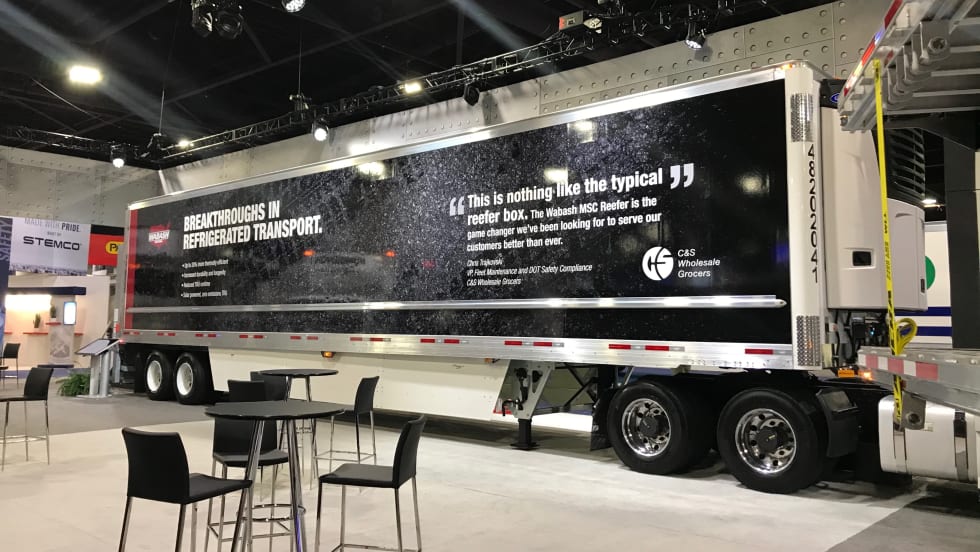
Reefer Trailer Aims to Help Reach Zero Emissions
Wabash National is partnering with C&S Wholesale Grocers to test a new type of zero-emissions refrigerated trailer.
Read More →