




Drones And the Future of Package Delivery
The Federal Aviation Administration has granted approval for Amazon to test drone delivery, but don't expect a drone on your doorstep soon.

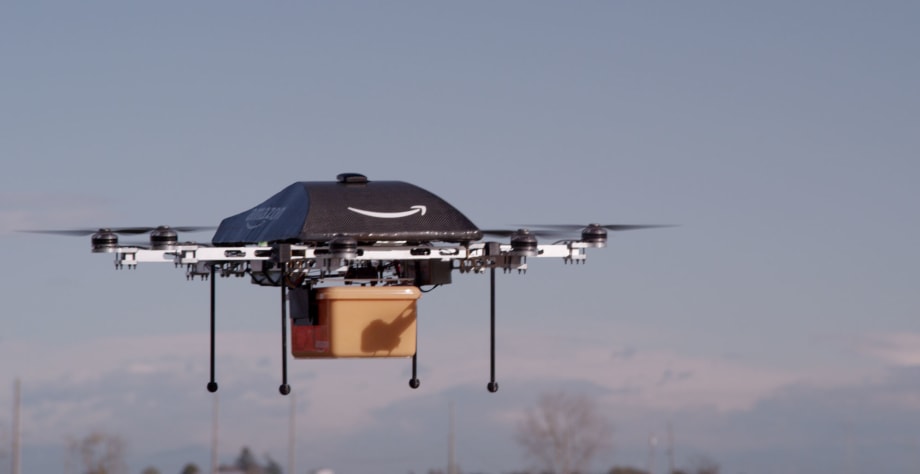
Amazon has received FAA permission to test its drones, with restrictions. Photo: Amazon
The Federal Aviation Administration has granted approval for Amazon to test drone delivery, but don't expect a drone on your doorstep soon.
FAA will allow Amazon's logistics unit to use drones for research, development and crew training. But there are a lot of restrictions -- the flights must be conducted at 400 feet or below during daylight hours. The drone must remain within the line-of-sight of the pilot, who must have at least a private pilot's certificate.
Amazon has ambitious plans for a nationwide network of delivery drones, called Amazon Prime Air. But considering the legal and technical restrictions the FAA has placed on the technology, this latest announcement is a small step indeed.
In 2012, Congress ordered the FAA to integrate drones into the skies with passenger planes by September 2015, but observers say it's not likely that's going to happen. The FAA small-drones proposal, which is open for public comment now, is expected to take 18 months to two years to complete.
To get around FAA rules, Google's drone program is experimenting abroad and Amazon began testing in the United Kingdom last year.
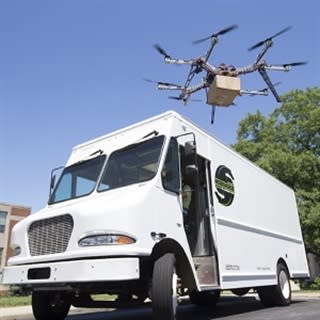
AMP Electric Vehicles' delivery-van-based drone concept may be more practical. Photo: Workhorse
But there may be a more practical way to use drones in delivery by combining them with the tried-and-true method: delivery trucks.
Mainstream media outlets such as Wired,Popular Science and "Car Talk" have been praising the HorseFly, an "octocopter" drone developed through a partnership between the University of Cincinnati and AMP Electric Vehicles, makers of the WorkHorse all-electric delivery truck.
Steve Burns, CEO of AMP, explains the process like this: The HorseFly will be positioned atop a delivery truck, awaiting a package from the driver. When loaded, the HorseFly will scan the barcode on the package, determine the path to the delivery address via GPS and fly away – completely self-guided – to the appropriate destination. Meanwhile, the delivery truck will continue on its rounds. After successful delivery, the HorseFly will zoom back to the truck for its next delivery run and, if needed, a roughly two-minute wireless recharge.
"Our premise with HorseFly is that the HorseFly sticks close to the horse," Burns says. "The fact that the delivery trucks are sufficiently scattered within almost any region during the day makes for short flights, as opposed to flying from the warehouse for each delivery."
After watching the video, the ironic thing that struck me about the HorseFly is the pairing of what seems like a fairly noisy delivery drone with the quiet of an all-electric vehicle. Nevertheless, this approach appears to have a number of advantages over the Amazon model.
As Wired put it: "There’s a big problem with the logistics of Amazon’s grand plan to deliver packages via flying drone: Sending swarms of aircraft from Amazon warehouses to American homes isn’t nearly as efficient as simply driving the packages on four wheels. But one startup’s plan to pair trucks with heavy-duty octocopters could make drone-dropped packages more than just a novelty. By working in tandem with delivery vans, drones have the potential to make shipping faster and cheaper than ever."
Meanwhile, over at Popular Science, writer Eric Sofge wrote, "HorseFly has one major advantage over Prime Air: it makes sense. From both a technological and logistical standpoint, Amp's truck-launched drone scheme is as level-headed about the realities of commercial, airborne robotics as Amazon appears to be ignorant of them."
More Blog Posts

Beyond the Central Transport Settlement: Lessons on Hiring and Risk
The $5.5 million discrimination settlement raises broader questions about hiring practices, safety performance, and the hidden risks that can lurk in a fleet's recruiting process.
Read More →
Are Diesel Shortages Something to Worry About Again?
There’s a certain déjà vu when tensions flare in the Middle East and diesel price spikes can give you panic attacks. What parallels are there between the current situation and the 1970s energy crisis?
Read More →
NOx Isn’t Laughing Gas. Let’s Clear That Up.
A recent EPA reference mixed up NOx and nitrous oxide. It’s an easy mistake. Just not one you expect to see in emissions policy. Let’s look at the difference.
Read More →
TMC 2025 Takeaway 2: Buy... or Subscribe?
TaaS. Does that mean trucks as a service, trailers as a service, or tires as a service? HDT's Deborah Lockridge has another takeaway from the Technology & Maintenance Council meeting in her blog.
Read More →
TMC 2025 Takeaway: The Journey Toward Vertical Integration
HDT's Deborah Lockridge on how the trucking industry has moved toward "vertical integration" over the past 25 years.
Read More →
Trucks Are For Girls!
HDT Editor and Associate Publisher Deborah Lockridge is a longtime Girl Scout leader and loves to connect her passion for inspiring girls with her love of the trucking industry.
Read More →
Trucking Advocacy: Impact Beyond the 2024 Elections
No matter who wins the election, trucking continues to work to educate the people who pass the laws and make the rules that affect the industry. HDT's Deborah Lockridge shares insights from two major trucking associations in her All That's Trucking blog.
Read More →
Recharge Your Brain for Better Business
Skimping on vacation may be the worst thing you can do for your business, your career, and your mental health. In her All That's Trucking blog, Deborah Lockridge writes about the importance of giving your brain what it needs to be innovative.
Read More →
Trucker Pre-Trip Leads to Mission 'Im-paw-sible'
See what happened when a truck driver found an unexpected stowaway during his pre-trip inspection.
Read More →
HDT Editor: 2023's Most Important Trucking Topics
Read Deborah Lockridge's picks for the most significant stories we covered at HDT in 2023: freight recession, zero-emission trucks, drivers and marijuana, and more.
Read More →