




Dealers Offer Maintenance Tips for Neglected Trailer Brakes
With more freight moving as the economy revives, fleets are pulling dormant trailers away from fences and putting them into service. But those trailers probably sat through at least one harsh winter and summer, and maintenance on them may have been neglected.
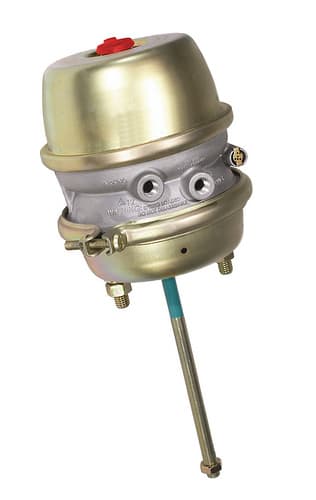
Dealers caution trailers owners to use good-quality brake chambers; this is one from TRP Aftermarket Parts, made with 10-gauge reinforced stud-mounted housing.
With more freight moving as the economy revives, fleets are pulling dormant trailers away from fences and putting them into service. But those trailers probably sat through at least one harsh winter and summer, and maintenance on them may have been neglected.
Parts specialists at some dealers suggest that a careful look at brake components, in particular, would be wise.
"When you have equipment sitting unused for extended periods of time, particularly trailers, condensation from rain penetration and snow melt can cause rust to build up," said Jason Swan, service manager of Peterbilt of Hattiesburg, Miss., one the five dealerships of the Day Dealer Group in southern Louisiana and Mississippi. "Operators should make a habit of inspecting the brakes on sidelined trailers by hooking them up to an air supply and actuating them."
"Dragging brakes and hanging brake chambers on trailers can throw the tractor out of alignment, damage the tractor's fifth wheel or cause problems in the suspension," said Jim Moore, parts manager for Kenworth of Mississippi-Jackson, part of KW of Alabama & Mississippi. He recommends that operators routinely check the brakes of sidelined trailers for rust at the parking brake side and the mounting bolts. If rust or any other structural damage is present, the brake chamber must be replaced.
"However, if you have problems with trailer brakes and no structural damage or rust is present on the emergency brake side, the brakes may just require adjustment or the air system may need to be checked," he said. "Also inspect movement of the brake cams. Hanging cams can cause all sorts of problems with brake chambers."
Quality components should be used for any replacements, the two managers agree. Their dealerships are among those who sell brake components distributed by TRP Aftermarket Parts, an arm of Paccar Inc., parent of Kenworth and Peterbilt. Aside from stout construction, TRP brake chambers have a colored stroke indicator that makes it easier for operators and mechanics to identify the need for a brake adjustment, Moore said.
Signs of Trouble
If trailer air valves are leaking, don't replace them without first checking to see if the diaphragms in the brake chambers are leaking. Over time the diaphragms can rot and leak as well, he said.
If the service diaphragm is leaking, it can be replaced without going to the expense of replacing the entire brake chamber assembly. A leaking emergency diaphragm means the entire brake chamber assembly should be replaced.
When a trailer brake is frozen, it's a sign of further brake trouble, said Swan at Peterbilt of Hattiesburg. A visual inspection needs to be done to determine if the problem is the result of brake shoes sticking to brake drums or the result of a brake chamber problem. Dirt and other contamination can also cause internal wear.
"Chemicals used in de-icing roads, such as magnesium chloride, can be very corrosive and eat through metal," Swan said. "The best way to prevent corrosion damage is to wash the trailer undercarriage regularly."
"Some of the biggest problems we see on trailers are associated with trailer brakes and result from the actions of inattentive drivers," said David Undernehr, inventory control manager for Peterbilt of Hattiesburg. "If a driver isn't careful when he's backing into a dock, he could miss the dock, allowing the dock lock to hit the brake chamber, damaging it or tearing it off."
"Using inferior brake chambers on trailers can also lead to major problems," he said. If the bolts holding the brake chamber to the bracket pull through the base of the chamber, that's usually a sign of a poor quality brake chamber made of lighter gauge steel.
More Blog Posts

Pulsing Back-of-Trailer Lamps Aim to Prevent Crashes
Can the addition of a pulsing brake lamp on the back of a trailer prevent rear-end collisions? FMCSA seems to think so, if its exemptions are any indication.
Read More →
Designing a 14-Foot Trailer
Trailers are 13 feet, 6 inches high, right? Not for Hub Group, which developed a special 14-foot-high trailer spec for a dedicated customer based in California. Learn more in the Trailer Talk blog.
Read More →
CARB Comes for Reefer Trailers
A new round of emissions control regulations decreed by the California Air Resource Board will begin affecting refrigerated trailer and TRU design and operations next year.
Read More →
5 Ways Data Analysis Maximizes the Value of Trailer Telematics
Are you getting the most out of your trailer telematics investment?
Read More →
Can You Guess What's in That Trailer?
You don’t always know what’s in the trailers that pass you on the road. But some of those trailers are carrying something a little more dangerous that frozen food or new bedding…like, maybe, a nuclear weapon. But this isn’t an ordinary trailer; this is a trailer specifically made to not only carry this type of payload, but protect it at all costs.
Read More →
How Trailers Are Harnessing 'Free' Energy
Can trailers play a more active role in sustainable transport beyond aerodynamic add-ons or low-rolling-resistance tires? Some companies think so.
Read More →
Wrapping a Trailer for COVID’s Everyday Heroes
“We don’t only deliver freight. We deliver awareness.” That’s what Jim Barrett, president and CEO of Road Scholar Transport, likes to say about the Dunmore, Pennsylvania-based carrier’s “awareness fleet.” Its latest trailer wrap honors the everyday heroes of the pandemic.
Read More →
How a Tanker Fleet is Using Unorthodox Trailer Lighting to Fight Rear-End Collisions
Groendyke Transport watched the number of rear-end collisions with its trailers rise steadily until it tried an unorthodox and then unapproved method of alerting following drivers that its trucks were applying brakes and slowing down.
Read More →
The Role Trailers are Playing in COVID-19 Funerals
In places such as New York City and Detroit, overwhelmed hospitals and mortuaries are using refrigerated trailers to store the bodies of people killed by COVID-19.
Read More →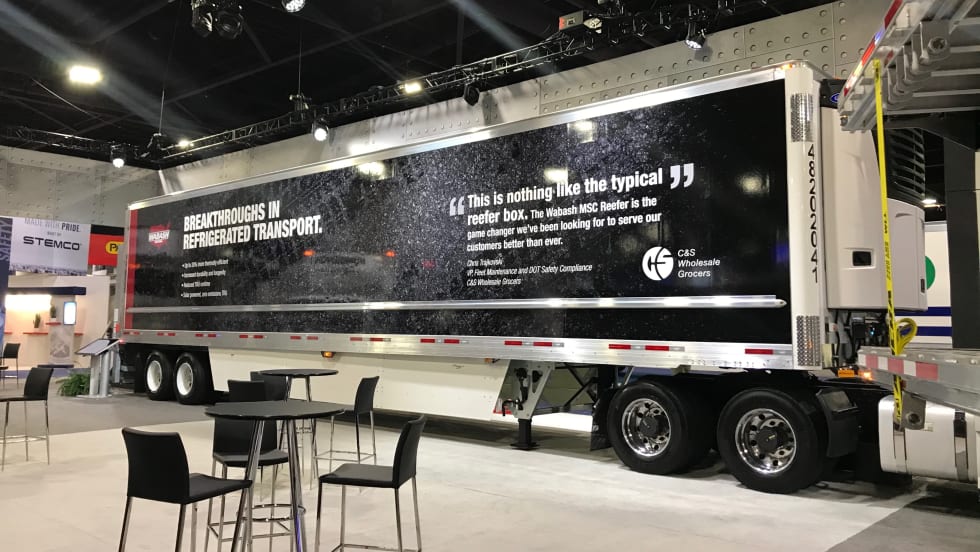
Reefer Trailer Aims to Help Reach Zero Emissions
Wabash National is partnering with C&S Wholesale Grocers to test a new type of zero-emissions refrigerated trailer.
Read More →