




Cold in Roanoke, a Shiny Overnite Rig, and a Volunteer Named Wizzy. How About That?
Piggyback and container trains were running on an O-gauge model railroad, and little big rigs were backed into loading docks, just like in the real world.

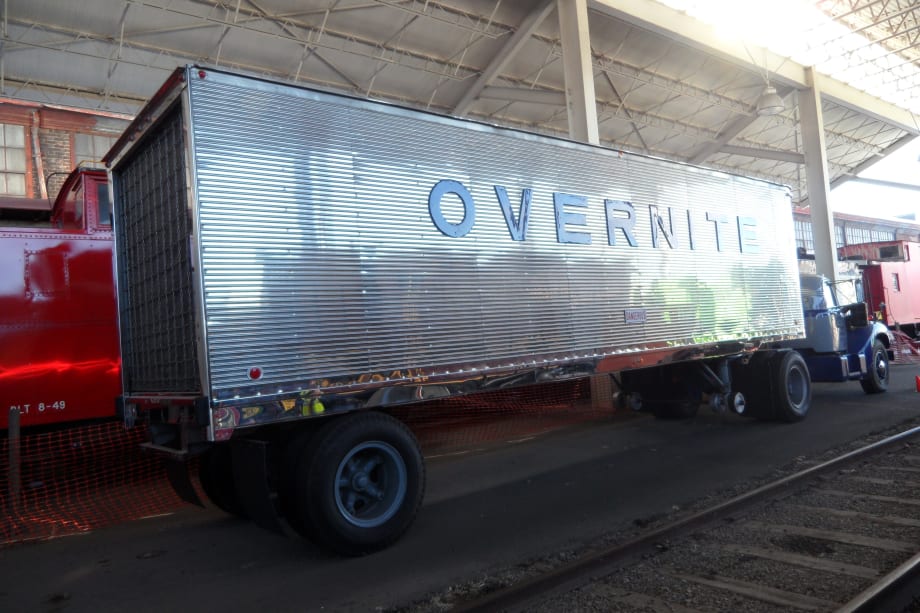
Stainless steel sides of '47 Fruehauf were so bight it was difficult to shoot a photo.
Ever think of Roanoke, Va., as a cold place? It is since “Son of Polar Vortex” swept in. As I write this it’s 23 degrees F with a strong breeze, which makes for a wind chill of what feels like zero. I know because I’m from Up North where it’s colder.
Yes, it’s a lot colder in Minnesota and North Dakota, but I just hoofed the six blocks from the Transportation Museum of Virginia to the Hotel Roanoke and am warming up in my room. The walk to the museum was worse because I faced the wind most of the way.
I spent a few hours wandering around looking at trains, planes and automobiles, as well as a few trucks. This is primarily a place for railroad buffs; there’s a lot of history in photos and short essays on the walls, and a recreation of an old city street with store-front facades.
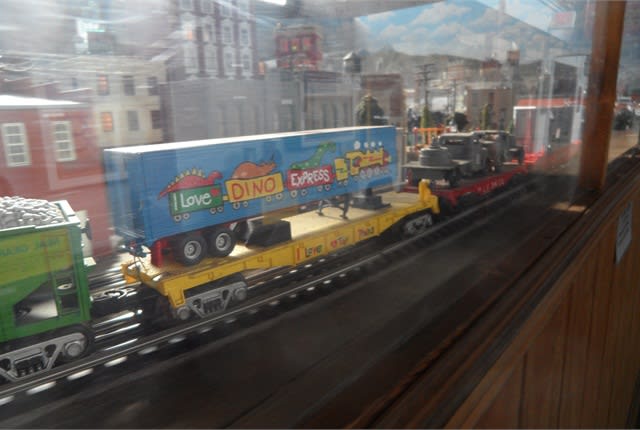
Piggyback is part of the O-gauge model railroad's operation.
Up front there's a large O-gauge model railroad on which piggyback and container trains were running, and tiny rigs are backed into loading docks, just like in the real world.
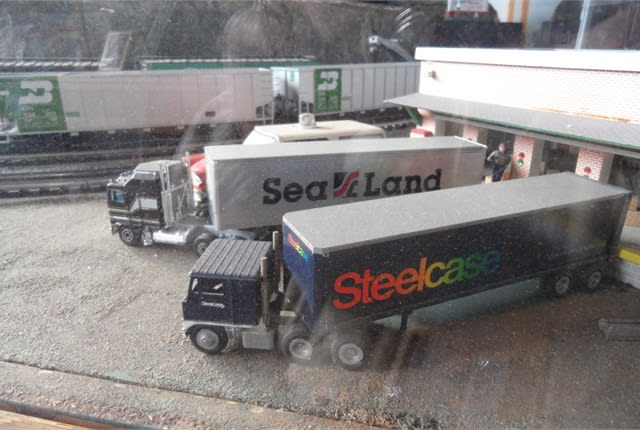
Little big rigs are backed into loading docks, like in real life.
There are a few real trucks, too. Some are Ford Model AA and B pickups from the late 1920s and ‘30s. These are part of an “automobile gallery” inside the building. Outside in the cold, slid in between rows of old steam and diesel-electric locomotives, are a few commercial vehicles.
Most noteworthy is the one you see here: A 1947 Fruehauf round-nosed semitrailer, maybe a 35-footer, hitched to a ’60 Mack B42 tractor, all lettered for the old Overnite Transportation.
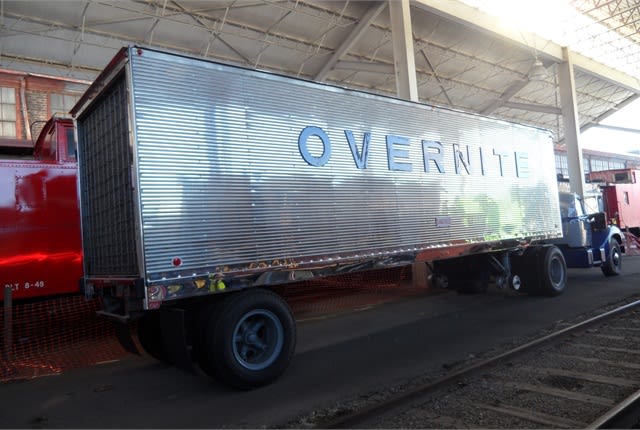
Stainless steel sides of '47 Fruehauf were so bight it was difficult to shoot a photo.
The trailer’s rear-end is chromed and spotless, and its polished stainless-steel sides gleam in the sun. They’re so shiny that I had trouble photographing the trailer. The Mack tractor wears the old blue-and-grey paint scheme and is likewise in show condition.
Overnite’s working rigs absolutely never looked like this, I can tell you. I’d see them on my travels 20 and 30 years ago and frowned at how dirty they usually were. While riding my motorcycle, I got behind them too often on southern California’s freeways and got the full effect of the tractors’ smoky exhaust billowing out from under the trailers.
Shortly after Overnite was sold to the Union Pacific Railway in 1987 by its founder, J. Harwood Cochrane, I interviewed him in his office in Richmond. The UP kept him on during a transition period, after which he went into semi-retirement.
He was a wiry white-haired guy in his 80s by then, and rather proud of what he had accomplished.
He started out as a milk deliveryman at age 17 in 1929 and later formed Overnite, a less-than-truckload carrier. He built it into the largest non-union trucking company in America. A Teamster organizing drive and maybe his advancing age caused him to take a UP offer that made him a billionaire.
During our conversation I thought of his smoky rigs, and that the tractors had horizontal exhaust systems rather than vertical stacks. I asked Mr. Cochrane why.
“You don’t know?” he retorted.
“No,” I don’t,” I said.
“Public relations!” he said forcefully. “With those vertical stacks, the exhaust smoke leaves big smudges on the front corner of the trailers. The low exhaust keeps the soot away from up there and out of the public’s sight!”
Unless the public is a guy on a motorcycle who gets to breathe in that smoke, I wanted to say, but didn’t. He was the billionaire and I was just a reporter.
(UP’s management knew how to run a railroad, but found it couldn’t run a truck line, so later sold Overnite to an outfit whose managers know what they’re doing -- United Parcel Service, which changed the name to UPS Freight.)
I thought of all that as I looked at the brighter-than-life Fruehauf and Mack. Just then a museum volunteer, all bundled up against the cold and engaged with colleagues in the moving of a giant Norfolk & Western steam locomotive, happened by. She and I began yakking, first about the weather, of course, and then where we both were originally from -- Wisconsin.
And here we are in Roanoke. How about that?
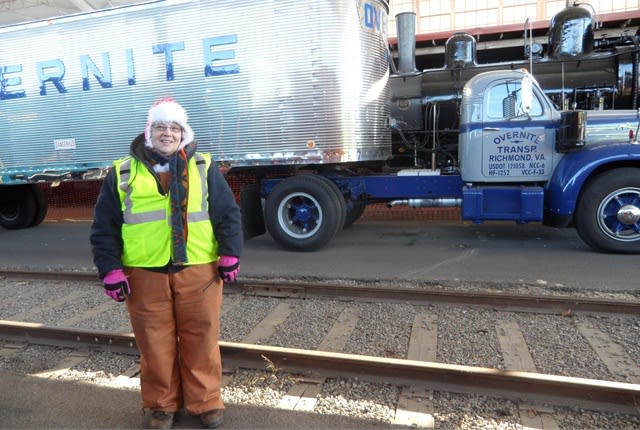
Lisa "Wizzy" Strom says museum volunteers keep the Overnite rig shined up.
Then we talked about the Overnite rig and I remarked that I recall, back in the day, seeing lots of Mack B61s, with tandem rear axles.
“Yeah,” she said.
But I don’t remember seeing a B42, I continued. That model number makes sense – four wheels with two of them driving.
“Right,” she said.
“How would you know that?” I asked her.
“My dad was a trucker. He drove for Chizek.”
“Chizek, out of Cleveland (Wis.),” I said. “Light blue-and-white tractors.”
“Yes!” How about that?
Her name is “Wizzy” Strom, but she’s Lisa when she goes back to Ashland, Wis., to visit friends and relatives. For some reason someone gave her the Wizzy nickname when she lived for a time in Oregon.
Well, the Overnite rig looks good, I said.
“Yeah, we keep it clean. About once a year we take it out from under here (we were inside a tall train shed) and out to the parking lot and drive it around, and shine it up.”
Then she had another thought.
“It was in a movie – ‘Killing Kennedy,’ on the History Channel. Did you see it?”
No, I hadn’t, but will look for it now.
“We had other vehicles in it, too. Our taxi, and some other cars, and an ambulance. It carried Kennedy’s ‘body.’ They were in toward the end.” It was filmed over in Richmond, she said.
That’s where J. Harwood Cochrane was from. How about that?
More Blog Posts
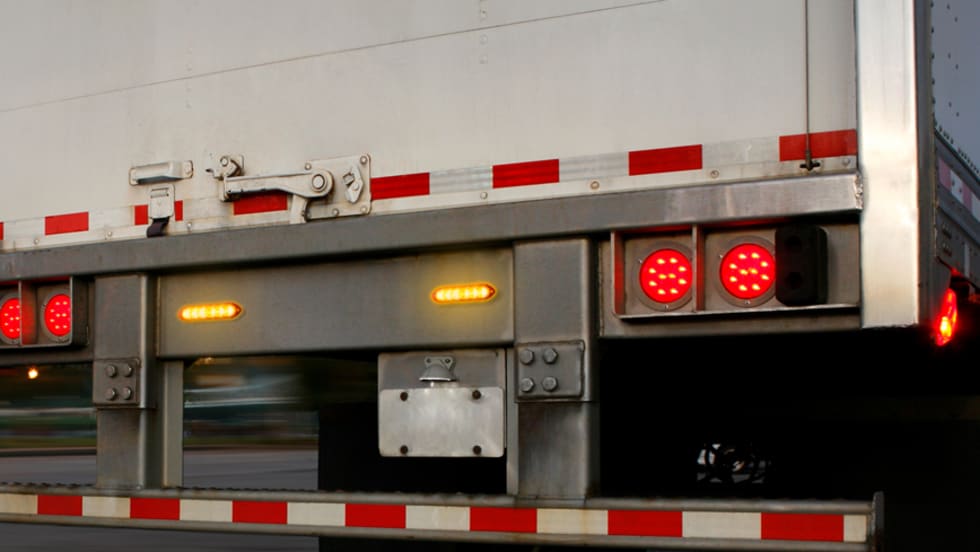
Pulsing Back-of-Trailer Lamps Aim to Prevent Crashes
Can the addition of a pulsing brake lamp on the back of a trailer prevent rear-end collisions? FMCSA seems to think so, if its exemptions are any indication.
Read More →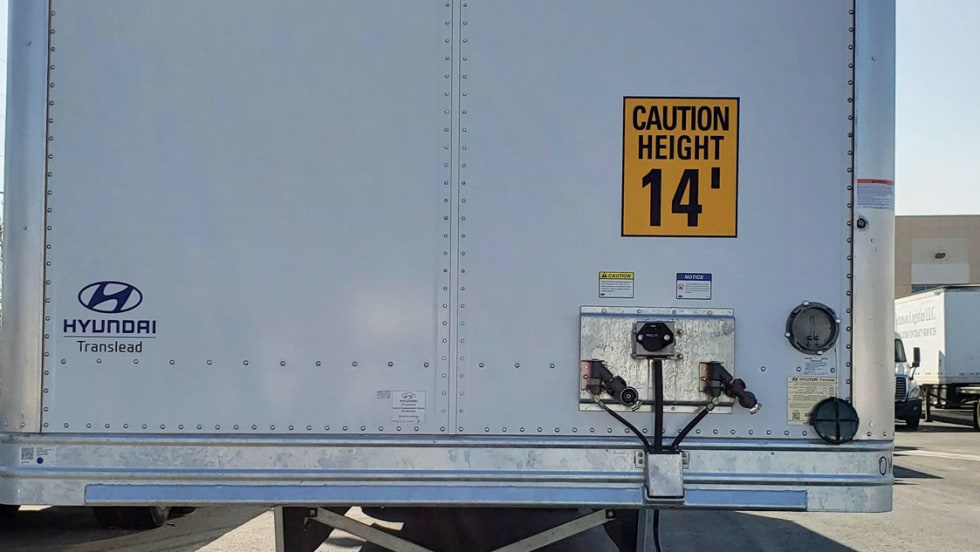
Designing a 14-Foot Trailer
Trailers are 13 feet, 6 inches high, right? Not for Hub Group, which developed a special 14-foot-high trailer spec for a dedicated customer based in California. Learn more in the Trailer Talk blog.
Read More →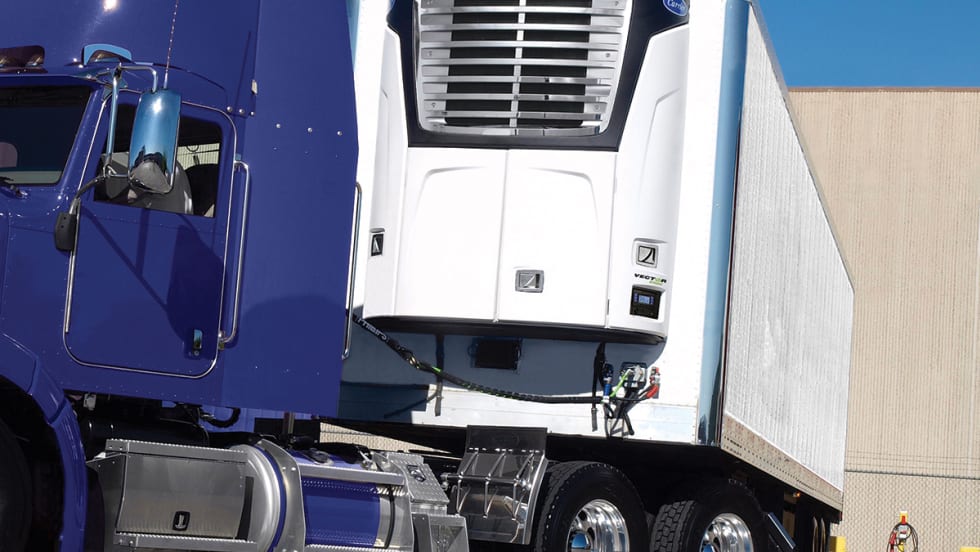
CARB Comes for Reefer Trailers
A new round of emissions control regulations decreed by the California Air Resource Board will begin affecting refrigerated trailer and TRU design and operations next year.
Read More →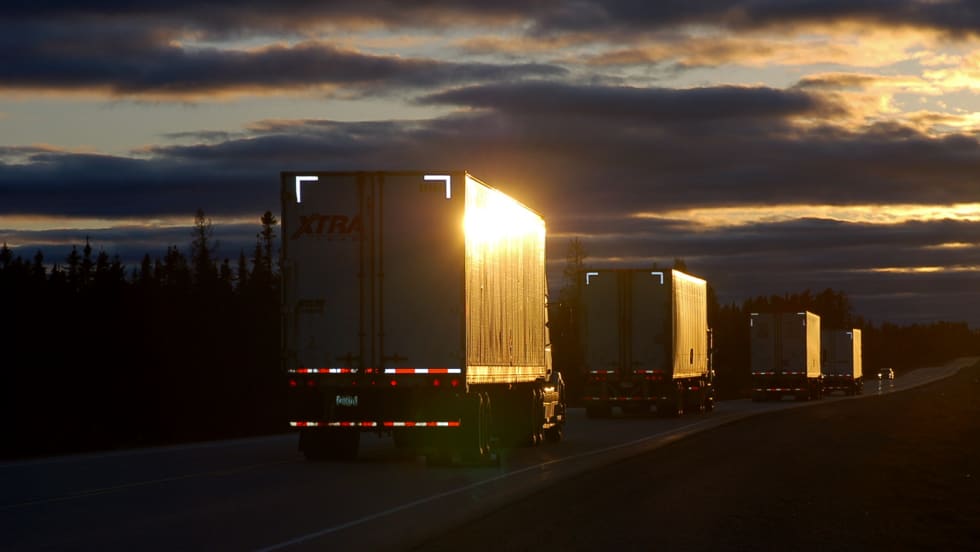
5 Ways Data Analysis Maximizes the Value of Trailer Telematics
Are you getting the most out of your trailer telematics investment?
Read More →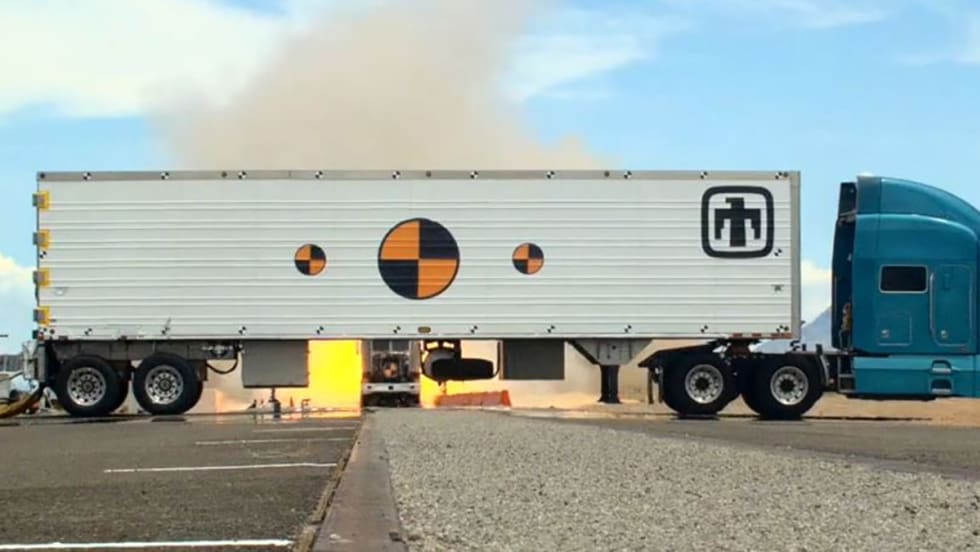
Can You Guess What's in That Trailer?
You don’t always know what’s in the trailers that pass you on the road. But some of those trailers are carrying something a little more dangerous that frozen food or new bedding…like, maybe, a nuclear weapon. But this isn’t an ordinary trailer; this is a trailer specifically made to not only carry this type of payload, but protect it at all costs.
Read More →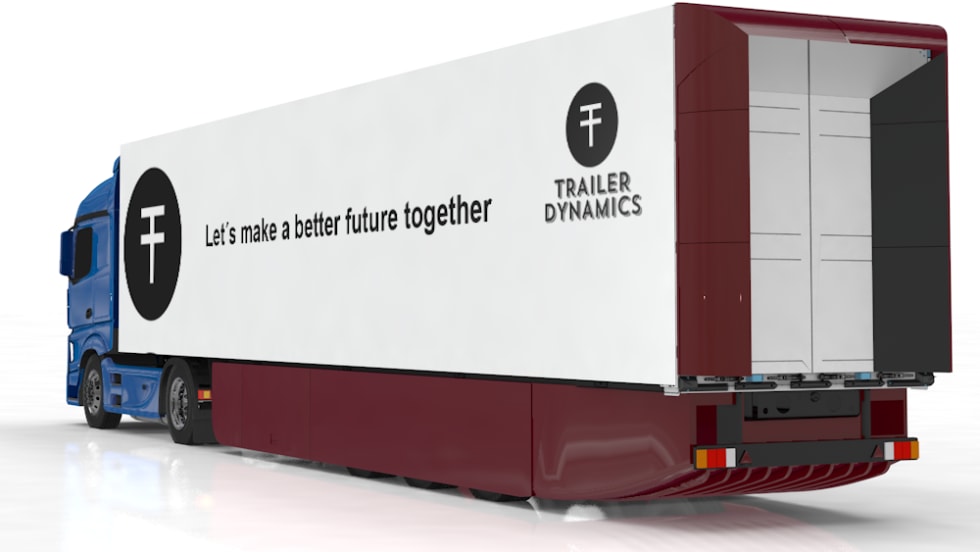
How Trailers Are Harnessing 'Free' Energy
Can trailers play a more active role in sustainable transport beyond aerodynamic add-ons or low-rolling-resistance tires? Some companies think so.
Read More →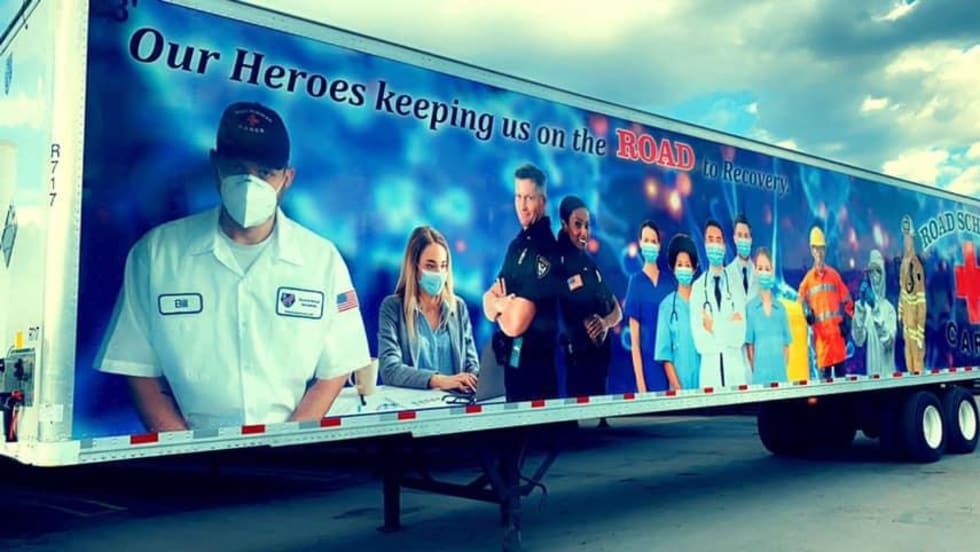
Wrapping a Trailer for COVID’s Everyday Heroes
“We don’t only deliver freight. We deliver awareness.” That’s what Jim Barrett, president and CEO of Road Scholar Transport, likes to say about the Dunmore, Pennsylvania-based carrier’s “awareness fleet.” Its latest trailer wrap honors the everyday heroes of the pandemic.
Read More →
How a Tanker Fleet is Using Unorthodox Trailer Lighting to Fight Rear-End Collisions
Groendyke Transport watched the number of rear-end collisions with its trailers rise steadily until it tried an unorthodox and then unapproved method of alerting following drivers that its trucks were applying brakes and slowing down.
Read More →
The Role Trailers are Playing in COVID-19 Funerals
In places such as New York City and Detroit, overwhelmed hospitals and mortuaries are using refrigerated trailers to store the bodies of people killed by COVID-19.
Read More →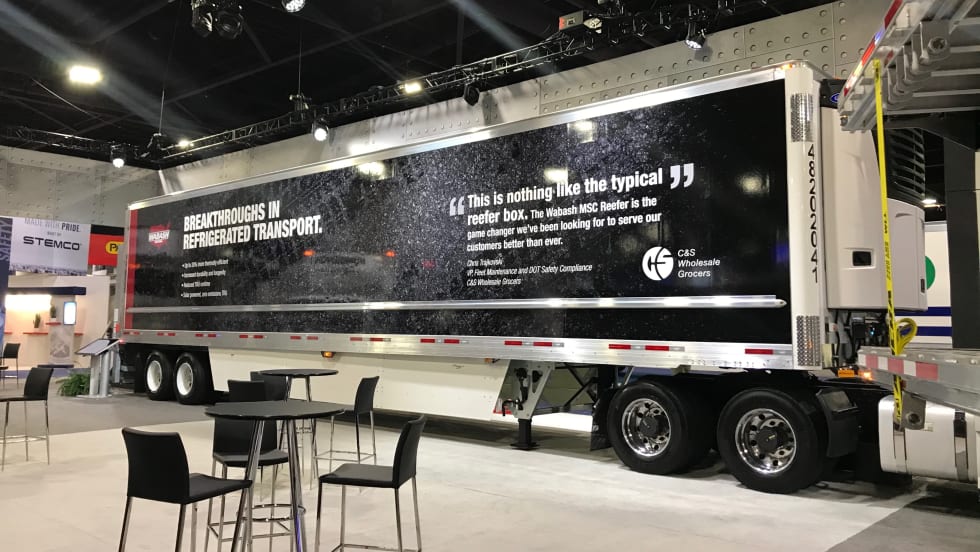
Reefer Trailer Aims to Help Reach Zero Emissions
Wabash National is partnering with C&S Wholesale Grocers to test a new type of zero-emissions refrigerated trailer.
Read More →