





Related:
CO2, Bad as a GHG, Becomes Good as a Refrigerant
The same CO2 that government regulators work to control as a greenhouse gas responsible for global warming might be embraced as a more environmentally friendly compound to keep our perishables at safe temperatures.
October 9, 2015
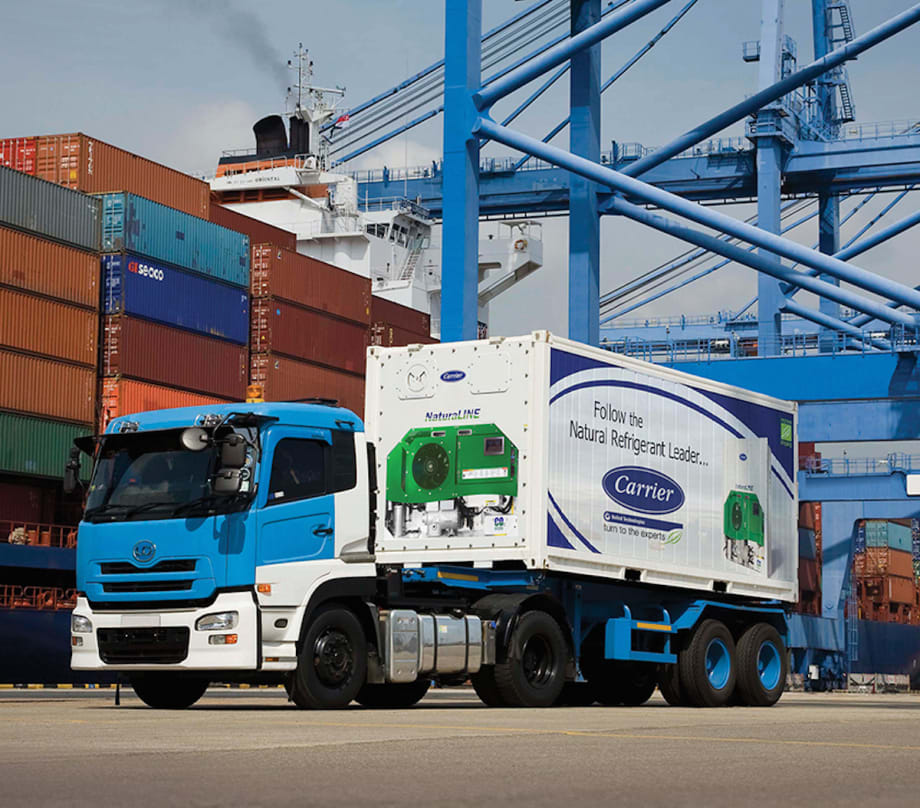
NaturaLine CO2 reefer units go to sea on containers hauling perishables. Photo: Carrier Transicold
3 min to read
NaturaLine CO2 reefer units go to sea on containers hauling perishables. Photo: Carrier Transicold
Carbon dioxide could be the next big compound used in cooling machinery in North America, including transport refrigeration. Yes, the same CO2 that government regulators work to control as a greenhouse gas responsible for global warming might be embraced as a more environmentally friendly compound to keep our perishables at safe temperatures.
CO2 is a “natural refrigerant” that’s thousands of times safer for the environment than current compounds that damage the atmosphere and the Earth as a whole, says Carrier Transicold. It’s already using CO2 as called R-744 in stationary systems in the European Union, which has approved it, and in transport refrigeration units on ocean containers.
“We are committed to expanding our proven, environmentally responsible natural refrigerant systems for road transport,” said David Appel, president, Carrier Transicold & Refrigeration Systems, in a statement issued this week. “Specifically, we are building on our expertise with the natural refrigerant carbon dioxide (CO2), which has a significantly lower global warming potential (GWP) than current synthetic refrigerants and their alternates.”
Truck and trailer reefer units in North America now use R-404A, one of a number of hydrofluorcarbon (HFC) refrigerants, Carrier explained. R-404A is many times safer than previous compounds, including the R-12 (called Freon by its maker, DuPont) that was used for many years but is now outlawed in the U.S.
The European Union is forcing the phase-out of R-404A in favor of safer alternatives, the company said. One is R-452A, a three-component blend that includes a hydrofluoroolefin (HFO) and has a global warming potential about 45% percent lower than R-404A. R-452A is awaiting approval by the U.S. Environmental Protection Agency for use in the United States.
If approved by the EPA, R-452A could become an interim option for U.S. truck and trailer customers seeking more environmentally responsible refrigerants, Carrier said.
But Carrier wants to go further.
“Carrier Transicold’s greater goal for transport refrigeration significantly surpasses the benefits of R-452A,” Appel said. “The natural refrigerant CO2 is cost-effective, readily available worldwide and has a GWP of only 1, which is roughly 2,000 times better than R-452A (GWP 2,140) and 4,000 times better than R-404A (GWP 3,922).”
Why is CO2 bad when emitted from exhausts of engine and power plants, but good as a refrigerant? Because it’s recycled as a useful compound instead of being blown into the atmosphere and it’s held inside the refrigeration unit. If released, such as during improper servicing, it does no more harm than if it had been emitted in the first place.
CO2 has been used before as a refrigerant, but requires high pressure to operate, and compressor outlet temperatures are also high. So manufacturers turned to other compounds, according to narratives on the Internet. Now those two drawbacks are seen as advantages: The high pressure creates density that boosts efficiency, and, in automotive air conditioning applications, high outlet temps defrost windshields quickly.
Carrier said it has successfully applied CO2 in both stationary commercial refrigeration and marine transport applications. Since its introduction in 2004, more than 1,600 supermarkets across Europe have adopted Carrier’s CO2OLtec commercial refrigeration system.
In 2013, Carrier Transicold launched the NaturaLine, claimed to be the world's first marine container reefer unit using CO2 refrigerant, which can lower carbon emissions by 28% compared to previous systems, according to the company. The NaturaLine unit is available to shipping lines and container leasing companies worldwide.
As for CO2 being readily available, it’s as close as our breaths. Exhale and there it is. I think I’ll breathe into a bag and sell it.
Subscribe to Our Newsletter
More Blog Posts
Pulsing Back-of-Trailer Lamps Aim to Prevent Crashes
Can the addition of a pulsing brake lamp on the back of a trailer prevent rear-end collisions? FMCSA seems to think so, if its exemptions are any indication.
Read More →
Designing a 14-Foot Trailer
Trailers are 13 feet, 6 inches high, right? Not for Hub Group, which developed a special 14-foot-high trailer spec for a dedicated customer based in California. Learn more in the Trailer Talk blog.
Read More →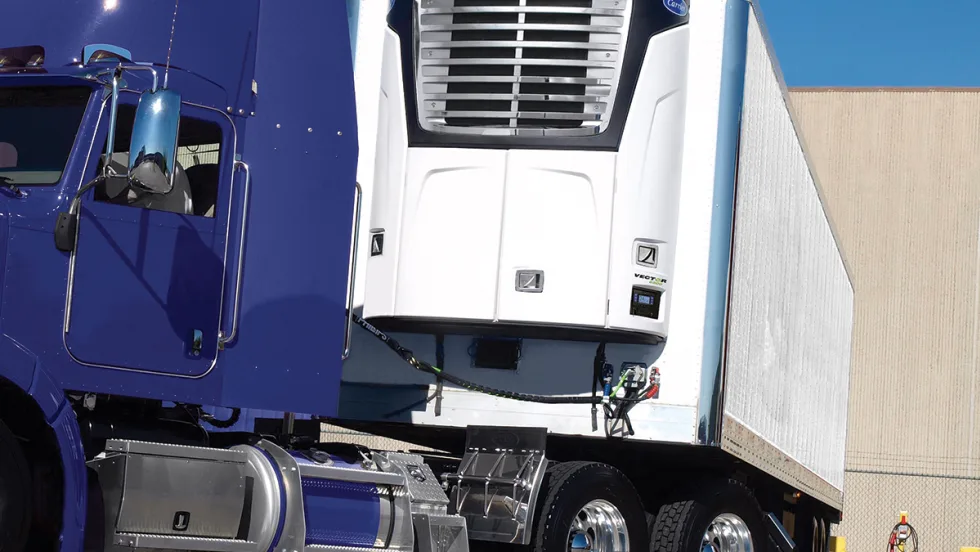
CARB Comes for Reefer Trailers
A new round of emissions control regulations decreed by the California Air Resource Board will begin affecting refrigerated trailer and TRU design and operations next year.
Read More →
5 Ways Data Analysis Maximizes the Value of Trailer Telematics
Are you getting the most out of your trailer telematics investment?
Read More →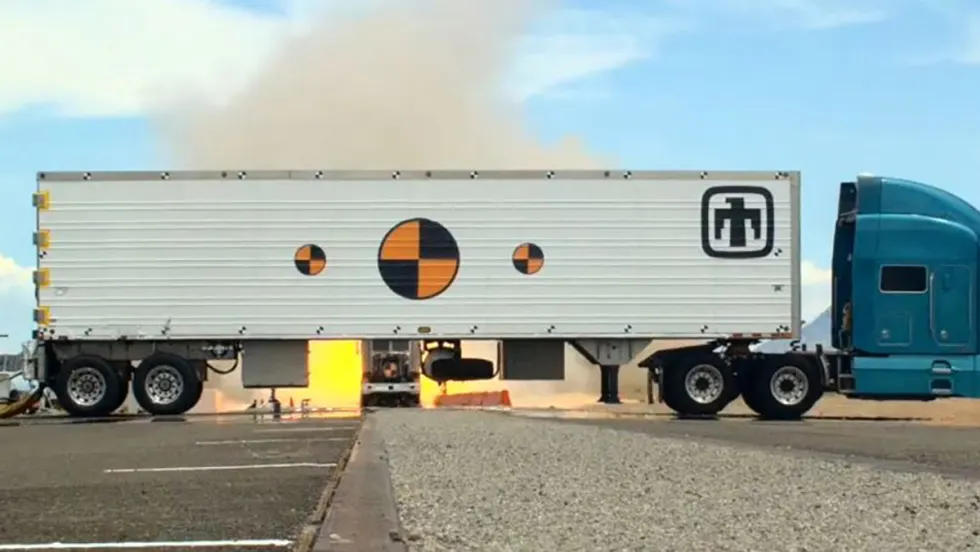
Can You Guess What's in That Trailer?
You don’t always know what’s in the trailers that pass you on the road. But some of those trailers are carrying something a little more dangerous that frozen food or new bedding…like, maybe, a nuclear weapon. But this isn’t an ordinary trailer; this is a trailer specifically made to not only carry this type of payload, but protect it at all costs.
Read More →
How Trailers Are Harnessing 'Free' Energy
Can trailers play a more active role in sustainable transport beyond aerodynamic add-ons or low-rolling-resistance tires? Some companies think so.
Read More →
Wrapping a Trailer for COVID’s Everyday Heroes
“We don’t only deliver freight. We deliver awareness.” That’s what Jim Barrett, president and CEO of Road Scholar Transport, likes to say about the Dunmore, Pennsylvania-based carrier’s “awareness fleet.” Its latest trailer wrap honors the everyday heroes of the pandemic.
Read More →
How a Tanker Fleet is Using Unorthodox Trailer Lighting to Fight Rear-End Collisions
Groendyke Transport watched the number of rear-end collisions with its trailers rise steadily until it tried an unorthodox and then unapproved method of alerting following drivers that its trucks were applying brakes and slowing down.
Read More →
The Role Trailers are Playing in COVID-19 Funerals
In places such as New York City and Detroit, overwhelmed hospitals and mortuaries are using refrigerated trailers to store the bodies of people killed by COVID-19.
Read More →
Reefer Trailer Aims to Help Reach Zero Emissions
Wabash National is partnering with C&S Wholesale Grocers to test a new type of zero-emissions refrigerated trailer.
Read More →