




A Lot of Thought Went Into This Tanker
On the road last month, Senior Editor Tom Berg spotted a pneumatic tanker trailer with some non-traditional features. He shares some insight from the driver in his latest Trailer Talk blog.

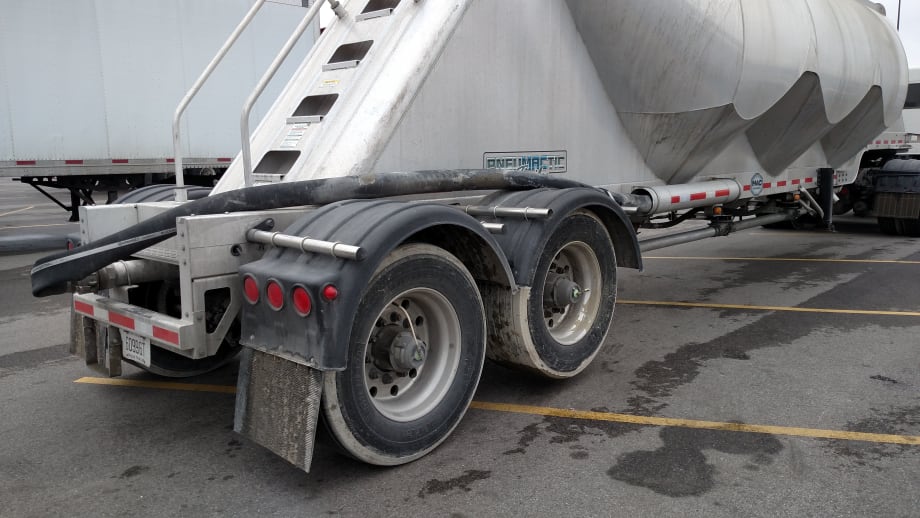
Mac trailer's forward axle is raised when the tank's empty. Note also the shrouding around the hoppers and the stairs.
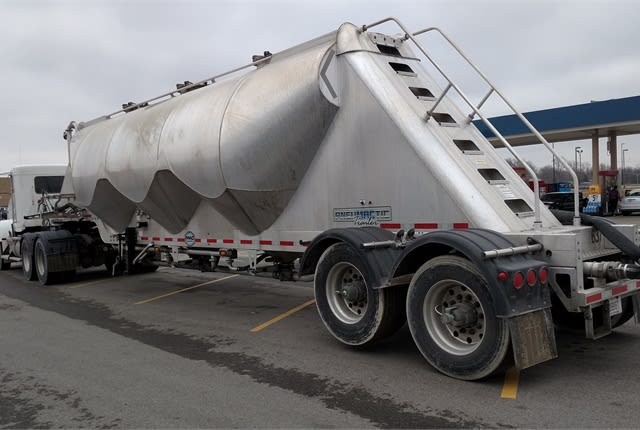
On a gloomy day I came upon this bright idea: a liftable axle as part of the trailer's tandem. Tires have a pressure monitoring and inflation system.
While on the road last month I spotted this tractor-trailer being backed into a parking space in a shopping mall in eastern Indiana. I noticed that the trailer, a Mac, was equipped not with the usual fixed tandem but with a lift axle. It was raised because the pneumatic tank was empty.
Liftable axles are nothing new, but it seems like there are more of them forming part of the tandem on trailers. I shot some photos, then went to talk with the driver, and learned there was more to the trailer than the axle.
He said his company hauls powdered cement from Kentucky to concrete producers around Indianapolis, and has a number of trailers with these axles. “Do they pull differently than a standard tandem?” I asked.
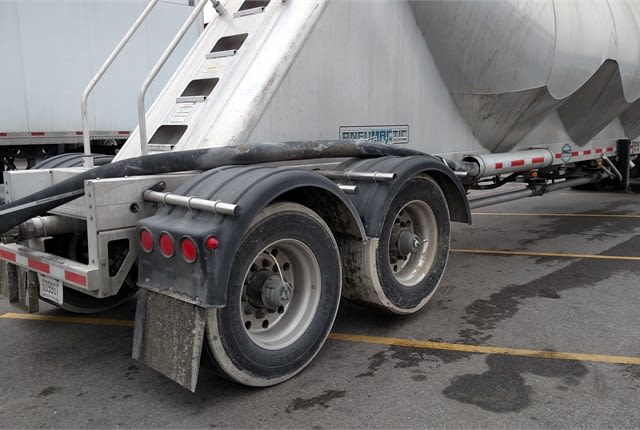
Mac trailer's forward axle is raised when the tank's empty. Note also the shrouding around the hoppers and the stairs.
“Yeah, they track better when the axle’s up,” he said. “And they turn corners easier,” because the tires on the single lowered axle don’t have to fight the ones on the other axle when it’s down.
I also noticed that this tanker lacked the usual forward fenders that protect the tank body from splash and debris kicked up by the tractor’s tandem. Full fenders on the tractor made the trailer fenders redundant, so they had been removed.
Air Products & Chemicals in Pennsylvania had gone this route to conserve fuel. The tanker fenders acted like sails, the manager said, catching wind at highway speeds and creating drag.
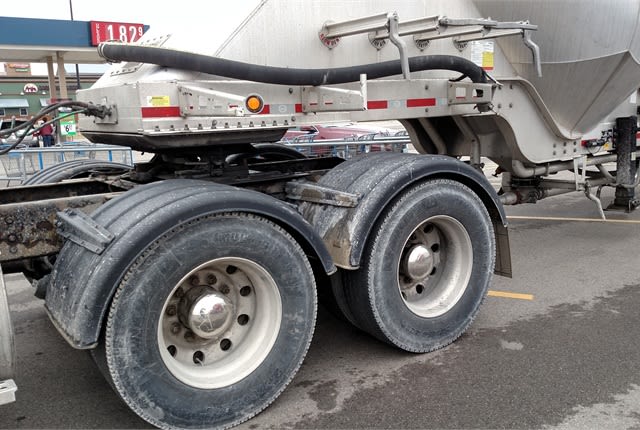
Fenders on the tractor's tandem make those on the trailer redundant, so they were removed. The brackets remain, but the clearance lamp sits on one and another helps support a hose.
This driver said a few of the company’s trailers had gotten the fender-removal treatment, and yes, they did seem to pull easier and save a little fuel. The tractor’s reinforced plastic fenders are lighter than the aluminum ones on the trailer, so the rig ends up a little lighter, too. Every little bit helps.
A fleet making such a changeover would have to put fenders on most of its tractors before removing fenders from the trailers, of course. But it seems worth the effort.
The driver also pointed out the shrouding that encloses part of the hopper mechanisms and around the ladder in the rear, which further smooths air flow. Tires are protected with a pressure monitoring and inflations system. And the ladder's mounting angle makes it more of a stairway, and the handrails add safety. A lot of progressive thought has gone into this trailer!
More Blog Posts

Pulsing Back-of-Trailer Lamps Aim to Prevent Crashes
Can the addition of a pulsing brake lamp on the back of a trailer prevent rear-end collisions? FMCSA seems to think so, if its exemptions are any indication.
Read More →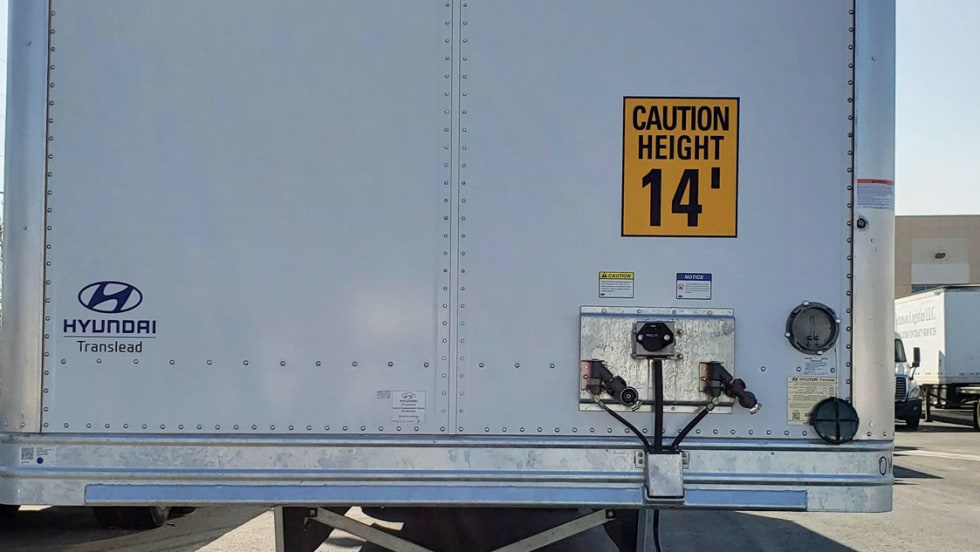
Designing a 14-Foot Trailer
Trailers are 13 feet, 6 inches high, right? Not for Hub Group, which developed a special 14-foot-high trailer spec for a dedicated customer based in California. Learn more in the Trailer Talk blog.
Read More →
CARB Comes for Reefer Trailers
A new round of emissions control regulations decreed by the California Air Resource Board will begin affecting refrigerated trailer and TRU design and operations next year.
Read More →
5 Ways Data Analysis Maximizes the Value of Trailer Telematics
Are you getting the most out of your trailer telematics investment?
Read More →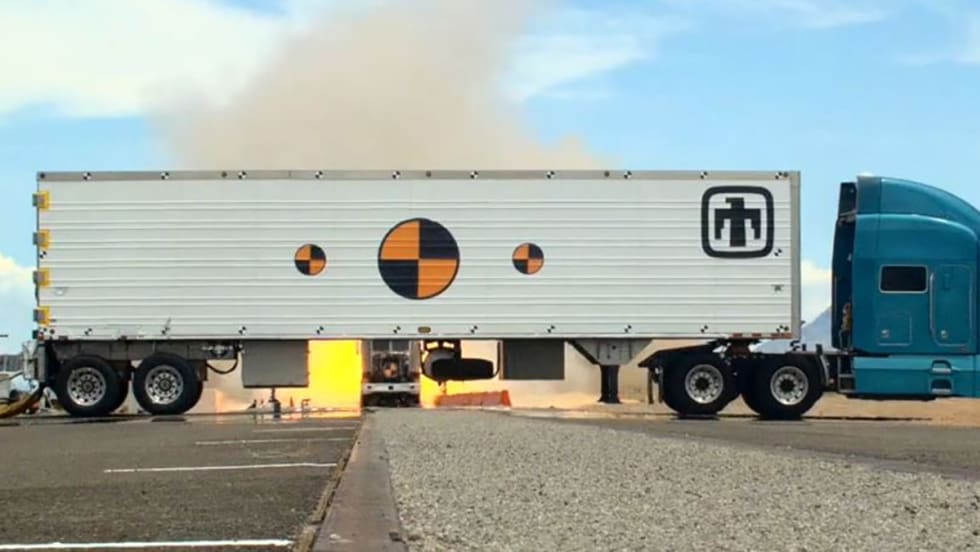
Can You Guess What's in That Trailer?
You don’t always know what’s in the trailers that pass you on the road. But some of those trailers are carrying something a little more dangerous that frozen food or new bedding…like, maybe, a nuclear weapon. But this isn’t an ordinary trailer; this is a trailer specifically made to not only carry this type of payload, but protect it at all costs.
Read More →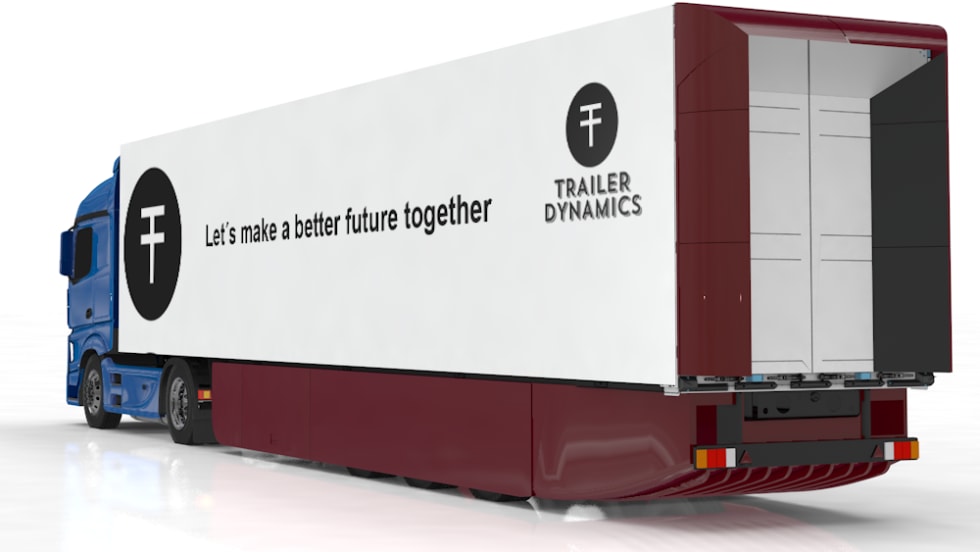
How Trailers Are Harnessing 'Free' Energy
Can trailers play a more active role in sustainable transport beyond aerodynamic add-ons or low-rolling-resistance tires? Some companies think so.
Read More →
Wrapping a Trailer for COVID’s Everyday Heroes
“We don’t only deliver freight. We deliver awareness.” That’s what Jim Barrett, president and CEO of Road Scholar Transport, likes to say about the Dunmore, Pennsylvania-based carrier’s “awareness fleet.” Its latest trailer wrap honors the everyday heroes of the pandemic.
Read More →
How a Tanker Fleet is Using Unorthodox Trailer Lighting to Fight Rear-End Collisions
Groendyke Transport watched the number of rear-end collisions with its trailers rise steadily until it tried an unorthodox and then unapproved method of alerting following drivers that its trucks were applying brakes and slowing down.
Read More →
The Role Trailers are Playing in COVID-19 Funerals
In places such as New York City and Detroit, overwhelmed hospitals and mortuaries are using refrigerated trailers to store the bodies of people killed by COVID-19.
Read More →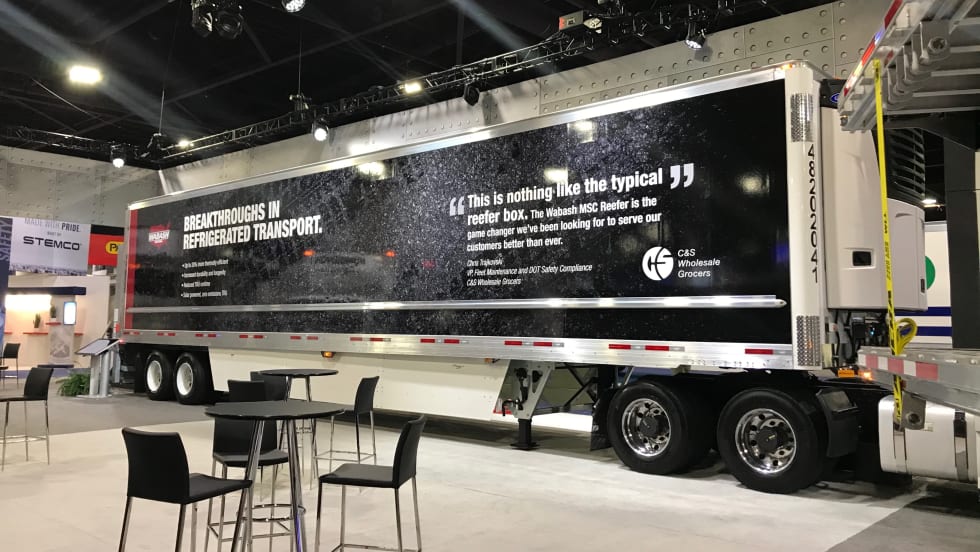
Reefer Trailer Aims to Help Reach Zero Emissions
Wabash National is partnering with C&S Wholesale Grocers to test a new type of zero-emissions refrigerated trailer.
Read More →