





Related: FMCSA Chief Says ELD Data May Shape Agency’s HOS Changes
What’s Happening with the Drug and Alcohol Clearinghouse?
The Federal Motor Carrier Safety Administration appears to be making progress in meeting the January 2020 deadline for implementation of its CDL Drug and Alcohol Clearinghouse for commercial driver’s license holders.
March 15, 2019
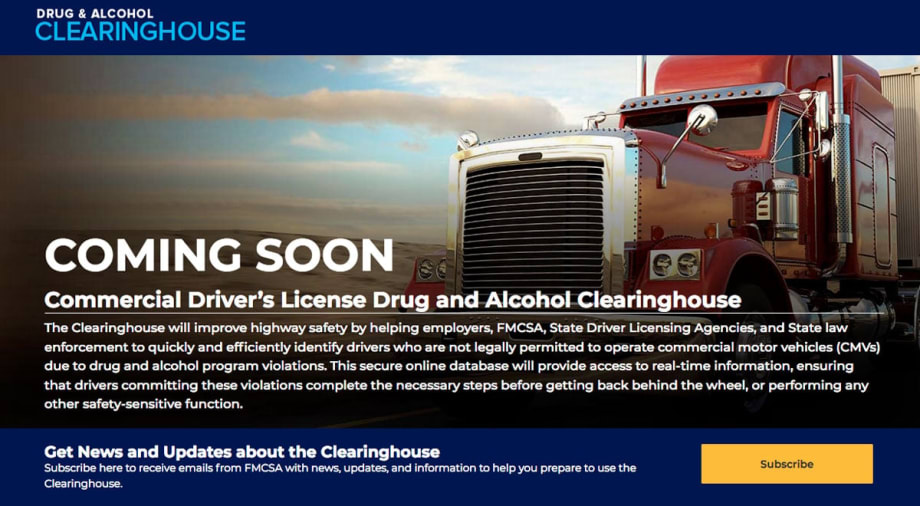
FMCSA has a new website with some answers about the upcoming drug and alcohol clearinghouse.
Image: FMCSA
4 min to read
The Federal Motor Carrier Safety Administration appears to be making progress in meeting the January 2020 deadline for implementation of its CDL Drug and Alcohol Clearinghouse for commercial driver’s license holders.
The agency recently announced a website, https://clearinghouse.fmcsa.dot.gov, with information and answers to frequently asked questions.
The clearinghouse has long been advocated for by motor carriers concerned about truck drivers who fail a drug and alcohol test at one company, then just go up the road to the next one and find a way to pass the test and get hired. There’s currently no way for a hiring company to know if a candidate has failed a drug test at another company. The clearinghouse aims to change that.
Congress passed a mandate to establish the clearinghouse, and the final rule was published in December 2016.
According to the new clearinghouse resource website, sometime this fall, users will be able to establish an account that will allow access to the Clearinghouse once it becomes operational on Jan. 6, 2020.
At that time, use of the clearinghouse will be mandatory to report and query information about driver drug and alcohol program violations. Employers must conduct both electronic queries within the clearinghouse and manual inquiries with previous employers to cover the preceding three years. By Jan. 6, 2023, employers will only have to query the clearinghouse and be able to drop the manual inquiries.
Dave Osiecki, president and CEO of Scopelitis Consulting, said FMCSA is working closely with the Volpe National Transportation Systems Center, a separate part of the Department of Transportation that serves as a technical resource for agencies like FMCSA, to write the software, acquire the hardware, establish system security protocols, create a carrier registration process, etc.
In addition to the new website, Osiecki said the agency is planning other outreach to help the industry understand the new system. That’s likely to include webinars, motor carrier checklists, and other user-friendly resource documents, similar to what FMCSA provided during implementation of the electronic logging device mandate.
“It’s important to note, however, that the ‘state side’ of the clearinghouse will experience a delay,” Osiecki said. “FMCSA’s 2016 clearinghouse rule did not specifically address how state driver licensing agencies were supposed to use drug or alcohol violation information in the clearinghouse during the CDL licensing or renewal process. As a result, FMCSA will be undertaking a rulemaking process this year to clarify state CDL-related responsibilities.”
Osiecki told HDT that trucking fleets are concerned about whether the new clearinghouse process will slow down the hiring process. “Speed to hire is very important aspect of the current driver [shortage] situation,” he said. “So identifying good candidates, getting them on board and qualified, and getting them in the trucks and on revenue-producing runs is critical. Anything that impacts the process of hiring people, that piques the interest of trucking companies. Companies are going to have to ping the clearinghouse, and it’s unknown how long it’s going to take to get the results back. Presumably that’s going to be quick, but what if it’s a day or two? That’s going to slow down the process.”
Another shortcoming of the new system is that it only includes DOT-mandated testing. As the frequently asked questions portion of the new resource website says, “Only results of DOT drug or alcohol tests or refusals may be reported to the clearinghouse. While employers may conduct drug and alcohol testing that is outside the scope of the DOT testing requirements, positive test results or refusals for such non-DOT testing may not be reported to the clearinghouse.”
For advocates who use optional hair analysis to test drivers for drugs and say it’s far more accurate than the required urine testing, that’s a bit of a loophole. Congress mandated that the Department of Health and Human Services come up with standards for hair testing, which DOT needs before it can promulgate a rule allowing for hair testing to be used in place of the currently required urine testing.
“Once hair tests are authorized by the DOT, then the results of those hair tests will be in the clearinghouse, but that’s not currently the case,” Osiecki explained. “I do believe all of this will be resolved at some point, but it’s still open.”
Subscribe to Our Newsletter
More Drivers

Platform Science Adds Dispatch and Safety Tools
Four additions to PS Fleet help fleets monitor loads, manage driver coaching, share truck locations and adjust video system settings.
Read More →
When Language Stops the Truck: The Return of ELP Out-of-Service Orders
English language proficiency rules for commercial drivers aren’t new, but renewed out-of-service enforcement has raised the stakes. Here’s what carriers need to know before a driver reaches a roadside inspection.
Read More →
Samsara Launches Custom AI Agent Builder
Agent Studio lets fleets create AI tools for hours-of-service monitoring, reporting and driver support, including agents that communicate by phone.
Read More →
Trucker Path Expands Reserved Parking Network
Trucker Path has added close to 6,000 more truck parking spaces to its Trucker Path Reserved Parking Network with the addition of Safe Truck Parking.
Read More →
EEOC Sues Texas Trucking Company Over Driver Age Limits
The agency says Trancasa USA rejected applicants over 65 and applied tougher driving-record standards to those over 60.
Read More →
Nussbaum, Roehl Announce Second Driver Pay Increase This Year
This year has seen a swath of major truck driver pay increases as freight capacity has tightened.
Read More →
From One Generation to the Next: How Mentorship Builds Safer Truck Drivers
After three decades in trucking, Harold Perry shares what he's learned about driver safety, mentorship, and helping the next generation build confidence behind the wheel.
Read More →
Truck Drivers Need More Than Another Alert
Fleets have more visibility into truck health, safety events, and driver activity than ever. The next challenge is turning all that information into useful guidance for the person who has to decide what to do next.
Read More →
FMCSA Removes 110 Truck Driver Training Schools from Certified ELDT List
Federal regulators also are targeting more than 160 additional training providers and launching a nationwide audit of third-party CDL skills testers as part of a broader crackdown on trucking fraud.
Read More →
Hours of Service Pilot Programs: FMCSA Readies for 2027 Rollout
Two pilot programs could eventually reshape hours-of-service rules, giving truck drivers options to pause their 14-hour clock or use longer split sleeper rest periods.
Read More →