



Part 1: Regular Tire Inspections Save Time in the Long Run
Part 2: Keep up the Pressure
Part 3: Align the Truck Before the Need Arises
Part 5: Retreading to Maximize Casing Value
 MENU
MENU SEARCH
Balanced tires and wheels have been shown to save fuel, but balancing can also save tires -- and money. Part four in Jim Park's five-part series for National Tire Safety Week.

Balancing compounds such as Equal Flexx from IMI Products keep the tire balanced even as conditions change. Photo by Jim Park

Balancing compounds such as Equal Flexx from IMI Products keep the tire balanced even as conditions change. Photo by Jim Park
The jury is still out on wheel balancing. We now have certified tests that show a small percentage of improvement in fuel efficiency, and balancing has proven to help prevent certain forms of life-robbing irregular wear, but it's not a routine maintenance item at a large number of fleets.
Years ago, before the big-name tire manufacturers got really good at producing tires, balancing was almost a requirement. Today, with much tighter manufacturing tolerances and state-of-the-art tools, tires are much more uniform and consistent in build. You can make an argument that modern tires really do not need balancing.
On the other hand, after the first mile of use the tire is no longer the same as the day it left the factory. Rubber scrubs off, chunks of tread get ripped away, irregular wear scrubs away tread rubber and on it goes. Maintaining balance in that tire may require some outside help.
Fred Staugh, vice president of maintenance at CRST, does not balance his tires. He spends a little more time ensuring they are mounted properly. He believes that unless there's a defect in the tire, if the tire and wheel assembly is round and running true, it won't need balancing.
"When I say round, I'm talking 60- or 90-thousandths of an inch of tolerance on radial and lateral runout as measured with a dial indicator," he says. "If you have that inspection process down and you use those guidelines, there's no reason on Earth to balance a steer tire."
Staugh believes you can eliminate the need to balance tires just by installing them properly and then checking them for runout and a heavy spot while on the vehicle. He says rims should be inspected with a runout gauge before the tire is mounted, and they should be within the manufacturer's tolerance. The mounted tire should be checked for concentric mounting by verifying the gap between the rim flange and the bead seating ring is the same all around the tire and on both sides of the tire.
"Even if you know you're putting a round tire on a round wheel, you still have to check after it's installed for its high spot," cautions Staugh. "With the high spot marked, place it at the 12 o'clock position on the hub where gravity will pull the wheel down onto the hub pilots creating a natural low spot. The two will cancel each other out. It doesn't get any better than that."
Guidelines for these inspection and mounting procedures can be found in the ATA's Technology and Maintenance Council Recommended Practice library. Look for RP 214D.
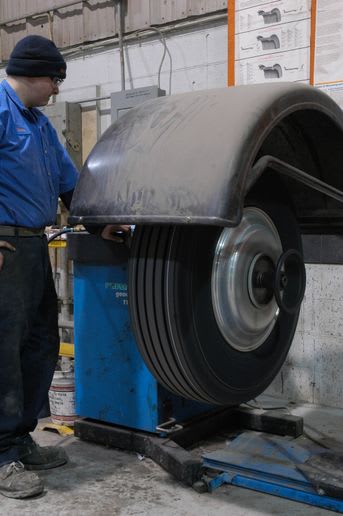
Balancing tires and wheels before they are installed helps ensure a smooth ride and better tread life.Photo by Jim Park
Lloyd Hair, maintenance director at heavy-hauler, Keen Transport, on the other hand, routinely balances steer tires, and will do so again if he gets driver complaints about ride or handling. He does not balance drive or trailer tires.
"I'll use as much as 16 ounces of weight to balance a tire," he says. "If it needs more than that, I'll deflate the tire, break the bead and rotate the tire 180 degrees on the rim and try it again. That more often than not does the trick. If that doesn't work, I send the tire back to the manufacturer."
When he gets a driver complaint about vibration, he doesn't automatically pull the wheels off and balance them; he investigates the complaint.
"If the tires are wearing properly and they aren't damaged, a vibration is usually a sign that something else is wrong," he says. "If you assume it's the tire and put a weight on it our use some balancing compound, you might be masking a driveline problem, such as a failing U-joint."
Hair says he cringes when he gets a complaint about vibration.
"It usually takes two or three hours to identify the source of a vibration," he says. "You have to find it, because it's a warning sign. It's not the problem. Balancing is sometimes wrongly used to mask a problem that really should be fixed."
Fleets have their choice of balancing methods, including internal balancing compounds, balancing rings that mount between the hub-face and the wheel, and weights. In days gone by, fleets were known to use things like golf balls and used anti-freeze to balance tires. The latter two do not come highly recommended by tire experts.
Most of today's name-brand balancing compounds are generally reusable and not harmful to the inner lining of the tire. Some older compounds were accused of clumping inside the tire after being exposed to moisture. That's generally not a risk factor anymore. Choose a product with a recognizable name that stands behind the product.
Balancing rings are also reusable and like the balancing compounds, will react to the actual balance condition of the tire/wheel assembly and move weight to where it's needed in the wheel to maintain balance. Name brand products are known last through several tires, which helps reduce the lifecycle cost.
Balancing weights are generally installed when the tire is initially mounted on a wheel. Unless the tire experiences a severe chunking or damage of some sort, balancing weights will help keep a tire balanced through much of its service life. Regulations in some jurisdictions now prohibit the use of lead weights, so suppliers are using different compounds such as zinc and steel.
TMC's S.11 Energy Conservation Study Group recently updated RP 1111, Relationships Between Truck/Trailer Components and Fuel Economy. In there you'll find a notation saying "tire balance across 18 tires on a tractor-trailer combination has been documented to save as much as 2.2% SAE J1326/RP 1102 Type II fuel testing at two different facilities."

For fleet managers and collision repair professionals keeping heavy-duty trucks on the road, getting the color right the first time isn't just about appearance — it's about efficiency, turnaround time, and bottom-line results. Discover how today's digital color tools are transforming the repair process from guesswork to precision.
Read More →
DTNA is recalling more than 2,400 trucks that received an incompatible software fix instead of the hardware repair required to address brake valve corrosion.
Read More →
Fleets have more visibility into truck health, safety events, and driver activity than ever. The next challenge is turning all that information into useful guidance for the person who has to decide what to do next.
Read More →
Making it through August isn’t the same as being ready for the next several months of operation. Find out what systems may have suffered from summer heat and need to be checked out before fall.
Read More →
With freight improving but costs still climbing, fleet maintenance executives explain how they're balancing price, quality, and supplier relationships.
Read More →
The nearly 6,000 Kenworth and Peterbilt trucks in the recall could potentially lose engine power, among other things.
Read More →
The new API PC-12 heavy-duty engine oil category reflects the changing demands of modern diesel engines. But fleets like Foodliner are looking to getting their own data before making decisions on adopting the new oils and questions such as extending oil drain intervals.
Read More →
Commercial vehicle inspectors are focusing on truck brakes during CVSA's Brake Safety Week, August 23-29.
Read More →On the recalled vehicles, manufacturing variations can cause the battery interconnect cable to contact the auxiliary stud and hold down the bracket.
Read More →
The joint venture will operate MCT's network of Carrier Transicold dealerships and mobile service locations, with the companies promising greater service capacity and uptime for refrigerated fleets.
Read More →