




Volvo Talks About Piston Technology in Latest Engines
The Volvo Group’s new truck engines in the U.S. are more fuel efficient thanks in part to a new piston design, which has "waves" on the piston crown that improve oxygen utilization.

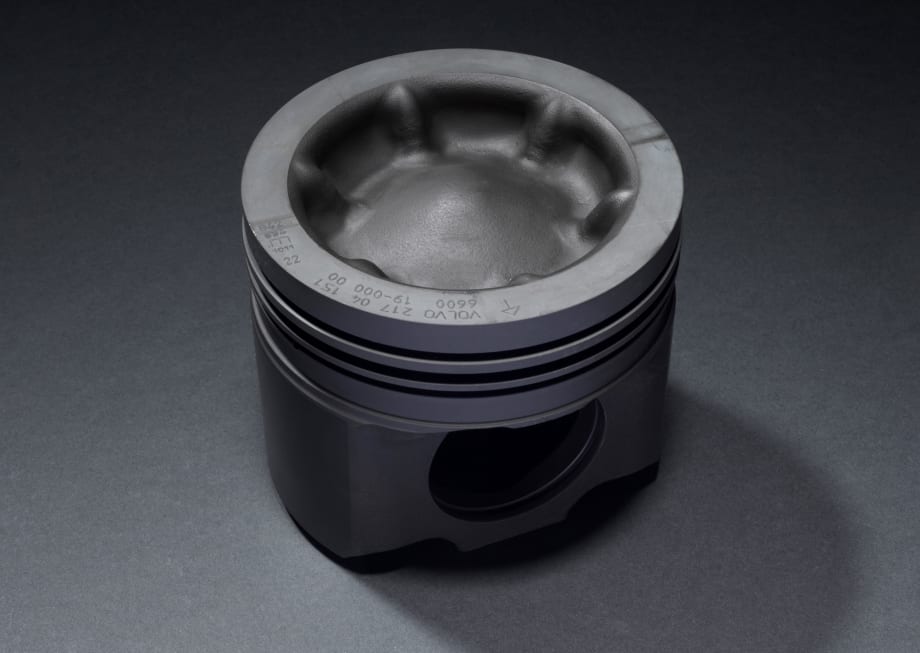
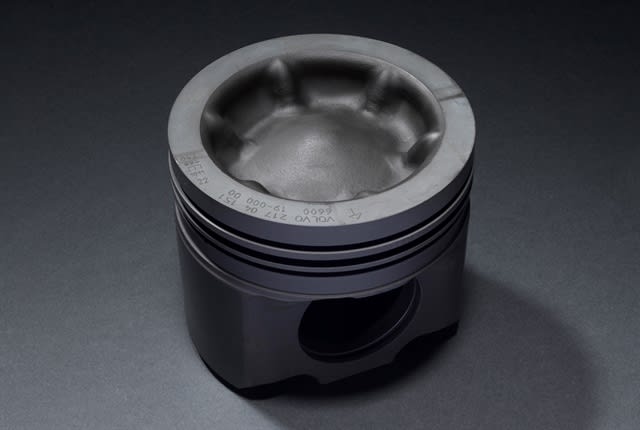
Despite being in existence and undergoing continuous development for 140 years, the internal combustion engine can still be improved, and Volvo recently highlighted one of its recent improvements that resulted in more fuel-efficient heavy-duty engines in the U.S.
“Over the past years, focus has mainly been on using computers to more efficiently control the combustion process,” says Jan Eismark, technical specialist in combustion systems. “It’s therefore, particularly pleasing that the change we have just made is exclusive to the hardware and the design of the piston crown.”
The more efficient combustion halves the quantity of soot particles and has reduced fuel consumption by an average of 2%.
However, it did require cutting-edge technology to prove that the initial ideas were correct and to identify the exact design of the piston crown. This involved using computational fluid dynamics (CFD) and high-speed filming of the combustion process inside the cylinder.
When the idea arose, the combustion development team was trying to reduce the amount of soot particles in exhaust gases in a project partly funded by the Swedish Energy Agency. They were using a single-cylinder engine to test different pistons and fuel injectors. The results of both engine test results and the CFD calculations showed substantial differences in soot quantities.
“The design of the combustion chamber seemed to be significant,” says Jan Eismark, who started to sketch possible changes to the design.
In a standard piston, the injector is located in the piston top and the fuel is sprayed toward the cylinder sides through a number of orifices in the injector. The combination of heat and pressure causes the fuel to ignite before hitting the wall. The flame hits the wall of the combustion chamber at a speed of up to 50 meters per second, spreads along the piston bowl wall and then collides with adjacent flames at an angle of 180 degrees, still at a high speed.
When the flames collide, they compete for the oxygen available there. At the same time, the oxygen in the center of the combustion chamber is never fully utilized.
“Therefore, we wanted to identify a method of leading the flames into the center of the combustion chamber and thereby better utilize the oxygen there,” explains Eismark.
They found they could do this using the ridges or waves in the piston crown. The piston has six such ridges and the injector, which is located in the center of the piston top, has six orifices to ensure the fuel is sprayed between the ridges. Eismark owns the basic patent for the technology together with his colleague Michael Balthasar.
But a clever idea will remain only an idea unless it can be industrialized. The new piston crown must be of at least the same quality as a standard piston crown and it should not cost any more to manufacture.
“Together with our suppliers, we have invested considerable effort into identifying a manufacturing method for the new piston crown,” says Frank Löfskog, responsible for the piston system for heavy-duty engines at the Volvo Group.
Standard pistons are forged and then finished by machining on a precision lathe, but this method will not work with the new design. Instead the piston must be precision forged to eliminate the need for further processing.
“The piston development team, the supplier and the combustion development team have had many discussions and conducted numerous tests to identify exactly how the piston crown should be designed to deliver the desired advantages and, at the same time, be possible to manufacture in a cost efficient manner,” says Löfskog.
The new piston crowns are ready and you'll see the new technology in engines in trucks from Volvo and Mack starting in January 2017.
More Fuel Smarts

New California Law Could Shed Light on Electric Truck Prices
Why do battery-electric Class 8 trucks remain so expensive? A California bill signed by Gov. Gavin Newsom would give fleets and state agencies more visibility into what manufacturers charge.
Read More →
How Volvo Updated Its D13 for EPA 2027 [Watch]
Volvo’s updated D13 promises lower emissions without sacrificing performance or fuel economy. Take a closer look at what changed inside the engine in this HDT Spotlight video.
Read More →
Diesel Price Spike Shortens Payback for Natural Gas Trucks, Report Says
Energy Vision estimates fleets could recover the higher purchase price of an RNG-fueled Class 8 tractor in 1.3 to 2.8 years under current fuel-price scenarios.
Read More →

Calstart Becomes Catalyst Mobility, Reflecting Broader Focus
Calstart is now Catalyst Mobility, reflecting the nonprofit’s growing national role in clean transportation, including zero-emission trucks, infrastructure and incentive programs.
Read More →
Record Diesel Prices Squeeze Trucking Fleets
Average U.S. diesel prices have climbed to nearly $6 a gallon, surpassing the 2022 record as tight refinery capacity and Middle East disruptions keep fuel costs elevated.
Read More →
How Fuel Delivery Shapes Engine Performance
Fuel delivery depends on more than what happens at the injector. For fleet, maintenance and technical professionals, looking at the full path from pump to injector can provide useful context for understanding engine performance.
Read More →
East Coast Port Launches $45M Electric Truck Push
The Port Authority of New York and New Jersey announced millions in incentives for zero-emission drayage trucks, yard tractors, and new charging hubs near the port.
Read More →
Detroit Opens Orders for EPA 2027 Engines
Detroit isn’t starting from scratch to meet EPA 2027 diesel emissions standards. Its Gen 6 DD13 and DD15 engines keep much of today’s platform while updating the fuel and aftertreatment systems.
Read More →
Zero-Emission Truck Corridor Planned for West Coast
California, Oregon, Washington, British Columbia and Baja California are coordinating plans for truck charging and hydrogen fueling from Canada to Mexico.
Read More →
A Closer Look at Kenworth’s Electric T880E Vocational Truck [Video]
Learn more about Kenworth's T880E battery-electric vocational truck at the Paccar Technical Center, including its range, applications, upfitting considerations, and PTO options, in this HDT Spotlight video.
Read More →