




Tire Storage & Inventory Management
Even when your tires aren't out on the road getting used and abused, they're still costing you money. Stacked in a warehouse or in a storage trailer on the back forty, they're taking up valuable floor spac

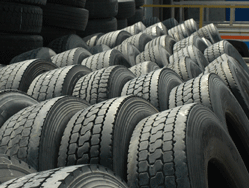
Storing tires and maintaining a current inventory is the task that never ends. There are easier ways to manage tire inventories.
Photo: Jim Park
Even when your tires aren't out on the road getting used and abused, they're still costing you money. Stacked in a warehouse or in a storage trailer on the back forty, they're taking up valuable floor space, and you're paying for the privilege of carrying all that inventory. Spare tires are good to have around when you need them, but there has to be a better way to balance need with economic reality.
Before you start worrying about the warehousing logistics, you need a starting point. How many of what types of tires do you need to keep on hand? If you had a tire-tracking program, whether a sophisticated computerized total tire management system or just good old pencil and paper, you'd know what your weekly or monthly needs were. Anything would be better than a seat-of-the-pants guess.
There are software systems on the market that will track tire wear and usage patterns, and provide estimated change-out times. That helps with purchasing. Knowing what you'll need and when you'll need it can help minimize on-hand inventory.
Help with Data
Some examples of tire management software include Dossier Tire Management from Arsenault and Squarerigger Revolution. TMT Fleet Maintenance from TMW Systems offers tire management features. There should be also systems offered by tire dealers, such as Goodyear's TVTrack and TCI Tire Centers' Track My Tread.
Data used by these systems can be collected manually or through a number of interfaces from handheld readers, RF readers or gate readers that pick up messages from trucks as they come through the gate. Automated data entry saves labor costs, and it's often more accurate.
In addition to the tracking capabilities, those systems and others help with maintenance scheduling, such as recommending tire rotation intervals.
Several tire pressure monitoring system providers, such as Bat RF from Stemco, PressurePro and TireStamp, have tire data tracking components in addition to their pressure monitoring capabilities. These may better suit users who don't require a full-blown and comprehensive maintenance management system.
"Maintenance and management reports take fleets from being reactive in their tire maintenance to proactive," says Peggy Fisher, president of TireStamp. "Staying ahead of the need keeps cost down and reduces unplanned maintenance requirements and unnecessary tire acquisition costs."
Farm it Out
The obvious alternative to managing all the detail on your own is to outsource it. Have someone else deal with the minutia and day-to-day maintenance and reporting tasks.
Tom Walters, fleet manager at Tony's Fine Foods in West Sacramento, Calif., found his solution right down the street. He contracts all his tire maintenance and tire management to a Les Schwab Tire outlet conveniently located a few blocks from the terminal.
"He's close by, so we make one parts run each day, dropping off today's casings and picking up yesterday's repairs," Walters says. "They handle all of our tire maintenance, retread procurement and storage for us."
Tony's Fine Foods is a specialty food distributor with 13 yards in California, Oregon and Nevada. The fleet of more than 80 power units and 120 refrigerated trailers serves the West Coast from Washington to Arizona.
Walters doesn't keep any tires on the premises other than the current day's supply.
Interestingly, he specs all of his new equipment with steer tires. When the trucks are delivered, the steers are stripped off and stored, replaced by retreaded tires (formerly new steer tires). The folks at Les Schwab store all those tires for him, and manage his retreading needs, which are Marangoni's ring-tread retreads.
His arrangements with Schwab include giving them all the service work, yard checks and road calls at regular prices, but Walters gets the tire storage and casing management services basically free.
"That keeps my labor costs really low," he notes. "About 90% of my tire costs are product - the tires themselves."
A significant factor in Walters' decision to farm out his tire and casing storage needs was West Sacramento's mosquito abatement laws. He says a single water-filled casing could cost him a $10,000 fine.
Your Tiremaker
Full-service providers such as Goodyear's FleetHQ and Michelin's Fleet Solutions Commercial Vehicle Service programs allow you to scale the level of outside involvement, from advice on managing a tire program to full-service tire management and on-site tire service.
"The power of FleetHQ is in bringing all the services together," says Bruce Woodruff, Goodyear's director of brand marketing. "It's more than a truckstop service network, it's more than yard checks and data collection and it's more than tire management. But it is all those, and then some. In partnership with a local service provider, we can accommodate any fleet's tire needs, relieving them of most of the stress associated with tire management and regular maintenance."
"Michelin's Fleet Solutions network is a service franchise that provides consistent levels of service and several advantages in inventory management," says Bill Guzick, Michelin's vice president of business development. "They worry about the inventory handling costs. You pay for only what you use. And in these times where shortages are possible, the network helps provide some increased assurances of supply of premium tires."
Depending on your budget, level of expertise, availability of labor and physical space, these tire programs offer alternatives to hands-on tire maintenance and exposure to risk.
Appetite for Safety
Risk may not be the first thing that comes to mind in deciding how to manage a tire program, but people get hurt handling tires. The Occupational Safety and Health Administration has a full set of requirements surrounding tires, and staff must be trained and qualified in those requirements. That's costly enough, but claims resulting from injuries can be enough to make your head spin.
Emphasis on Risk
Brian Evans runs 18 trucks and trailers from a terminal near Detroit hauling scrap metal. His tires are like pin cushions, so he keeps a good stock of spares at the yard, and he has two full-time tire installers on staff. A third is currently off on long-term disability with a crushed foot.
"We put a high emphasis on safety in the shop, especially in the tire department," Evans says. "We do everything by the OSHA book, but one day a worker was pulling a tire down from a rack and it fell from about chest-height onto the top of his foot. He had the required safety footwear on, but the way the tire landed was up near his ankle. His toes were fine."
Evans says they have to keep a lot of tires on hand, because he can go through a dozen a day on a bad day. Limited floor space in the shop forced him to rack the spare tires. Now he stores them in a rack designed for pallets and stacks the tires on pallets requiring a forklift.
"It's expensive, but it's safer," he says.
Managing tires and maintaining an inventory of replacements is no longer as simple as stuffing stacks of them into a storage trailer. Having rolling stock sitting around taking up space is costly today - on several fronts. And all that has to factor into the cost-per-32nd calculations you so diligently make when spec'ing and buying tires.
And keep an eye out for the mosquito patrols.
Storing Tires for a Rainy Day
You have to keep some inventory. Trucks come and go from the shop all the time, so you can't always afford to wait while your tire supplier delivers what you need.
To keep carrying costs down, you could maintain a minimum inventory of common sizes and wheel positions, based on records of weekly or monthly consumption. Usage records are important.
More Maintenance

Color Match Smarter: Tools That Restore & Perform
For fleet managers and collision repair professionals keeping heavy-duty trucks on the road, getting the color right the first time isn't just about appearance — it's about efficiency, turnaround time, and bottom-line results. Discover how today's digital color tools are transforming the repair process from guesswork to precision.
Read More →
Wrong Repair Prompts Recall of Freightliner, Western Star 4x2 Trucks
DTNA is recalling more than 2,400 trucks that received an incompatible software fix instead of the hardware repair required to address brake valve corrosion.
Read More →
Truck Drivers Need More Than Another Alert
Fleets have more visibility into truck health, safety events, and driver activity than ever. The next challenge is turning all that information into useful guidance for the person who has to decide what to do next.
Read More →
The Maintenance Checks Trucking Fleets Should Prioritize Before Fall Freight Picks Up
Making it through August isn’t the same as being ready for the next several months of operation. Find out what systems may have suffered from summer heat and need to be checked out before fall.
Read More →
What Three Fleets Are Doing Differently When Buying Truck Parts in 2026
With freight improving but costs still climbing, fleet maintenance executives explain how they're balancing price, quality, and supplier relationships.
Read More →
Paccar Recalls 2027 Trucks Built This Summer for Possible Electrical Problem
The nearly 6,000 Kenworth and Peterbilt trucks in the recall could potentially lose engine power, among other things.
Read More →
Will API PC-12 Oil Change Trucking Fleet Maintenance?
The new API PC-12 heavy-duty engine oil category reflects the changing demands of modern diesel engines. But fleets like Foodliner are looking to getting their own data before making decisions on adopting the new oils and questions such as extending oil drain intervals.
Read More →
Brake Safety Week to Focus on Drums and Rotors
Commercial vehicle inspectors are focusing on truck brakes during CVSA's Brake Safety Week, August 23-29.
Read More →Possible Battery-Cable Fires Prompt Recall of 15,000+ International MV and HV Trucks
On the recalled vehicles, manufacturing variations can cause the battery interconnect cable to contact the auxiliary stud and hold down the bracket.
Read More →
Rush, MCT Team Up to Grow Refrigeration Service Network
The joint venture will operate MCT's network of Carrier Transicold dealerships and mobile service locations, with the companies promising greater service capacity and uptime for refrigerated fleets.
Read More →