





Related: Figuring Out Wide-Base Single Tires
Tire Maintenance with Ryder's Scott Perry
Ryder Systems has one of the most diverse fleets in the country, and one of the largest. Management of that fleet's tire assets falls to Scott Perry, vice president of supply management. You may not find him out in the yard gauging tires, but he certainly responsible for getting every last penny in value from his tires.
May 12, 2015
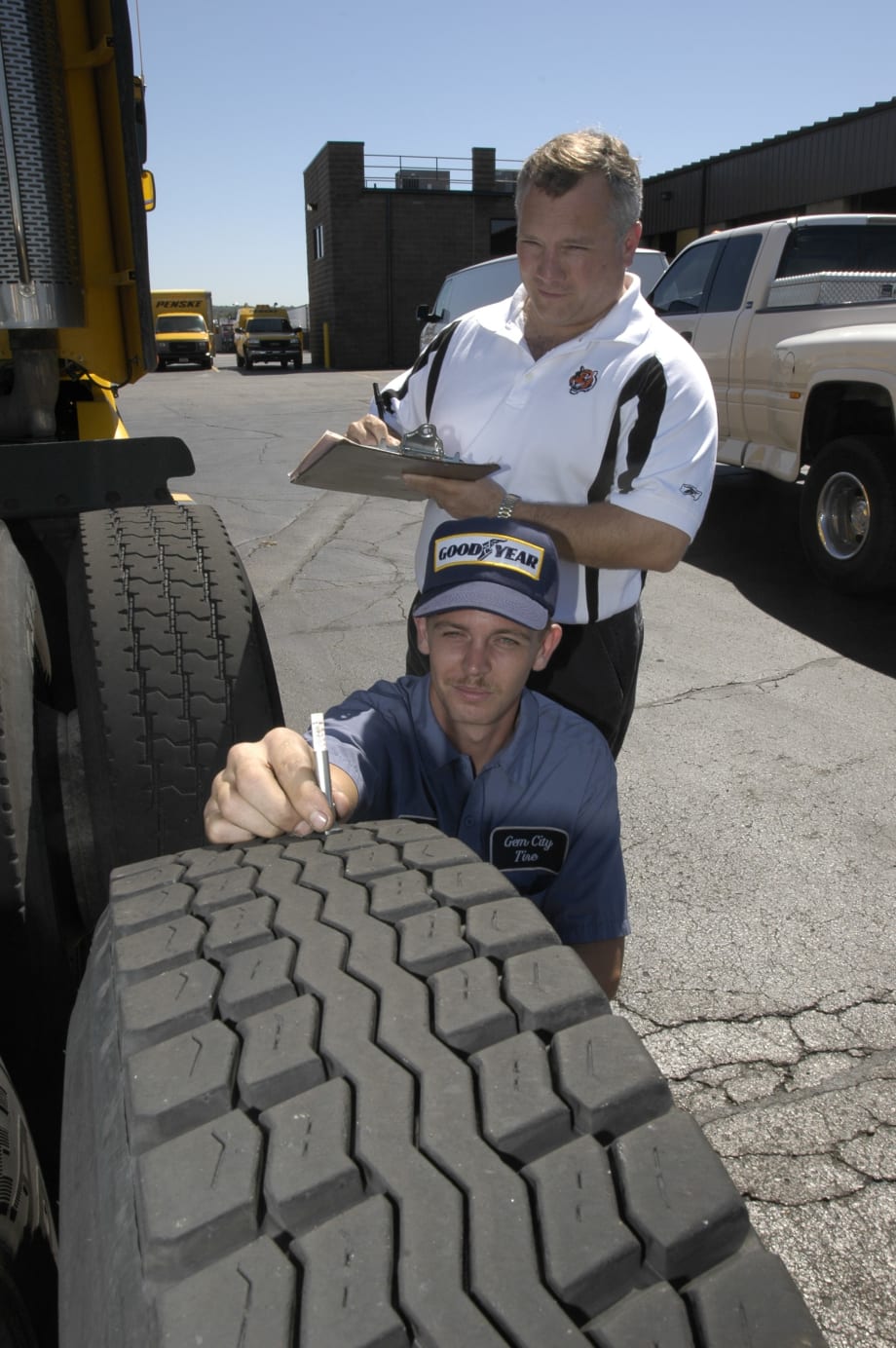
Check and record tire pressure and tread depth every time you see a tire. Photo courtesy of Goodyear
6 min to read

Scott Perry
Ryder Systems has one of the most diverse fleets in the country, and one of the largest. Management of that fleet's tire assets falls to one fellow, Scott Perry, vice president of supply management.
You may not find him out in the yard gauging tires, but he certainly is responsible for getting every last penny in value from his tires. His management philosophy is pretty simple and straightforward: Buy the right tire for the job, monitor it closely through its life, retread it a few times, and then dispose of it before it starts costing money.
HDT: Even with the diversity in your fleet today, you must have some expectation of how a tire will perform. Could you share some of your thoughts on getting off on the right foot, right from the spec'ing stage?
Perry: It all starts with how we spec the vehicle, I guess, and what application we intend to put it in with the customer. We have data on a number of specific tire models based on vehicle configurations and applications, so we draw on that historic information in choosing the right tire for the next truck we order.
HDT: Once the vehicle is in service, I assume you would be collecting data on that tire as well. What sort of information do you gather and track?
Perry: Throughout the course of that tire's life we’re capturing performance stats and we’re monitoring the number of miles the vehicle's operating. We're also capturing tread depth readings every time that vehicle comes in for a maintenance inspection. If it’s a customer that's fueling with us, we’ll get tread depth readings along the way. Virtually any time that vehicle pulls into our shop for any type of service or maintenance we have a close look at it. That helps us get a feel for how it's performing and how many miles per thirty-second of thread depth we’re able to achieve within that application. That helps us manage the life expectancy of that specific vehicle and the tires that are on it. It also affirms that we’ve got the right tire on the truck.
HDT: Do you ever find that your original spec'ing assumption was incorrect?
Perry: We have had instances where the application wasn't exactly as we expected, or a customer changed what they were doing with the truck. When you're making frequent tire checks you can catch things like accelerated wear before it goes too far. If we catch it early we might pull the tires and replace them with a more suitable tire.
HDT: What determines your next steps with a failing tire?
Perry: If we're still ahead of the mid-life point, we could pull it and run it out at a trailer position to maximize the yield on it. But if its three-quarters into its expected service life then we’ll just let it run out. It's really just a matter of how much tread depth is left on it when we’re making that decision.
HDT: And once the tire is worn to a certain tread depth, it's off to the retreader?
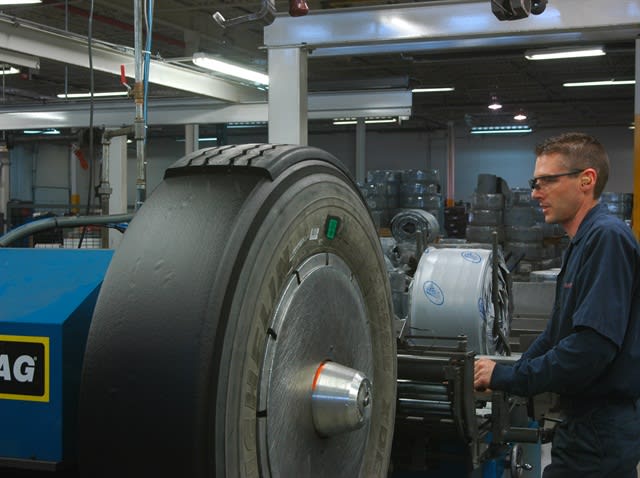
Retreading enhances lifetime value of the tire. Well maintaned casings can be redreaded many times. Photo by Jim Park
Perry: We do have a pretty aggressive retreading program with a dedicated tire management at Bridgestone Bandag. We have established a program that's really been evolving over 30-plus years in how we manage the removal of tires and how we inspect those casings. We’ll grade those casings based upon whether it's had any type of nail hole repairs or section repairs; they use shearography devices to inspect the belt package making sure that we don’t have any unseen damage that may have occurred that’s not detectable on the visual inspection. After that we’ll grade that tire A, B or C. That helps us determine after we retread it whether it’s going to be a tire we put back into service.
HDT: How do you go about gathering all this data? Do you have electronic tire readers or scanners or do good ol’ human beings get out there and inspect and measure the tire?
Check and record tire pressure and tread depth every time you see a tire. Photo courtesy of Goodyear
Perry: Its generally good ol’ human beings. We have resources though the Bridgestone-Bandag network from an engineering standpoint that are dedicated to us and help us oversee those programs. A lot of it just comes down to our maintenance disciplines when the trucks come in for service. It's almost second nature after putting chocks under the wheels to keep the vehicle from moving and securing the keys so that no one inadvertently starts the vehicle, the next thing we do is walk around and start checking air pressure and gauging tires, measuring tread depth and recording that on the PM paperwork. As the technician completes the paperwork, they’re entering those readings into our maintenance system. That helps give us that population of data. With about 1.2 million tires on the ground at any point in time, we have a lot of data that’s charting constantly.
HDT: We have readers who are still doing this with Excel spreadsheets or sheets of paper. What would you recommend as first steps for a smaller fleet if they were embarking on a program such as this. What should they be tracking, what results can they expect and what can they do with that data once they are done with it?
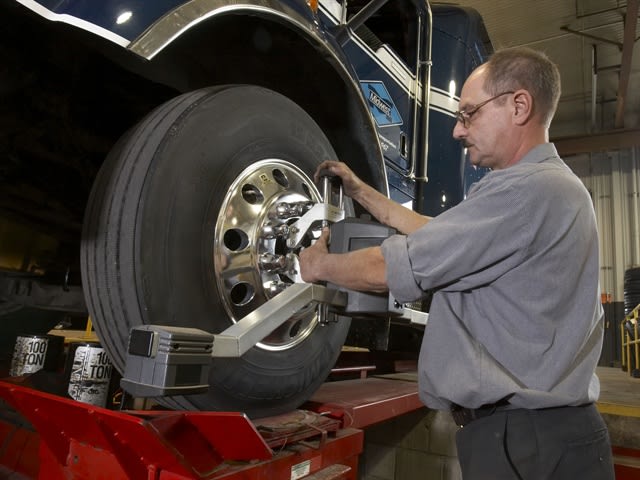
Bad alignment is a source of irregular wear. Catch it early and you'll save the tire. Repair the problem before installing a new tire. Photo courtesy of Michelin
Perry: The biggest insight is stick to the basics, making sure they’re monitoring the tire inflation and have a good compliance program with their drivers. Walking around with a stick and trying to gauge tire pressure from sound doesn’t work. Have a good tire pressure gauge calibration program, make sure that you’re getting good accurate readings and make sure you’re using it daily. Then when you’re performing your service, capture those tread depth readings, make sure that you’re translating that back to your miles that are being operated and you can gain a lot of insight into the way that those tires are surviving.
If you are seeing abnormal wear characteristics, start with the basics like alignment. Do you have an alignment problem? Are you performing good housekeeping with regards to lubrication of your fifth-wheel plate? Do you have your trailer pushing the tractor around and limiting your ability to articulate the steering on the tractor, is one of the things you would need to look at if you have excess wear on the steer tires.
Understand that you’re not going to see a trend in two, three or four months. After month nine you should begin to see some good indications as to what your wear rates are going to be and how that compares to other vehicles in your fleet. It will also show whether you have drivers that aren’t maintaining tire pressure, or whether you have a maintenance issue. Maybe you aren’t getting tire rotations on the basis that you would like. There are a number of things that you could look at for a root cause analysis, but the data is the key.
Subscribe to Our Newsletter
More Maintenance

Sponsored•September 16, 2026
Color Match Smarter: Tools That Restore & Perform
For fleet managers and collision repair professionals keeping heavy-duty trucks on the road, getting the color right the first time isn't just about appearance — it's about efficiency, turnaround time, and bottom-line results. Discover how today's digital color tools are transforming the repair process from guesswork to precision.
Read More →
Wrong Repair Prompts Recall of Freightliner, Western Star 4x2 Trucks
DTNA is recalling more than 2,400 trucks that received an incompatible software fix instead of the hardware repair required to address brake valve corrosion.
Read More →
Truck Drivers Need More Than Another Alert
Fleets have more visibility into truck health, safety events, and driver activity than ever. The next challenge is turning all that information into useful guidance for the person who has to decide what to do next.
Read More →
The Maintenance Checks Trucking Fleets Should Prioritize Before Fall Freight Picks Up
Making it through August isn’t the same as being ready for the next several months of operation. Find out what systems may have suffered from summer heat and need to be checked out before fall.
Read More →
What Three Fleets Are Doing Differently When Buying Truck Parts in 2026
With freight improving but costs still climbing, fleet maintenance executives explain how they're balancing price, quality, and supplier relationships.
Read More →
Paccar Recalls 2027 Trucks Built This Summer for Possible Electrical Problem
The nearly 6,000 Kenworth and Peterbilt trucks in the recall could potentially lose engine power, among other things.
Read More →
Will API PC-12 Oil Change Trucking Fleet Maintenance?
The new API PC-12 heavy-duty engine oil category reflects the changing demands of modern diesel engines. But fleets like Foodliner are looking to getting their own data before making decisions on adopting the new oils and questions such as extending oil drain intervals.
Read More →
Brake Safety Week to Focus on Drums and Rotors
Commercial vehicle inspectors are focusing on truck brakes during CVSA's Brake Safety Week, August 23-29.
Read More →Possible Battery-Cable Fires Prompt Recall of 15,000+ International MV and HV Trucks
On the recalled vehicles, manufacturing variations can cause the battery interconnect cable to contact the auxiliary stud and hold down the bracket.
Read More →
Rush, MCT Team Up to Grow Refrigeration Service Network
The joint venture will operate MCT's network of Carrier Transicold dealerships and mobile service locations, with the companies promising greater service capacity and uptime for refrigerated fleets.
Read More →