




Tire Casing Cost Recovery
Think of a tire casing as a foundation. It's the foundation of the whole tire, but also the foundation of a successful tire-cost management program

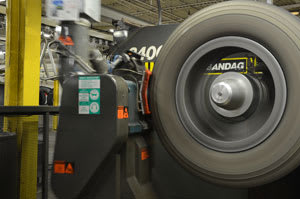
Tire mileage turned to dust: Tread scrubbing machines remove all traces of old tread to sculpt the casing for the new tread.
Think of a tire casing as a foundation. It's the foundation of the whole tire, but also the foundation of a successful tire-cost management program.
When measuring tire costs in cents per mile, one way to add zeros directly to the right of the decimal point is to keep casings in service as long as you can. With good management and a bit of luck, you can easily retread a casing twice or perhaps three or even four times.
Each time you turn a casing into a retreaded tire, you extend its life and lower its life cycle cost. You also get a good-as-new tire for half to two-thirds the cost of a new one. And since it's a form of recycling, you can add it to your company's list of "green" efforts.
We all know good tire management and successful retreading programs are labor intensive and require some up-front expense. With that in mind, we presume a number of things here: First, that you're not large enough to support a tire management department with staff to track all that stuff. Second, that you are already retreading your tires. If not, you should be. You're giving up way more than you realize by not retreading or at least seeking recovery on your casings.
And third, that you are now thinking to yourself, "Sure, retreads, casings, tire inflation, etc. All those things would be manageable if I had the time and people to do it."
Tampa-based Quality Carriers once had a tire problem. It was prematurely pulling nearly one out of every three tires it ran because of irregular wear, inflation-related problems, mismatched duals and more. Bob Potochney, director of maintenance for the company, knew there was opportunity for savings, but managing 25,000 new tires annually across a network of more than 150 company-run and franchise terminals scattered across the U.S., Canada and Mexico proved a challenge.
Oversimplifying it, the answer was to hand off the tire maintenance and casing management to a third party - Goodyear's fleetHQ in this case. Following recommendations, Quality Carriers' tire casing failure rate went from 30% down to less than 1%. In the process, the company recovered about $500,000 in casing credits and saw about $700,000 in pure tire-cost savings through retread utilization, all in just a few years time.
All that did not happen with the flip of a switch. Problem areas had to be identified and targeted for improvement, tire pressure management systems had to be instituted, and a centralized maintenance, repair and retreading program had to be put in place.
Potochney was surprised at the findings. "We discovered that locations that had higher tire costs weren't necessarily doing anything wrong," he says. "But we also found that locations where we didn't think we had any issues really did need to make significant changes in how they managed tires."
Once he had the fleet best-practices program in place, Potochney was more open to the idea of implementing a retread program.
"For years, we adhered to the idea that a retread program would be risky, given the $75,000 we have invested in each stainless steel tank trailer in our fleet," he says.
Retread advocates would say, correctly, that perceptions about retreads are little more than that. Virgin tires and retreads suffer the same fate if run underinflated. For Quality Carriers, overcoming inflation issues paved the way for savings through longer tire life and better tire utilization with retreading.
Several of the major tire makers offer cost-effective cradle-to-grave tire management programs (in addition to Goodyear's fleetHQ, there is Michelin's Advantage program and Bandag's BASys system, among others) that can provide the labor and the oversight needed to make such programs successful.
Such services can include:
- regular yard surveys
- pressure checks
- reports and recommendations
- mounting and dismounting service
- on-road repairs
- casing management through dealer networks
- monthly billing.
Such programs can be very cost effective for small fleets as well as large ones.
Retread plants have big machines called scrubbers that grind off tread rubber so the new tread will fit properly around the casing. All the rubber removed in that process is lost miles-per-32nd to the fleet. Bridgestone suggests tire tread be run down to about 6/32 of an inch before retreading in order to get maximum safe mileage from the tread. We say safe because a thinner tread is less resistant to punctures and stone-drilling, which can damage the casing.
Further, Bridgestone advises running a drive tire down to about 12/32, and then moving it to a trailer position. It has been found that trailer tires run out more slowly than drive tires, so miles-per-32nd increases, prolonging the life of the tire even further.
"You want maximum mileage out of the tread before sending it off to be retreaded, but you don't want to risk casing damage by pushing it too far," says Guy Walenga, Bridgestone's director of engineering for commercial products and technologies.
"Your retreader can advise you on optimum mileage-to-pull based on your casing damage history and the type of operating environment. Those guidelines are safe recommendations in a line-haul application, but you might do better."
Matt King runs the retreading facility of King's Tire Service in Bluefield, W.V., a ContiLifeCycle retread dealer. He says original tire selection is an important factor in future retreadability.
"Name-brand tires are always your best bet," he says. "We suggest the first cap on a name-brand casing should be a drive recap, and then go to the trailer tread if the casing comes back again. Generally, the casing is best used for the application it was in when it was new. Many of the import casings are not wide enough for a drive tread and can only be used in a trailer application."
King says some of his over-the-road customers are averaging three to four retreads in a casing life. With a little care and a lot of attention to inflation pressure, a good casing may even go two rounds in a drive position.
When buying new tires, consider what your retread needs will be in a year's time, and buy what you'll need to meet that need, he says. "If you can get several retreads out of a new trailer tire, it'll be cheaper than a drive tire up front and could serve you well on a trailer position."
King says a high-demand name-brand casing with no repairs that has never been retreaded might fetch as much as $95 in today's market. That may sound like a lot until you consider how much you're giving up by selling that casing.
Proper maintenance and good management, coupled with or provided by a capable service provider, can add thousands of miles to the life of your casings. So, where's the real value? A $95 casing credit, or half a million miles on several retreads? You decide.
From the July 2012 issue of HDT
More Maintenance
The Maintenance Checks Trucking Fleets Should Prioritize Before Fall Freight Picks Up
Making it through August isn’t the same as being ready for the next several months of operation. Find out what systems may have suffered from summer heat and need to be checked out before fall.
Read More →
What Three Fleets Are Doing Differently When Buying Truck Parts in 2026
With freight improving but costs still climbing, fleet maintenance executives explain how they're balancing price, quality, and supplier relationships.
Read More →
Paccar Recalls 2027 Trucks Built This Summer for Possible Electrical Problem
The nearly 6,000 Kenworth and Peterbilt trucks in the recall could potentially lose engine power, among other things.
Read More →
Will API PC-12 Oil Change Trucking Fleet Maintenance?
The new API PC-12 heavy-duty engine oil category reflects the changing demands of modern diesel engines. But fleets like Foodliner are looking to getting their own data before making decisions on adopting the new oils and questions such as extending oil drain intervals.
Read More →
Brake Safety Week to Focus on Drums and Rotors
Commercial vehicle inspectors are focusing on truck brakes during CVSA's Brake Safety Week, August 23-29.
Read More →
Possible Battery-Cable Fires Prompt Recall of 15,000+ International MV and HV Trucks
On the recalled vehicles, manufacturing variations can cause the battery interconnect cable to contact the auxiliary stud and hold down the bracket.
Read More →
Rush, MCT Team Up to Grow Refrigeration Service Network
The joint venture will operate MCT's network of Carrier Transicold dealerships and mobile service locations, with the companies promising greater service capacity and uptime for refrigerated fleets.
Read More →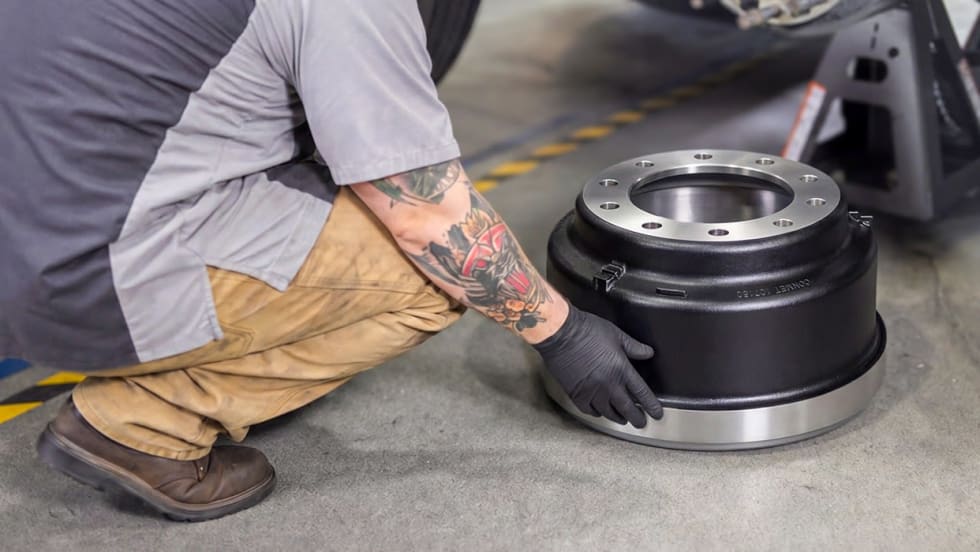
ConMet Expands Aftermarket Brake Drum Lineup With TruCast
A new heavy-duty truck brake drum option in the aftermarket gives customers more flexibility within the ConMet product family.
Read More →
Mack Expands Premium Service Contract Coverage to Medium-Duty MD
With a service contract, inspections, preventive maintenance and repairs can be handled in a single visit instead of multiple ones.
Read More →
Maintenance in the Messy Middle Part 5: Battery-Electric Trucks
No oil changes. No diesel exhaust fluid. No exhaust aftertreatment. But NACFE battery-electric trucks still require specialized maintenance procedures.
Read More →