





Related Video: Ultimate Test Drive: Detroit Assurance -The Basics
Test Drive: Daimler's Detroit Assurance Safety System
Detroit Assurance is the name of a new safety system from Daimler Trucks North America that could save your hide in a crash while saving fuel in less dire circumstances.
January 19, 2015

Detroit Assurance includes an optional Lane Departure Warning system consisting of a forward-looking camera that detects roadway lane markings. Drivers get audible alerts if they cross out of a lane without using the turn signal.
6 min to read
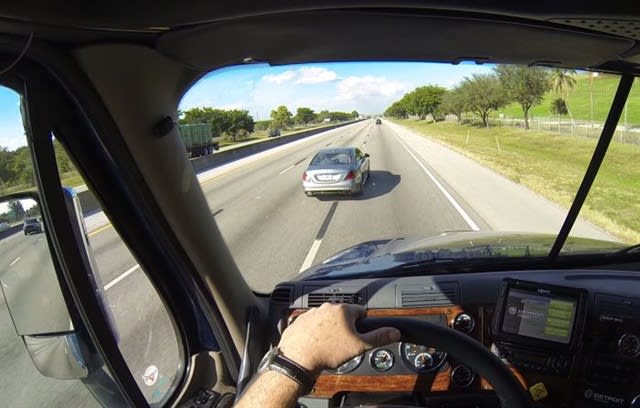
Detroit Assurance’s forward-looking radar can track up to 40 targets at a distance of 660 feet.
Detroit Assurance is the name of a new safety system from Daimler Trucks North America that could save your hide in a crash while saving fuel in less dire circumstances.
There are two components to the system: Adaptive Cruise Control and Active Brake Assist.
The system uses a forward-looking radar-based system designed to maintain a preset following distance from any vehicle ahead of the truck while this system is engaged. It has an active-braking component that will slow the truck dramatically ahead of an imminent collision — even when the system is disengaged — mitigating the potential impact of a crash.
To the driver, it’s invisible unless it’s working. When it is engaged, it’s so unobtrusive that few will even remember it’s on until an intervention occurs.
On top of that, while the system is managing the driver’s forward space cushion, it’s slowing and accelerating the truck in the most fuel-efficient manner possible.
The functionality is not new to North America. Several third-party systems are already widely deployed and some are available on DTNA Class 8 trucks. However, Brad Williamson, manager of Powertrain Marketing for DTNA, claims the level on integration capable with its proprietary system goes beyond what an add-on system can deliver.
“The vendor systems we offer work well and perform well, but we think the deep integration offered with Detroit Assurance takes functionality and performance to a new level,” he explained. “Similar systems have been in place in Mercedes Benz cars for better than two decades, and on Daimler trucks in Europe for more than 10 years. But all the software, all the logic and all the algorithms with this system are proprietary to DTNA.”
Heavy Duty Trucking recently spent a full day in south Florida experiencing the benefits of Detroit Assurance, and we got a pretty good taste of what it can do.
Following the leader
The demonstration began with an innocuous lane incursion by a slower vehicle — a chase car that was in radio contact with the truck so everyone knew what was going on at all times. The car pulled in front of the truck while accelerating, so the system ignored it. When the chase car let off the gas, the truck did the same, basically coasting behind the car at the prescribed following distance. When the car made a gentle brake application, the truck applied a little engine brake to slow us even more. Then, when the car hit the brakes in earnest, so did the truck, its service brakes slowing us from 50 mph to 40 in no time.
Then, as planned, the car took off. The truck, too, began accelerating — but not at a breakneck pace. Rather, as a fuel-conscious driver would with a gentle throttle application and gear changes at very low rpm.
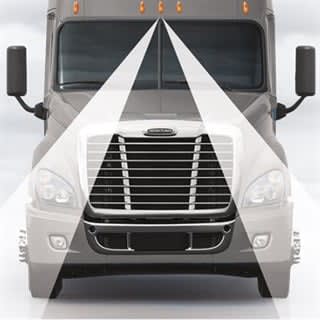
Detroit Assurance includes an optional Lane Departure Warning system consisting of a forward-looking camera that detects roadway lane markings. Drivers get audible alerts if they cross out of a lane without using the turn signal.
That was the Adaptive Cruise Control system at work. When the cruise control is engaged, ACC activates as well. The factory preset following distance is 3.5 seconds, but there’s an option that will allow the driver to dial that back to 2.3 seconds.
The system looks ahead more than 600 feet and can track up to 40 objects in its path, even on a curve. Daimler says it refreshes its speed, distance, and time calculations 200 times per second, so the response time is very quick. It will ignore objects outside the lane-wide path, or those that are accelerating away from the truck.
In a similar scenario with the ACC off — the cruise control not engaged — we heard a beep from the collision warning system and the truck applied brakes to maintain the 3.5-second space cushion. It did not resume cruise speed once the chase car had moved off.
With the ACC on, I followed the car off an exit ramp and through a toll booth before coming to a stop at a red light. The ACC held the truck behind the car at the preset following distance, effectively allowing the car to set the pace of travel. The car led me down the exit ramp, slowing to about 15 mph as we passed through the electronic toll booth, and further down to about 5 mph as we approached the red light. The car went through the intersection on a green, but I would not have made it through before it turned red, so I had to stop.
The ACC will stay engaged until cruise is disengaged or until it reaches a preset lower limit (the factory setting is 9 mph, but it’s a customer programmable option), so I had to manually apply the brakes for the light.
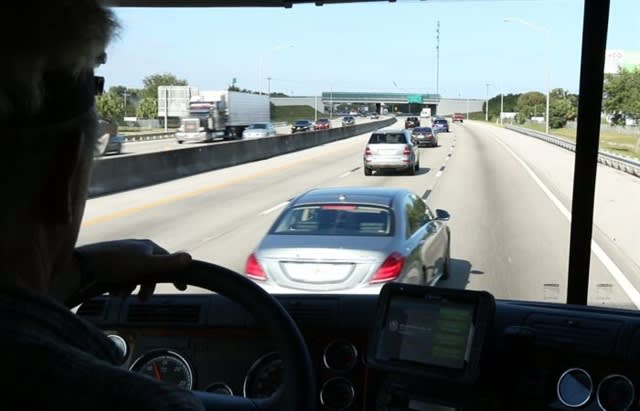
Even in this close, the system will not react to a vehicle that is accelerating away from the truck.
Active Brake Assist
On another occasion where the car stopped in front of me, I hit the brakes before the system did. Had I not applied the brakes, the system would have done it for me, I’m told, but my professional-driver instincts kicked in before the Active Brake Assist feature did. I kept my foot off the brake as long as I comfortably could, but that was contrary to anything I had ever done as a driver in close proximity to a very expensive car.
Brad Williamson, the marketing manager, was sitting in the passenger seat; he assured me the ABA system would have applied the service brakes and stopped the truck had I not chickened out and hit them first. You have to remember, this was a test of the system, not the way a driver would use it in real life.
Another useful application of the ACC system is following in heavy traffic. For a time, we were on a side road off the highway following the chase car. My cruise was still set to 65, yet the car was traveling at about 40 mph. So the ACC established the appropriate following distance and we were towed along by the car, slowing and accelerating as the need arose, with no brake or throttle input from me. Upon coming to a stop for a light, I simply re-engaged the cruise control — still set at 65 — and followed the car through the toll booth, back onto the highway and promptly accelerated up to 65 mph once again.
The system is very aware of its surroundings and always keeping fuel efficiency high in the order of priorities.
If there’s any risk to the ACC system, it might be in remembering to turn it off, or setting it to a reasonable disengage speed — maybe 20 mph rather than 9 like ours was. On one occasion, while entering a rest area, I followed the car in at about 20-25 mph, and when the car turned out of the path of the truck to find a parking spot, the system sensed the target was no longer in front of us and powered up, and we started accelerating through the rest area. A quick tap on the brake took care of the situation, but I could see where that function could become a problem, say at a stop sign or a red light.
As safety systems go, Detroit Assurance is designed to prevent any unintended interaction between cars and trucks, and it does that very effectively. It wasn’t an obtrusive system, and the gentle braking and acceleration — where warranted, more severe at other times — shows the system is very aware of its surroundings and always keeping fuel efficiency high in the order of priorities.
Subscribe to Our Newsletter
More Safety & Compliance

NYC Expands Speed, Pedestrian Safety Tech Across Fleet
New York City is expanding intelligent speed assistance and pedestrian-alert systems across its municipal fleet, moving the technologies from pilot programs into vehicle procurement and retrofit requirements.
Read More →
FMCSA Removes 110 Truck Driver Training Schools from Certified ELDT List
Federal regulators also are targeting more than 160 additional training providers and launching a nationwide audit of third-party CDL skills testers as part of a broader crackdown on trucking fraud.
Read More →
Beyond DOT Compliance: What Makes a Trucking Fleet Truly Safe?
A trucking fleet can follow every rule and still make unsafe decisions. The real test comes when safety conflicts with freight, productivity, or cost.
Read More →
Hours of Service Pilot Programs: FMCSA Readies for 2027 Rollout
Two pilot programs could eventually reshape hours-of-service rules, giving truck drivers options to pause their 14-hour clock or use longer split sleeper rest periods.
Read More →
New Guide Offers Pet Safety Tips for Truck Drivers
Hundreds of thousands of pets travel in truck cabs. A new safety guide from Volvo Trucks and the Center for Pet Safety offers practical advice for truck drivers who bring dogs and cats along for the ride.
Read More →
Medical Cards, English Proficiency Reshape Roadcheck Violations
Medical-card violations jumped to the top of the driver out-of-service list during CVSA’s 2026 International Roadcheck, while English-language proficiency violations appeared among the leading violations for the first time.
Read More →
How Lance Evans Turns Enforcement Experience Into Better Fleet Safety
HDT Truck Fleet Innovator Lance Evans brings lessons from law enforcement to K&B Transportation’s approach to safety technology, data, driver coaching, and compliance.
Read More →
New FMCSA Chief Safety Officer Has Trucking Industry and Law Enforcement Experience
Steve Dowling joins FMCSA after serving as senior director of safety at Covenant Logistics and in leadership roles in commercial motor vehicle industry organizations.
Read More →
Driver Trust Can Make or Break the Success of Fleet Safety Technology
New Teletrac Navman research suggests that onboarding, transparency about driver data, and positive feedback can play a significant role in how commercial drivers respond to safety and coaching technology.
Read More →
FMCSA: Stop Using These 15 Electronic Logging Devices
Fleets and drivers must replace the revoked ELDs with ones on the FMCSA's registered device list of electronic logging devices.
Read More →