




Synthetic-Web Strapping Under Scrutiny
What do you know about the synthetic web strapping you use to secure cargo? What you need to know is that it has a label, tag or stencil showing the manufacturer's name and/or trademark, and the working load limit of the strap in pounds or kilograms. You've got all that? The label even says the strap is DOT approved. You're good to go, right? Guess what? There are no DOT standards for cargo strapping

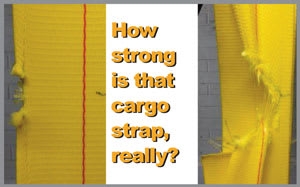
Testing demonstrated that even minor cuts in the sides of the tested straps caused failures at much lower tension than expected.
What do you know about the synthetic web strapping you use to secure cargo? What you need to know is that it has a label, tag or stencil showing the manufacturer's name and/or trademark, and the working load limit of the strap in pounds or kilograms. You've got all that? The label even says the strap is DOT approved. You're good to go, right?
Guess what? There are no DOT standards for cargo strapping.
The FMCSA's cargo securement rules incorporate by reference manufacturing standards for certain types of tiedowns -- including synthetic webbing -- developed by the Web Sling & Tie Down Association. That group describes its own manufacturing standard as more of a guide than a requirement. The following caveat appears on page two of the Web Sling & Tiedown Association's Recommended Standard Specification for Synthetic Web Tiedowns:
This recommended standard specification has been formulated as a guide to users, industry and government to ensure proper use, maintenance and inspections of synthetic web tie down assemblies. The existence of this recommended standard specification does not, however, prevent members of the Web, Sling, & Tie Down Association, Inc. and other manufacturers from manufacturing or selling products not conforming to this standard.
"It's ironic; you can't buy a $10 lamp in this country that doesn't have an Underwriter's Laboratory (UL) approval sticker on it, but there's no policing of the cargo securement product sold to the trucking industry," says Ralph Abato, vice president of sales and marketing for Ancra International.
Abato has raised the issue of cargo strap quality with enforcement officials, and he has provided test data showing some of the commercially available product falls alarming short of its indicated working strength.
"The biggest issue is the influx of importers and local sellers of strap assemblies that don't meet any standards at all," Abato says. "They either don't understand the standards or don't care. They don't do any testing, and they put out vastly inferior product that's basically mislabeled."
On top of that, when it comes to enforcing the cargo securement rules, inspectors tend to take the rating labels and tags at face value, he says. "They're looking for compliance with the total number and working load limit (WLL) of the tie down devices. They rarely question the integrity of the straps' rating."
Strap condition
In 2009, Abato brought some documented cargo strap testing to officials' attention that shows, among things, that straps might be more prone to abrasion and crushing damage that originally thought. The testing also demonstrated that even minor cuts in the sides of the tested straps caused failures at much lower tension than expected.
Ten samples of new, commercially available 4-in. cargo strapping rated at 20,000 pound breaking strength were intentionally damaged (minor damage) in repeatable ways and then subject to a destructive pull test. The undamaged samples all exceeded the rated breaking strength in a preliminary test.
With an edge cut of 10 percent of the width of the strap (about a quarter of an inch), the average breaking strength was 47.4 percent of the new breaking strength. Actual breaking tension ranged from 9,368 pounds to 9,480 pounds out of 20,000.
Simulated abrasion testing revealed the test straps failed at 69.5 percent of the rated breaking strength. The straps all ruptured at the point the strap had been damaged.
In a combination test, with simulated abrasion and a 10-percent edge cut, the straps survived only 15 alternating cycles of a full working load limit pull test, failing at an average of 29.6 percent of the 20,000-pound breaking strength, or just 5,924 pounds.
Abato says he has not yet heard from CVSA on how it might proceed, armed with this information, but he expects there will be another round of testing done to verify the previous tests.
It's certainly cause for concern, but not panic. CVSA is looking at the issue of edge damage to cargo straps, and is contemplating a tightening of the standards. The key take away-here is to use quality strapping from a reputable manufacturer, make sure it's properly marked, and keep in it good condition.
Read more about cargo securement in the June issue of HDT.
More Safety & Compliance

FMCSA Pauses Biennial-Update Enforcement Amid Motus Transition
Carriers whose updates were due on or after June 1 have more time, while FMCSA works to stabilize its new registration system and warns of phishing sites impersonating its new carrier registration system, Motus.
Read More →
ZF Expands Commercial Vehicle Push in North America
ZF is expanding its North American commercial-vehicle presence with new transmission applications, electrification, trailer technology and autonomous-driving systems.
Read More →
Truck Drivers Need More Than Another Alert
Fleets have more visibility into truck health, safety events, and driver activity than ever. The next challenge is turning all that information into useful guidance for the person who has to decide what to do next.
Read More →
Tesla Wants a Self-Driving Semi. Are Cameras Enough?
Could Tesla’s camera-only autonomous driving technology work on an 80,000-pound Semi? In this commentary, HDT's Deborah Lockridge takes a look at Tesla, Cybercab, and how autonomous trucks see the road.
Read More →
What DOT’s Automated Vehicle Strategy Means for Trucking
The U.S. Department of Transportation issued a new automated-vehicle strategy that outlines plans for driverless-truck regulations, cross-state freight corridors, and federal safety standards.
Read More →
NYC Expands Speed, Pedestrian Safety Tech Across Fleet
New York City is expanding intelligent speed assistance and pedestrian-alert systems across its municipal fleet, moving the technologies from pilot programs into vehicle procurement and retrofit requirements.
Read More →
FMCSA Removes 110 Truck Driver Training Schools from Certified ELDT List
Federal regulators also are targeting more than 160 additional training providers and launching a nationwide audit of third-party CDL skills testers as part of a broader crackdown on trucking fraud.
Read More →
Beyond DOT Compliance: What Makes a Trucking Fleet Truly Safe?
A trucking fleet can follow every rule and still make unsafe decisions. The real test comes when safety conflicts with freight, productivity, or cost.
Read More →
Hours of Service Pilot Programs: FMCSA Readies for 2027 Rollout
Two pilot programs could eventually reshape hours-of-service rules, giving truck drivers options to pause their 14-hour clock or use longer split sleeper rest periods.
Read More →
New Guide Offers Pet Safety Tips for Truck Drivers
Hundreds of thousands of pets travel in truck cabs. A new safety guide from Volvo Trucks and the Center for Pet Safety offers practical advice for truck drivers who bring dogs and cats along for the ride.
Read More →