Heavy Duty Trucking Logo
MenuMENU
SearchSEARCH

Retreads May Soon Be On SmartWay's Green List

Have a look at the list of U.S. EPA SmartWay approved low-rolling-resistance, fuel-efficient tires and you'll notice there are no retreads on the list.

Jim Park
Jim ParkFormer HDT Equipment Editor
Read Jim's Posts
July 12, 2010
Retreads May Soon Be On SmartWay's Green List

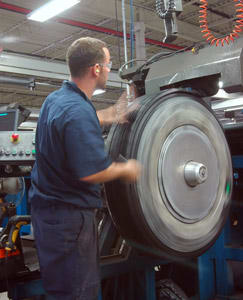
What constitutes a fuel-efficient retreaded tire? An industry committee could soon have the answer. (Photo by Jim Park)

4 min to read


Have a look at the list of U.S. EPA SmartWay approved low-rolling-resistance, fuel-efficient tires and you'll notice there are no retreads on the list.

They are absent because of the difficulty in quantifying the relative fuel efficiency of a two-part system. Like tractor and trailer braking systems, casing and treads are designed to work together, but a host of variables in both cases makes objective measurements a challenge. Of late, there has been a lot of interest in getting retreaded tires onto the SmartWay list. We should see them there soon, possibly as early as 2011.

Ad Loading...

Historically, tire manufacturers and retreaders individually provided EPA with data on their retreads, but they often used different test methods. Left to sort the data out for itself, EPA concluded it needed more consistency across the tests and the results in order to make a decision. So, a committee of tire manufacturers from within the Rubber Manufacturers Association was formed and charged with developing a single test method and a reporting system to help EPA sort out the multitude of treads and casings on the market that could conceivably one day become a single retreaded tire.

Part of the challenge has been defining the "retreaded tire" within the SmartWay context. Is it the casing you measure, or the tread? Kyle Jensen, manager of industry and government relations at Bridgestone Bandag Tire Solutions, says while measuring the rolling resistance contribution of the tread alone is difficult enough, measuring casings is equally complex.

"Each retreaded tire is a unique product because of the history of the casing," he says. "Given its age, previous applications, etc., achieving rolling resistance values for each casing would not be easy."

Without a precise definition of a retreaded tire in this context, the default position is that a SmartWay casing should be the basis for a SmartWay retread. That, however, could allow any tread - even a deep lug tread - to be used on a SmartWay casing, and thus be considered a SmartWay retread. That's clearly not the desired outcome.

Typically, the casing accounts for less than half of the tire's efficiency, and there generally isn't a great deal of difference across casing brands of similar design and application. The tread, most agree, has a greater effect on rolling resistance.

Ad Loading...

"Most of the casing is steel. You can't do much with that," says Roger Stansbie, director of radial truck tire technology development at Continental Tire. "It's the rubber surrounding the steel where you can fine-tune some minor improvements. When we develop a low-rolling-resistance tire, what we're doing is refining the tread compound and the tread design."

The RMA committee is working on the premise that if you de-emphasize the role of the casing - after establishing a rolling resistance standard for applicable casings - and work toward an objective rolling resistance measurement for tread designs and compounds, you'd have a more objective way of determining the fuel efficiency of a retreaded tire.

Larry Tucker, marketing manager for commercial tires at Goodyear, is a member of the RMA committee examining this situation. He says EPA is looking for a way to define a tire that meets its greenhouse gas reduction objectives, and industry is stepping up the plate to help.

"We are going to decide on which test method, what wheel position, and what testing criteria is needed to provide accurate data on rolling resistance by wheel position, by tread design, and by casing," he says. "It will be our responsibility to give the EPA the data it needs to make informed decisions in setting the target values."

Assuming the committee is successful, the next step would be to develop a common mark manufacturers can use to certify their retreads to SmartWay standards. "We have to identify a 'retreaded tire,' which includes the casing and the tread. The marking will have to go on the face or the shoulder of the tread," Tucker says.

Ad Loading...

"Once we have collected sufficient data on retread tires, our intention is to analyze the data to better understand the range of rolling resistance for retread tires, the effect of the casing on retread tire rolling resistance, and even the effect of the tire retread process itself on retread tire rolling resistance," says Dave Ryan, spokesman for SmartWay. "We need to understand these factors before we can establish retread tire criteria for SmartWay."

If the RMA committee is successful in establishing a measuring system for tire treads that opens the doors to using retreaded tires on any casing – not just SmartWay casings – fleets facing a looming deadline in California will be heaving a huge sigh of relief.

To qualify under the California Air Resources Board rules right now, only SmartWay-certified casings can be used for approved retreaded tires, says Michelin's Baldwin. There just are not enough casings from SmartWay-approved tires in the pipeline yet. If fleets have to buy new SmartWay tires in order to get into California, the budget impact will be huge.

"Our challenge as tire manufacturers, and the retread subcommittee, is to get the data EPA needs in a very timely fashion to they can make a decision in a very timely manner," notes Tucker.

Taking care of casings

If you ever wanted to build an economic argument for an aggressive maintenance program, just look at the value accrued from retreading a single casing two, three, or maybe four times. Sixty percent savings in tire costs is very compelling.

But you don't get value like that for nothing.

Pat Demianenko, national sales manager for retread systems at Goodyear, says the best way to optimize tire life when retreading is to pull them a little earlier than you would if you were just running them out.

"You want to protect the top belt of the tire, and prevent moisture from entering the casing through a puncture. If you leave a little more tread on the tire, you'll have an extra margin of safety," he explains. "We suggest pulling the tire with at least 6/32 of tread. You'll give up a little life on the original, but you'll gain a lot in retreadability."

Proper care throughout the life of the tire includes maintaining correct inflation pressure for the application, and prompt and proper repair of any damage. If you follow those guidelines, the casing could be retreaded two or three times in a long-haul application, and many more times in some applications, like refuse or other vocational services.

Each casing is carefully inspected prior to retreading, so any possible casing damage will be revealed. Your retreader can track your rejects, and you can use that information to spot weaknesses in your maintenance operation. You can look at brand and model performance, wear patterns, and previous damage, and then see trends.

Goodyear's G-tracks program allows fleets to track casings by brand, how many and what type of repairs have been made on the tire, how many times it has been retreaded, and if it had been rejected and why.

If you track your tires closely enough internally, you can trace it back to the specific truck and possibly even the wheel position for closer examination.


Subscribe to Our Newsletter

More Maintenance

SponsoredFebruary 1, 2026

Reducing Fleet Downtime with Advanced Diagnostics

This white paper examines how advanced commercial vehicle diagnostics can significantly reduce fleet downtime as heavy duty vehicles become more complex. It shows how Autel’s CV diagnostic tools enable in-house troubleshooting, preventive maintenance, and faster repairs, helping fleets cut emissions-related downtime, reduce dealer dependence, and improve overall vehicle uptime and operating costs.

Read More →
SponsoredFebruary 1, 2026

Stop Watching Footage, Start Driving Results

6 intelligent dashcam tactics to improve safety and boost ROI

Read More →
Brake telematics in heavy trucks.
Maintenanceby Jack RobertsJanuary 30, 2026

Why Are Brake Telematics So Tough for Class 8 Trucks?

Brakes are the final frontier for telematics on Class 8 trucks. But Hendrickson is close to a breakthrough that could change the game in getting real-time brake system information back to fleets.

Read More →
Ad Loading...
Warehouse aisle with pallet racking filled with boxed inventory at a distribution center.
Maintenanceby News/Media ReleaseJanuary 28, 2026

Phillips Opens High-Tech Distribution Center for Faster Parts Delivery

Phillips Industries’ new Cincinnati-area distribution center is now shipping aftermarket trucking parts nationwide, aiming to speed up delivery times for customers.

Read More →
Cummins MFlex4 heavy-duty brake pad.
MaintenanceJanuary 20, 2026

Cummins Launches MFlex4 Air Disc Brake Pad for Heavy Duty Aftermarket

Cummins used Heavy Duty Aftermarket Week (HDAW) to introduce a new brake pad platform aimed squarely at one of the aftermarket’s biggest pain points: Complexity.

Read More →
SponsoredJanuary 19, 2026

3 New Ways Fleet Software Pays: ROI opportunities for modern fleet managers

Safety, uptime, and insurance costs directly impact profitability. This eBook looks at how fleet software is evolving to deliver real ROI through proactive maintenance, AI-powered video telematics, and real-time driver coaching. Learn how fleets are reducing crashes, defending claims, and using integrated data to make smarter operational decisions.

Read More →
Ad Loading...
SponsoredJanuary 19, 2026

Basic Tracking vs Next Generation Fleet Technology

Fleet software is getting more sophisticated and effective than ever, tying big data models together to transform maintenance, safety, and the value of your existing tech stack. Fleet technology upgrades are undoubtedly an investment, but updated technology can offer a much higher return. Read how upgrading your fleet technology can increase the return on your investment.

Read More →
MaintenanceJanuary 16, 2026

What is AI Doing for Pilot's Fleet Maintenance Program? [Video]

Artificial intelligence gets plenty of attention at tech shows like CES — but what does it look like in a real trucking maintenance shop? Watch what Brent Hickman has to say about how one of the largest fuel-hauling fleets in the country is using AI.

Read More →
Maintenanceby News/Media ReleaseJanuary 16, 2026

ACC Fleet Solutions Launched to Address Recurring Heavy-Duty Truck Parts Failures

ACC Fleet Solutions is a new offering that allows fleets to address recurring part failures with higher-performing, custom-engineered solutions developed at no up-front cost.

Read More →
Ad Loading...
Henrickson aftermarket parts.
Maintenanceby News/Media ReleaseJanuary 15, 2026

Hendrickson to Highlight Aftermarket Portfolio at HDAW 2026

In addition to suspension components, Hendrickson will highlight a range of complementary systems and technologies at HDAW 2026.

Read More →