




Q&A: WiTricity CMO Amy Barzdukas on Wireless Charging for MD Trucks
Wireless charging by WiTricity for medium-duty and last mile delivery trucks is here now and it works, says WiTricity Chief Marketing Officer Amy Barzdukas.

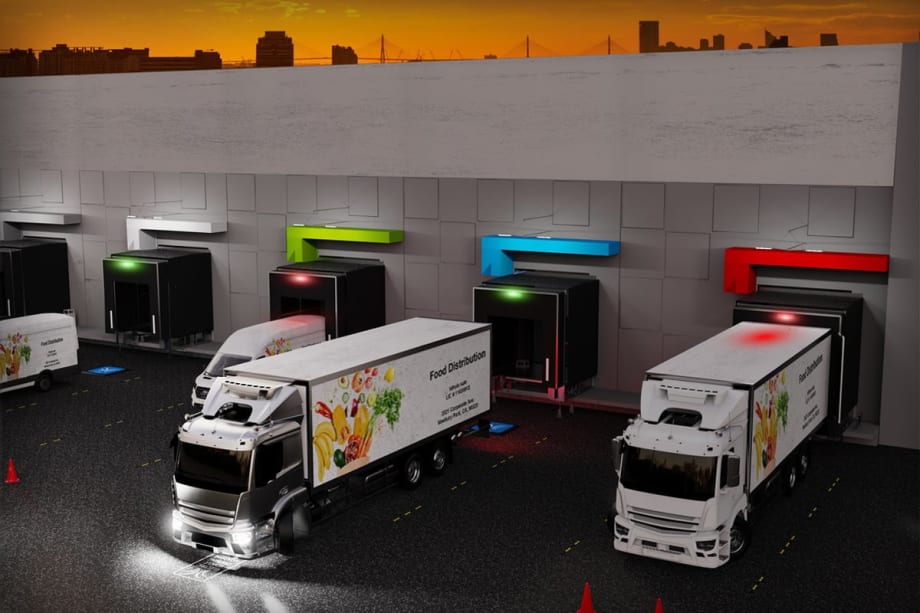
Wireless charging pads can be embedded in pavement allowing trucks to charge without cumbersome cables.
Photo: WiTricity
Even in these early days of battery electric vehicles, charging cables are already proving to be potential problems. They can be heavy and unwieldly, they are trip hazards, and if it hasn’t already happened, drivers are bound to drive off without first unplugging, or just leaving the cable laying on the ground.
Is wireless charging a practical alternative?
A new technology developed by a company called WiTricity makes wireless charging possible for all types of electric vehicles, including trucks. It allows wireless energy transfer at power levels from milliwatts to kilowatts over distances up to several meters and through materials such as metal, concrete and pavement.
WiTricity’s wireless charging concept is based on the principle of induction, where an electric current passed through a coil of copper wire creates a magnetic field around the coil. If a second coil is placed within that magnetic field, electric current will flow through it as well. Previous forms of induction-based wireless charging required the device to be charged to be precisely aligned with the charger and separated by no more than a few millimeters.
The coils WiTricity uses are magnetic resonators. First, a rapidly oscillating electric current is applied to a coil at its specific resonant frequency. This creates a magnetic field in the region around the coil. If a second coil is tuned to the same resonant frequency as the source and it will couple, resonating anywhere within that region and converting the oscillating magnetic field into an electrical current within the second coil. This response is called highly coupled magnetic resonance.
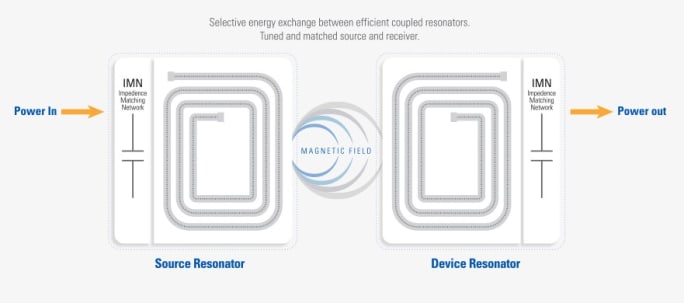
Photo: WiTricity
In an EV charging application, a vehicle would have to only drive over top of the charger and stop. The resonator on the vehicle doesn’t need to be closely aligned with the source, or even particularly close to initiate charging at the same power levels as a cabled charger.
The company was formed seven years ago at the Massachusetts Institute of Technology and is now moving into the pilot-project stage, with several trials underway with passenger cars. WiTricity is interested in partnering with some middle-and last-mile delivery fleets to test wireless charging in those applications.
Charging heavy-duty trucks may still be some time off, but there is a project underway in Wenatchee, Washington, with transit buses. WiTricity’s chargers are embedded at several high-volume bus stops where the bus remains stationary for some minutes and can “snack” from the wireless charger to gain additional range from the batteries.
WiTricity’s Chief Marketing Officer Amy Barzdukas told HDT the company is examining future applications for wireless charging beyond simply replacing a cable charger. Some of the concepts they are looking at include:

WiTricity CMO Amy Barzdukas
Autonomous trucks or drones such as yard spotters that could function independently without a human tending to the charging needs.
Electric reefer trailers could be spotted at remote locations in drop yards with embedded chargers to keep the unit running rather than tying up dock space to connect to shore power.
Delivery route trucks could be recharged while unloading at certain strategic locations to improve range or to reduce the overall size of the battery packs, and much more.
HDT spoke with WiTricity’s Amy Barzdukas, where she explained some of the advantages of wireless charging and shared some of the company’s near- and long-term goals for the technology. (This interview has been edited for length and clarity.)
Question: What are the upsides and downsides of wireless charging versus cable charging?
Anwser: First, cables break. They have moving parts, and they have pins in them. Drivers forget to plug them in; drivers forget to unplug them and drive away, breaking the cable. Cables can also be very heavy, and [chargers] take up a lot of space. If you have a lot of electric vehicles your real estate needs will be greater. There are also trip hazards associated with cables. In harsh weather, the plastic tends to get brittle. It's not pleasant to be in harsh weather having to wrangle the cord. With wireless charging, you just park the vehicle over top of the charger.
Q: There are usually losses involved with any form of energy conversion, like when converting AC power to DC. With this, the magnetic resonance happens in the charging plate and reverses itself on the vehicle. How much efficiency do you lose over the process from “well to wheel” as we used to say?
A: In a passenger vehicle setting, a WiTricity system will be about 93% to 94% efficient, which is roughly the same as a plug-in charger. People tend to think with a plug-in it's going direct, but there are — for lack of a better word, because this isn’t technically accurate — there are air gaps and other things put into place in plug-in charging to make sure that your vehicle doesn't blow up, nor does your vehicle blow up your house. They aren’t 100% efficient either. They range from 89% to 93% or 94% efficient as well. So, it's about the same. And that carries through regardless of the power level.
Q: Does it matter does if there's snow over top of the charger? Or it's wet or raining?
A: The charger can be embedded under the pavement. It doesn't have to be on top. So, when they're repaving or doing new construction, they can embed the charger under the surface so you don't even see it. Think about snowplows. We already know, anecdotally, that snowplows take out a fair number of electric chargers each year in the northeast.
Q: How about foreign objects like litter or even a small animal?
A: We have engineered the ability to detect a foreign object or a living object. You know, when I first joined WiTricity, I was like: “Well, what if my cat gets under the car?” Nothing would happen to the cat, but, just in case, there is a shutoff. That's particularly important if it's a metal object because that could — with the magnetic resonance — become hot and potentially flame. There are fire and flame hazards associated with virtually any means of power, but the software takes care of that. In case of foreign object detection, we trigger an alarm and shut off the charging. We also send an alert so someone can manually check to make sure that there's nothing wrong.
Q: Going back to the cable versus wireless for a moment. If you backed a 53-foot trailer into a loading dock, you’d need a cable about 70 feet long to reach the tractor to charge it while it was loading. On the other hand, you could place a charging pad about 75 feet away from the dock, or roughly where the tractor would be when parked at a loading dock. How would that work for a straight truck? Would you embed a long charger under the pavement or place two pads in strategic locations?
A: That's a great question. I think this speaks to the need to partner with vehicle manufacturers and come up with some standards about where you would expect [the charger] to be on what size of vehicle. Or you could have designated dock for different lengths of vehicle. These are all details we still need to work out, but I think for that reason the first implementation will be on last mile delivery vans that are not as varied in size. And because of their size — compared to passenger vehicles — there are more opportunities to do retrofits for electric vans that weren't built for wireless.
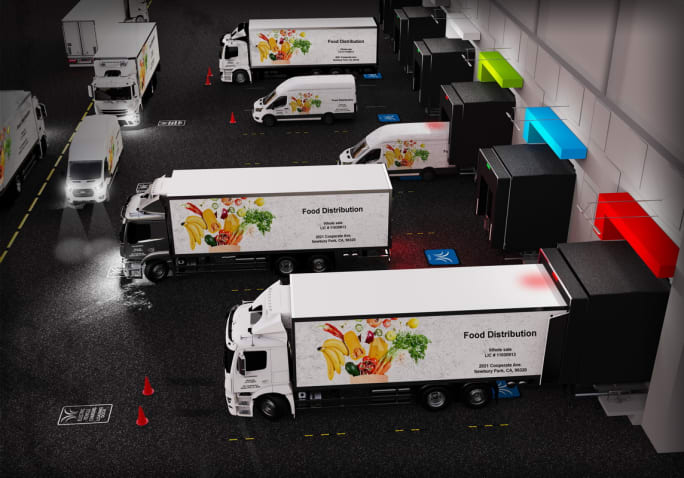
Wireless charging could open up much flexibility in yard planning and terminal layout, freeing trucks from having to charge at a separate location from where they load or unload.
Photo: WiTricity
Q: It's early days, and everything depends on scale and uptake, but how much would a wireless charger installation cost compared to a wired installation?
A: It varies a lot. In the last mile van example that we did, the installation of the wireless charging pads was less expensive than the DC fast chargers that would otherwise be used. Included in the cost is the permitting, the installation and the ongoing maintenance. Once the wireless charger is installed, there’s really no ongoing maintenance associated with it. Whereas a fast charger has cooling system, it has moving parts that break and need regular inspections and possibly repairs to ensure it keeps working.
Q: Where is WiTricity now in terms of testing and pilot projects?
A: We have started with passenger cars, so right now that is a little bit further along. There are others who are using WiTricity technology, so anybody who's doing wireless charging, or vehicles, large or small, are using our technology and using our patents. I should say we have a massive set of patents associated with the wireless charging. There are some heavy-duty applications in testing as well. We have an engineering team in Auckland, New Zealand, who are focused specifically on heavy-duty applications and are really making great progress.
We are ready to start working with some last-mile vehicles on some pilots. We’d like to get something going within the next six to 12 months, so if you have such a fleet, give us a call and we’ll get our business development involved.
More Fuel Smarts

How Volvo Updated Its D13 for EPA 2027 [Watch]
Volvo’s updated D13 promises lower emissions without sacrificing performance or fuel economy. Take a closer look at what changed inside the engine in this HDT Spotlight video.
Read More →
Diesel Price Spike Shortens Payback for Natural Gas Trucks, Report Says
Energy Vision estimates fleets could recover the higher purchase price of an RNG-fueled Class 8 tractor in 1.3 to 2.8 years under current fuel-price scenarios.
Read More →
Calstart Becomes Catalyst Mobility, Reflecting Broader Focus
Calstart is now Catalyst Mobility, reflecting the nonprofit’s growing national role in clean transportation, including zero-emission trucks, infrastructure and incentive programs.
Read More →

Record Diesel Prices Squeeze Trucking Fleets
Average U.S. diesel prices have climbed to nearly $6 a gallon, surpassing the 2022 record as tight refinery capacity and Middle East disruptions keep fuel costs elevated.
Read More →
How Fuel Delivery Shapes Engine Performance
Fuel delivery depends on more than what happens at the injector. For fleet, maintenance and technical professionals, looking at the full path from pump to injector can provide useful context for understanding engine performance.
Read More →
East Coast Port Launches $45M Electric Truck Push
The Port Authority of New York and New Jersey announced millions in incentives for zero-emission drayage trucks, yard tractors, and new charging hubs near the port.
Read More →
California Bill Could Shed Light on Electric Truck Prices
Why do battery-electric Class 8 trucks remain so expensive? A California bill headed to Gov. Gavin Newsom would give fleets and state agencies more visibility into what manufacturers charge.
Read More →
Detroit Opens Orders for EPA 2027 Engines
Detroit isn’t starting from scratch to meet EPA 2027 diesel emissions standards. Its Gen 6 DD13 and DD15 engines keep much of today’s platform while updating the fuel and aftertreatment systems.
Read More →
Zero-Emission Truck Corridor Planned for West Coast
California, Oregon, Washington, British Columbia and Baja California are coordinating plans for truck charging and hydrogen fueling from Canada to Mexico.
Read More →
A Closer Look at Kenworth’s Electric T880E Vocational Truck [Video]
Learn more about Kenworth's T880E battery-electric vocational truck at the Paccar Technical Center, including its range, applications, upfitting considerations, and PTO options, in this HDT Spotlight video.
Read More →