




Protecting Data Is Key to Good Business
Understanding what data your company has is just as important as protecting it in the information age.


Technology comes with many benefits, as well as some vulnerabilities.

Technology comes with many benefits, as well as some vulnerabilities.
The future can be a wonderful thing — and it’s here. The smartphone in your pocket has more computer power than all of NASA in 1969. The amount of real-time data you can access about your trucks, drivers and customers is mind-boggling.
Unfortunately, with that commonality and integration comes a common threat.
HNI, a risk management company, recently held an online seminar focusing on cyber risks to transportation companies. Kevin Zinter, senior vice president of the insurance company AmWins, pointed out the growing amount of information a company stores and who has access to it.
“With trucking firms and transportation firms there’s a lot of employment information on their own employees, prospective hires, vendors, customers,” said Zinter. “There’s health information, financial, identity — but beyond your four walls, it’s the sharing of that confidential information and what they’re doing with it.”
Whether it’s financial information from customers or the social security numbers of employees, valuable data is being stored all the time. Not only does it paint a target on a business’ computer system, but in many cases it makes fleets liable for breaches of that data. One of the best ways to reduce your risk is to understand just how much information a company has.
“How many records do you hold?” asked Zinter during the webinar. “Sometimes the numbers are hard to figure out, but it’s a good thing to understand.”
Along with stored records within a company, the sharing of that data can also be a risk. Zinter pointed out that a lot of transportation firms use logistics providers and freight brokers and it’s crucial to know if they will safeguard your data.
“It’s important to look at your contracts and understand who has your information,” he said.
The methods hackers use can vary in complexity and scale. In the case of a large company like Target, which was recently the victim of breach, it took a complicated and concerted effort. But even smaller companies make for enticing targets.
Last year, a transportation company called CorporateCarOnline was hacked and the credit card information of 850,000 customers was compromised. The data was stored in plain text, making the information as easy to parse as a spreadsheet.
One of the best ways to add security to your data is to encrypt it, which scrambles data with a unique code that would be difficult to decipher without more advanced techniques and time. Even if a hacker can access your files, they are useless as the information is unreadable. Not only is it a more secure practice, you’re less likely to be liable for damages to those affected when the proper measures are in place.
“Are your laptops and mobiledevices encrypted?” asked Zinter. “If they are and that data is lost, in some states you wouldn’t even need to do a notification.”
For businesses looking to ensure security, there are third-party risk management service providers who will analyze your company’s data and put in place the proper security measures.
The most vulnerable company is the one that assumes it’s safe, or worse, the company that thinks it has nothing to protect. It’s important to remember that a security breach doesn’t just mean liability for damages; it could also mean a loss of business.
More Safety & Compliance

FMCSA Pauses Biennial-Update Enforcement Amid Motus Transition
Carriers whose updates were due on or after June 1 have more time, while FMCSA works to stabilize its new registration system and warns of phishing sites impersonating its new carrier registration system, Motus.
Read More →
ZF Expands Commercial Vehicle Push in North America
ZF is expanding its North American commercial-vehicle presence with new transmission applications, electrification, trailer technology and autonomous-driving systems.
Read More →
Truck Drivers Need More Than Another Alert
Fleets have more visibility into truck health, safety events, and driver activity than ever. The next challenge is turning all that information into useful guidance for the person who has to decide what to do next.
Read More →
Tesla Wants a Self-Driving Semi. Are Cameras Enough?
Could Tesla’s camera-only autonomous driving technology work on an 80,000-pound Semi? In this commentary, HDT's Deborah Lockridge takes a look at Tesla, Cybercab, and how autonomous trucks see the road.
Read More →
What DOT’s Automated Vehicle Strategy Means for Trucking
The U.S. Department of Transportation issued a new automated-vehicle strategy that outlines plans for driverless-truck regulations, cross-state freight corridors, and federal safety standards.
Read More →
NYC Expands Speed, Pedestrian Safety Tech Across Fleet
New York City is expanding intelligent speed assistance and pedestrian-alert systems across its municipal fleet, moving the technologies from pilot programs into vehicle procurement and retrofit requirements.
Read More →
FMCSA Removes 110 Truck Driver Training Schools from Certified ELDT List
Federal regulators also are targeting more than 160 additional training providers and launching a nationwide audit of third-party CDL skills testers as part of a broader crackdown on trucking fraud.
Read More →
Beyond DOT Compliance: What Makes a Trucking Fleet Truly Safe?
A trucking fleet can follow every rule and still make unsafe decisions. The real test comes when safety conflicts with freight, productivity, or cost.
Read More →
Hours of Service Pilot Programs: FMCSA Readies for 2027 Rollout
Two pilot programs could eventually reshape hours-of-service rules, giving truck drivers options to pause their 14-hour clock or use longer split sleeper rest periods.
Read More →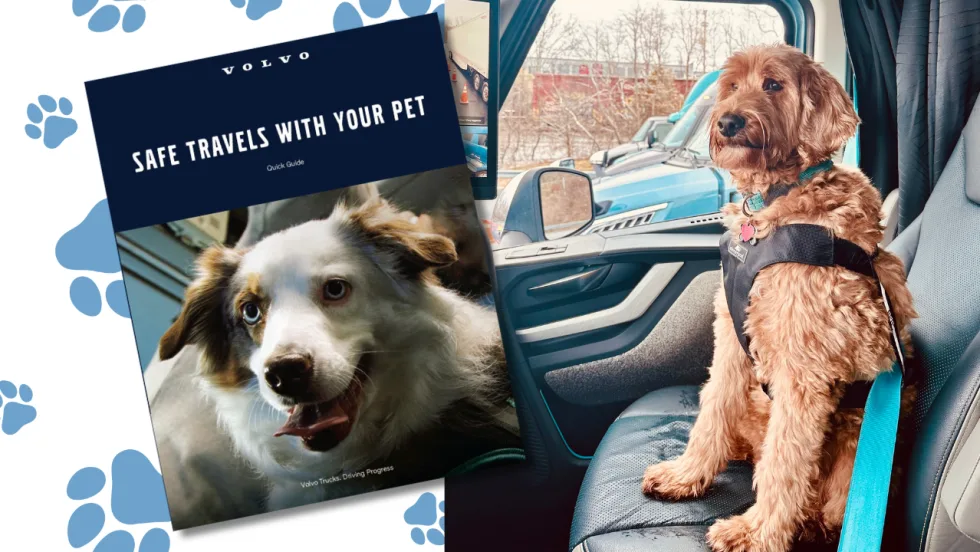
New Guide Offers Pet Safety Tips for Truck Drivers
Hundreds of thousands of pets travel in truck cabs. A new safety guide from Volvo Trucks and the Center for Pet Safety offers practical advice for truck drivers who bring dogs and cats along for the ride.
Read More →