




Private Fleets Find Fuel Savings in Changing Driver Behavior
With the federal government's new regulations setting fuel economy goals for medium- and heavy-duty trucks, there's been a lot of attention paid to current technologie

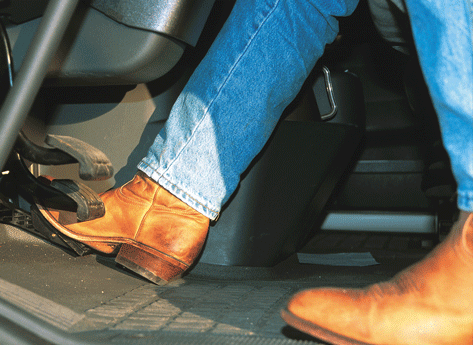
You can teach old dogs new tricks (Photo: Jim Park)
With the federal government's new regulations setting fuel economy goals for medium- and heavy-duty trucks, there's been a lot of attention paid to current technologies
such as low-rolling-resistance tires and future developments in things like waste-heat recovery. Yet some of the most dramatic fuel economy improvements come not from the latest gadgets, but from the operator.
During a session on fuel cost mitigation at the National Private Truck Council meeting earlier this year, two private fleets talked about how focusing on driver habits has paid off.
Upstate Niagara Cooperative is a food and beverage co-op owned by about 400 dairy farmers in western New York State. They run a well-maintained fleet of 121 vehicles, with two milk plants, a cultured products plant, and four distribution centers.
Ed Porter, director of transportation, said driver behavior can make a huge difference in fuel economy.
"The big thing is drivers, we're not in the cab with them every day," he said, explaining that idle time, shifting patterns, gear selection, speeding, and cruise control are all factors. The same kind of driver behavior that wastes fuel, also creates a ripple effect in operations, with increased likelihood of breakdowns and accidents.
"Our approach has been trying to work with the drivers, coaching them while they're in the cab," Porter said. "We installed intelligent telematics technology; we're working on coaching them before they go out on their route and when they come back." They use classroom training, in-cab coaching, and target retraining of poor performers.
A big focus is getting drivers to shift more in the sweet spot. He showed a chart of data from 10 trucks from the first three months of telematics system. One truck had a good idling score, but the driver was wasting fuel by running in the 1,700-1,800 rpm range. "In 9th gear at 1,500 rpm he easily could have shifted then, and gotten better fuel economy all the way through," Porter said.
But it's not easy to change that behavior, he admitted. "The older drivers were all trained that you wind it out in every gear."
The in-cab telematics unit the co-op is using gives the driver an audio tone when he's over-revving. Other than that, the screen is blank until the truck is stopped. At that point, the screen comes on and the driver can see his shift ranges and fuel economy.
"He can see what his supervisor is seeing and have a better idea what he's going to hear when he gets back in," Porter said.
Seven out of the 10 trucks tested saw marked improvement after the first three months. "We're not where we need to be yet, but we are seeing an improvement," Porter said.
The pre-coaching average was 5.81 mpg, the post-coaching average 6.10 mpg. They've calculated the payback on the telematics system to be six to eight months.
Aquatic Trucking Co. makes bathtubs and showers, with six manufacturing locations and fleet locations nationwide. It is seeing fuel mileage in the 6.8-7.1 mpg range in its fleet of 108 Freightliner Century Class tractors running in mostly over-the-road operations.
"The reason for that is driver training," said James Pysher, transportation equipment and compliance manager. "It doesn't matter how you spec a vehicle, it doesn't matter if you add an APU - if the drivers aren't trained correctly and you can't have their buy-in, you're not going to get anywhere."
Aquatic brings engine builders and representatives from Penske to do regular driver training. At each location, drivers also participate in a training program where they ride with a driver trainer, not only when they're hired but also throughout their employment. They do post-accident ride alongs as well. "Any time those drivers can be with a trainer, we take that opportunity."
They train on throttle use, shifting patterns (although the company has moved largely to automatic and automated transmissions), use of cruise control, idling habits, and proper use of auxiliary power units.
"Drivers are habitual by nature," Pysher said. "Most of us have drivers on the road that have been doing this a long time. If you can break the bad habits, like always wanting to put the hammer down, and create positive driving habits, we will see the benefits in fuel cost savings. They say it takes 21 days to break a habit, but if they really want to do it we've found it's faster than that."
Aquatic also publicly posts several reports for the drivers to see, such as mpg, idle time and cruise control settings for each and every driver.
"When they started seeing their buddy's information, it drives that competitive nature. They don't want their buddy to have one over on them."
It's also important to show drivers what they save by using those positive habits. If they average 80,000 miles a year, he said, every 1/4 mpg represents roughly $1,650 a year at $4 a gallon. "Drivers understand dollars."
From the September 2011 issue of HDT.
More Fuel Smarts

How Volvo Updated Its D13 for EPA 2027 [Watch]
Volvo’s updated D13 promises lower emissions without sacrificing performance or fuel economy. Take a closer look at what changed inside the engine in this HDT Spotlight video.
Read More →
Diesel Price Spike Shortens Payback for Natural Gas Trucks, Report Says
Energy Vision estimates fleets could recover the higher purchase price of an RNG-fueled Class 8 tractor in 1.3 to 2.8 years under current fuel-price scenarios.
Read More →
Calstart Becomes Catalyst Mobility, Reflecting Broader Focus
Calstart is now Catalyst Mobility, reflecting the nonprofit’s growing national role in clean transportation, including zero-emission trucks, infrastructure and incentive programs.
Read More →

Record Diesel Prices Squeeze Trucking Fleets
Average U.S. diesel prices have climbed to nearly $6 a gallon, surpassing the 2022 record as tight refinery capacity and Middle East disruptions keep fuel costs elevated.
Read More →
How Fuel Delivery Shapes Engine Performance
Fuel delivery depends on more than what happens at the injector. For fleet, maintenance and technical professionals, looking at the full path from pump to injector can provide useful context for understanding engine performance.
Read More →
East Coast Port Launches $45M Electric Truck Push
The Port Authority of New York and New Jersey announced millions in incentives for zero-emission drayage trucks, yard tractors, and new charging hubs near the port.
Read More →
California Bill Could Shed Light on Electric Truck Prices
Why do battery-electric Class 8 trucks remain so expensive? A California bill headed to Gov. Gavin Newsom would give fleets and state agencies more visibility into what manufacturers charge.
Read More →
Detroit Opens Orders for EPA 2027 Engines
Detroit isn’t starting from scratch to meet EPA 2027 diesel emissions standards. Its Gen 6 DD13 and DD15 engines keep much of today’s platform while updating the fuel and aftertreatment systems.
Read More →
Zero-Emission Truck Corridor Planned for West Coast
California, Oregon, Washington, British Columbia and Baja California are coordinating plans for truck charging and hydrogen fueling from Canada to Mexico.
Read More →
A Closer Look at Kenworth’s Electric T880E Vocational Truck [Video]
Learn more about Kenworth's T880E battery-electric vocational truck at the Paccar Technical Center, including its range, applications, upfitting considerations, and PTO options, in this HDT Spotlight video.
Read More →