




One Answer to Trucking's Decarbonization Challenge: Low-Viscosity Oils
As truck makers and fleet managers face increasing pressure to lower their carbon footprint, one step fleets can take to help with decarbonization efforts is using lower-viscosity engine oils.

Using low-viscosity engine oil is one way trucking fleet managers can improve their greenhouse gas emissions calculations.
Photo: Foodliner
As Environmental Social and Governance goals and objectives have continued to grow in importance, most industries are striving for efficient ways to prioritize decarbonization to meet those ESG goals – or those of their customers. The trucking industry is no exception.
On April 12, the EPA announced a proposal for more stringent standards to reduce greenhouse gas and CO2 emissions from heavy-duty vehicles beginning in 2027. While this may seem a ways off, it will arrive quickly.
In addition to these incoming standards, the EPA has also implemented the Greenhouse Gas Reduction Fund, a $27 billion investment to combat the climate crisis. Within this fund, there will be three grant competitions that will award organizations that prioritize decarbonization. This fund is another example of the continued environmental focus.
This ever-changing landscape is putting pressure on vehicle manufacturers and fleet managers in the trucking industry.
One step fleets can take to help with decarbonization efforts is using lower-viscosity engine oils.
Low-Viscosity Oils Drive Decarbonization
The main way to lower CO2 levels is to improve fuel economy. New low-viscosity heavy-duty engine oils do just that, by burning less fuel.
In the heavy-duty market, SAE 15W-40 had been the workhorse viscosity grade for many years, but it has peaked and is forecasted to decline to around 30% by 2029.
To support fuel economy drivers and the introduction of new emissions reduction hardware, the American Petroleum Institute introduced CK-4 and FA-4 in late 2016. In addition to being eco-friendly, the new standards deliver improved engine aeration performance, wear, and deposit protection, oxidation control and shear stability over API CJ-4.
In addition, API FA-4 introduced fuel economy SAE XW-30 grades with high temperature/high shear (HTHS) viscosity range of 2.9cP–3.2cP for fleets’ on-highway applications.
To meet those specs, a rapid shift toward SAE 10W-30 is expected. By 2029, SAE 10W-30 may account for roughly 40% of the market and SAE 5W-30, although not reaching mainline volumes, could make up about 10% of the market.
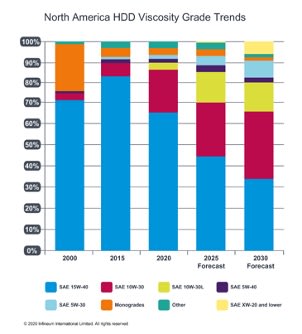
SAE 15W-40 had been the workhorse viscosity grade for many years, but it has peaked and is forecasted to decline to around 30% by 2029.
Source: Infineum International Limited
The growth in use of even lower SAE XW-20 viscosity grades, however, looks likely to be a slow process that depends on further innovations by engine makers.
On a positive note, fleet owners and operators are becoming increasingly comfortable with API CK-4 SAE 10W-30 fluids, but some are still hesitant to use lower viscosity API FA-4 if not explicitly supported across the entire fleet.
It is essential to note that, in the quest for fuel economy, the introduction of lower-viscosity grades does not compromise the durability of the engine or the compatibility of emissions system. Additives are designed to help ensure lubricants can function at much lower viscosities and retain their protective properties over ever-extending oil drain intervals.
Other Benefits of Low-Viscosity Oils
In addition to improving fuel economy, switching to low-viscosity heavy-duty products can help improve engine efficiency. Other benefits of low-viscosity products include:
Cost savings. A commercial truck can consume more than $70,000 (20,500 gallons) of diesel fuel per year. A switch from 15W-40 to a properly formulated 10W-30 can result in up to 3% fuel savings.
Improved engine durability, extended engine life, performance, and protection in old and newer engines.
Flexible formulation for mixed fleets with heavy-, medium-, and light-duty engines, as well as off-road and stationary diesel engines.
Most products are approved, or suitable, for use in engines by leading heavy-duty engine manufacturers, including Ford, Paccar, Volvo, Caterpillar, Cummins, Mack, Detroit Diesel, and Mercedes-Benz.
Multiple options, such as API CK-4 and FA-4 engine oils, are available to fit each fleet’s operations.
Some heavy-duty engine oils are guaranteed to reduce total operating costs, improve fuel efficiency, and improve carbon footprint.
How Low is Too Low When it Comes to Engine Oil Viscosity?
More OEMs are adopting 10W-30 CK-4 heavy-duty engine oils for their factory fill, and some are going even further with FA-4. OEMs provide valuable resources on allowable limits on viscosity grades and oil-drain interval extension.
When it comes to viscosity, thicker is not always better. Rather, a balanced formulation, proven to provide engine protection, coupled with fuel economy benefits, should be considered.
Newer truck engines are fitted with enhancements, such as polymeric coatings, for improved fuel economy and friction protection. As a result, modern engines (which are often smaller, hotter-running, higher-output engines) are designed to operate on the SAE 10W-30 oils that are more common today.
The bottom line: moving to low-viscosity engine oils can not only help your fleet be more “carbon friendly,” but can also provide improved efficiency and cost control and streamlined inventory management.

Steven Bowles is Citgo senior product specialist, with 17 years of experience in lubricants and 16 years of experience in laboratory supervision/analytical chemistry. Is is a certified lubrication specialist and certified oil monitoring analyst through the Society of Tribologists and Lubrication Engineers. This article was authored and edited according to Heavy Duty Trucking’s editorial standards and style to provide useful information to our readers. Opinions expressed may not reflect those of HDT.
More Fuel Smarts

How Volvo Updated Its D13 for EPA 2027 [Watch]
Volvo’s updated D13 promises lower emissions without sacrificing performance or fuel economy. Take a closer look at what changed inside the engine in this HDT Spotlight video.
Read More →
Diesel Price Spike Shortens Payback for Natural Gas Trucks, Report Says
Energy Vision estimates fleets could recover the higher purchase price of an RNG-fueled Class 8 tractor in 1.3 to 2.8 years under current fuel-price scenarios.
Read More →
Calstart Becomes Catalyst Mobility, Reflecting Broader Focus
Calstart is now Catalyst Mobility, reflecting the nonprofit’s growing national role in clean transportation, including zero-emission trucks, infrastructure and incentive programs.
Read More →

Record Diesel Prices Squeeze Trucking Fleets
Average U.S. diesel prices have climbed to nearly $6 a gallon, surpassing the 2022 record as tight refinery capacity and Middle East disruptions keep fuel costs elevated.
Read More →
How Fuel Delivery Shapes Engine Performance
Fuel delivery depends on more than what happens at the injector. For fleet, maintenance and technical professionals, looking at the full path from pump to injector can provide useful context for understanding engine performance.
Read More →
East Coast Port Launches $45M Electric Truck Push
The Port Authority of New York and New Jersey announced millions in incentives for zero-emission drayage trucks, yard tractors, and new charging hubs near the port.
Read More →
California Bill Could Shed Light on Electric Truck Prices
Why do battery-electric Class 8 trucks remain so expensive? A California bill headed to Gov. Gavin Newsom would give fleets and state agencies more visibility into what manufacturers charge.
Read More →
Detroit Opens Orders for EPA 2027 Engines
Detroit isn’t starting from scratch to meet EPA 2027 diesel emissions standards. Its Gen 6 DD13 and DD15 engines keep much of today’s platform while updating the fuel and aftertreatment systems.
Read More →
Zero-Emission Truck Corridor Planned for West Coast
California, Oregon, Washington, British Columbia and Baja California are coordinating plans for truck charging and hydrogen fueling from Canada to Mexico.
Read More →
A Closer Look at Kenworth’s Electric T880E Vocational Truck [Video]
Learn more about Kenworth's T880E battery-electric vocational truck at the Paccar Technical Center, including its range, applications, upfitting considerations, and PTO options, in this HDT Spotlight video.
Read More →