




Idle Reduction is Key for Ohio Construction Fleet
How do you save fuel in a work-truck and heavy-haul operation? “Leave the truck parked,” quips Wayne Queen, trucking yard manager at Kokosing Construction.

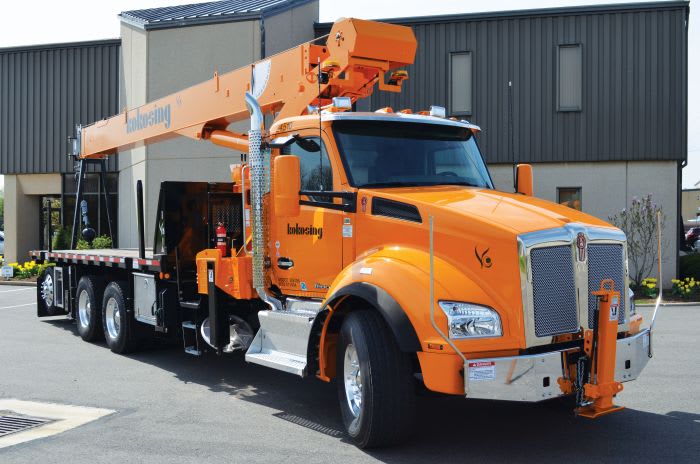
The newest Kenworths in the construction firm’s fleet are T880s, like this multi-axle flatbed truck with a National 27-ton on-board crane. They carry and lift materials and mechanical equipment at heavy bridge and industrial projects, and engines run hydraulic pumps to operate the cranes. Thus idle-reduction isn’t always possible.
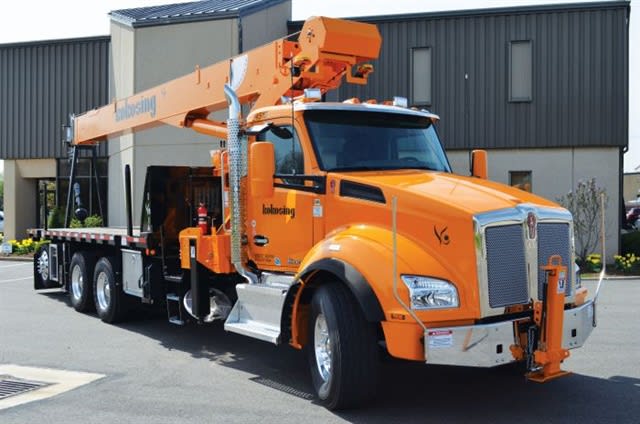
The newest Kenworths in the construction firm’s fleet are T880s, like this multi-axle flatbed truck with a National 27-ton on-board crane. They carry and lift materials and mechanical equipment at heavy bridge and industrial projects, and engines run hydraulic pumps to operate the cranes. Thus idle-reduction isn’t always possible.
How do you save fuel in a work-truck and heavy-haul operation? “Leave the truck parked,” quips Wayne Queen, trucking yard manager at Kokosing Construction, named for a river that flows past its headquarters at Fredericktown, Ohio.
“In the vocational world, [fuel economy] is a tough sell – everything is big, wide and tall. Some trucks run equipment through PTOs, so the engines have to run and it’s hard to save fuel.”
He directly manages 32 Kenworth T800 and T880 trucks and tractors. The latter have Cummins 550- and 600-hp diesels and pull lowboys to move equipment to project sites in Ohio and nearby states. Heavy straight trucks haul materials handled by on-board cranes. They sometimes gross over 70,000 pounds, and loaded tractor-trailers gross 80,000 to 200,000 pounds. So high mpg numbers aren’t likely.
“Idling is our biggest concern and is what we focus on to save fuel,” Queen says. “We tell our drivers, ‘Turn the truck off when you come into the office.’ I see a driver in the hall and look outside and his truck’s running. If I go out and happen to walk by a running truck, I’ll turn it off. Starters are cheap compared to fuel.”
Kokosing also has scores of mechanics’ service trucks whose power take-offs operate various equipment while on assignments. But if the engine isn’t running something through the PTO, turn it off, drivers are told. Many work trucks have diesel-driven electric welding rigs that can also be used to run tools and pumps, and managers tell operators to use those whenever possible.
Route planning works, too. “Combine the routes whenever you can to reduce miles run. Figure out the best route possible for distance and to avoid left turns,” Queen says. “The biggest thing is, educate your drivers, and manage your fleet with knowledge of idle times and ways to avoid it.”
More Fuel Smarts

New California Law Could Shed Light on Electric Truck Prices
Why do battery-electric Class 8 trucks remain so expensive? A California bill signed by Gov. Gavin Newsom would give fleets and state agencies more visibility into what manufacturers charge.
Read More →
How Volvo Updated Its D13 for EPA 2027 [Watch]
Volvo’s updated D13 promises lower emissions without sacrificing performance or fuel economy. Take a closer look at what changed inside the engine in this HDT Spotlight video.
Read More →
Diesel Price Spike Shortens Payback for Natural Gas Trucks, Report Says
Energy Vision estimates fleets could recover the higher purchase price of an RNG-fueled Class 8 tractor in 1.3 to 2.8 years under current fuel-price scenarios.
Read More →

Calstart Becomes Catalyst Mobility, Reflecting Broader Focus
Calstart is now Catalyst Mobility, reflecting the nonprofit’s growing national role in clean transportation, including zero-emission trucks, infrastructure and incentive programs.
Read More →
Record Diesel Prices Squeeze Trucking Fleets
Average U.S. diesel prices have climbed to nearly $6 a gallon, surpassing the 2022 record as tight refinery capacity and Middle East disruptions keep fuel costs elevated.
Read More →
How Fuel Delivery Shapes Engine Performance
Fuel delivery depends on more than what happens at the injector. For fleet, maintenance and technical professionals, looking at the full path from pump to injector can provide useful context for understanding engine performance.
Read More →
East Coast Port Launches $45M Electric Truck Push
The Port Authority of New York and New Jersey announced millions in incentives for zero-emission drayage trucks, yard tractors, and new charging hubs near the port.
Read More →
Detroit Opens Orders for EPA 2027 Engines
Detroit isn’t starting from scratch to meet EPA 2027 diesel emissions standards. Its Gen 6 DD13 and DD15 engines keep much of today’s platform while updating the fuel and aftertreatment systems.
Read More →
Zero-Emission Truck Corridor Planned for West Coast
California, Oregon, Washington, British Columbia and Baja California are coordinating plans for truck charging and hydrogen fueling from Canada to Mexico.
Read More →
A Closer Look at Kenworth’s Electric T880E Vocational Truck [Video]
Learn more about Kenworth's T880E battery-electric vocational truck at the Paccar Technical Center, including its range, applications, upfitting considerations, and PTO options, in this HDT Spotlight video.
Read More →