




Hydraulic Hybrid Drive Systems Can Save You Fuel
Hybrid drive systems deliver value by reducing engine load, replacing or supplementing engine output through alternate means of powering the vehicle, or recovering energy normally turned into heat during braking and putting it back to work. Heavy-duty hydraulic hybrids accomplish all three.

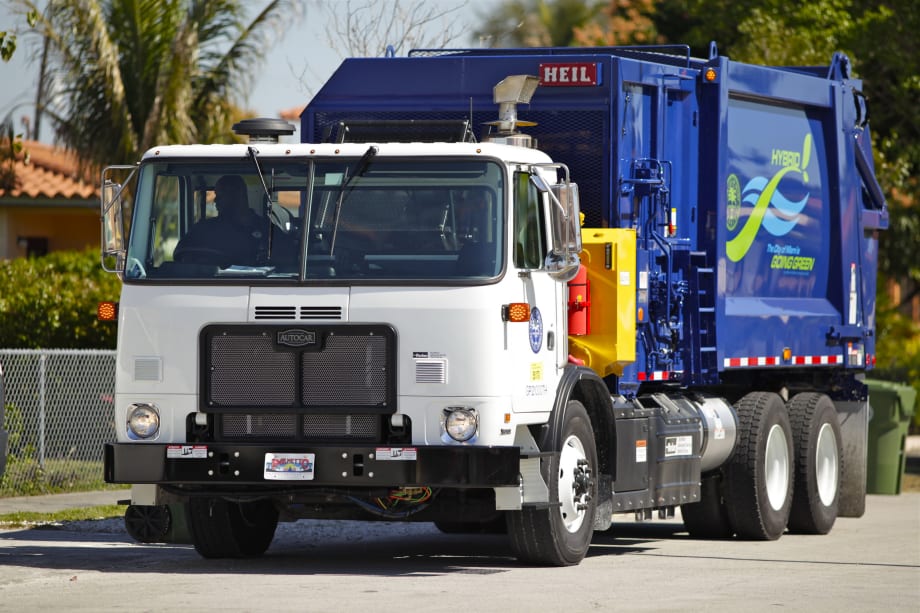
Hydraulic hybrid drive systems can cut fuel consumption and dramatically improve brake life for refuse fleets.
Hybrid drive systems deliver value by reducing engine load, replacing or supplementing engine output through alternate means of powering the vehicle, or recovering energy normally turned into heat during braking and putting it back to work. Heavy-duty hydraulic hybrids accomplish all three.
Hydraulic hybrid drive systems can cut fuel consumption and dramatically improve brake life for refuse fleets.
Eaton recently discontinued its Hydraulic Launch Assist system, which was a parallel hydraulic hybrid. That leaves the RunWise Advanced Series Hybrid drive system from Parker to serve the refuse market, where both systems had built up some market share.
RunWise does not have a conventional drivetrain. The engine is not coupled directly to the drive wheels, and there is no traditional transmission. Instead, the engine delivers power to the hydrostatic drive system via a shaft in the “power drive unit.”
In hydrostatic drive mode, the PDU sends hydraulic fluid through a secondary pump/motor to drive the truck in one of two “gears:” hydraulic low (0-22 mph) or hydraulic high (22-40 mph). At speeds from 40 to 65 mph, the drive axles are coupled mechanically to the engine through the PDU at a 1:1 ratio for direct drive.
The RunWise hydraulic hybrid reduces energy consumption in two ways. Using the diesel engine to power the hydrostatic drive system maintains a steadier engine rpm while collecting trash and reduces the fuel-gulping transient spikes in engine speed. Additionally, energy recovered through regenerative braking is reused to launch the vehicle, further reducing power demand on the engine.
Regenerative braking uses the vehicle’s kinetic energy to pump hydraulic fluid from a reservoir through variable displacement, bent-axis and hydraulic pump/motors in the driveline into pressurized cylinders called accumulators.
Pumping the fluid into the accumulators decelerates the truck. Tom DeCoster, business development manager for Energy Recovery at Parker, say the process captures between 70% and 80% of the energy normally turned into heat during braking.
In the acceleration phase, fluid in the high-pressure accumulator flows back to the reservoirs through the hydraulic pump/motor in the drivetrain, transmitting torque to the wheels and supplementing or replacing torque from the vehicle’s engine.
Fuel use cut by half
Parker says its RunWise system can reduce fuel consumption by 20 to 30 gallons of fuel per day, depending on the density of the pickup route, system utilization, etc.
“The operating cycle between starting and braking repeats itself a few thousand times a day in refuse use,” DeCoster says. “The higher the number of start and stop cycles, the more efficient the system operates and the more fuel consumption and brake wear is reduced for the end user.”
DeCoster told us expected fuel savings can be on the order of 50%, depending on the application. Officials from the City of Miami and Miami-Dade County report saving of 51% and 45% respectively.
The savings in brake maintenance are equally noteworthy. Jose Davilla, superintendant for the City of Miami, says at the six-year point in the vehicle’s expected 10-year lifecycle, brake maintenance savings is $81,000.
“Normally, we would replace the brakes on refuse trucks three to four times a year,” he says. “We are now over six years on some trucks and we haven’t touched them yet.”
Maintenance costs for the RunWise PDU are said to be about $600 per year.
DeCoster also notes that the RunWise system is fuel-agnostic, meaning it could be powered by a traditional diesel (including one running on biodiesel) or by a natural gas engine.
“Even through we’re certified and commercialized with the diesel platform, we are developing a CNG version with Autocar,” he says. “The big draw with CNG is productivity. If you compare a traditional-drivetrain diesel ISL [from Cummins] to a CNG ISL, the diesel will be faster from zero to 20 mph than the CNG truck. But with the stored energy in the RunWise system, you get better-than-diesel performance from a natural-gas-fueled truck.”
And then there’s the emissions issue. “Cities are saying they want the cleanest vehicles they can get,” DeCoster notes. “Diesels still produce carbon. Natural gas does not.”
Although refuse is the primary target for hydraulic hybrid technology, Parker is currently field-testing its RunWise system on package delivery trucks.
“It’s a different duty cycle from refuse, so it’s slightly different technology, but we still use the series architecture for engine-off operation. You could, for example, pull away from an intersection and accelerate up to speed on just stored energy. Drivability is very, very close to a standard diesel parcel truck. Again, we’re fuel agnostic, so it would work for CNG, LNG, or propane.”
Eaton drops hydraulic hybrid
Eaton’s Hydraulic Launch Assist hydraulic hybrid system, often referred to as a mild hybrid rather than a full hybrid, offered energy recovery of up to 70 to 80%, and fuel savings on the order of 4 to 5 gallons of fuel per day with an ROI of 2 1/2 to 5 years, Eaton said. That apparently wasn’t enough.
Recently, Eaton quietly withdrew its HLA system from the market, leaving Parker’s RunWise system as the sole player in the refuse market.
RunWise is a full hydraulic hybrid power system offering regenerative braking as well as a full-time hydrostatic drive. The company claims, and customer testimonials seem to bear out, that it could save up to 20 to 30 gallons of fuel in a day – approximately a 50% reduction in fuel consumption, depending on the duty cycle.
With natural gas quickly becoming the dominant fuel in the refuse sector, where supply infrastructure exists, its reduced cost and carbon emissions have changed the business case for mild hydraulic hybrids.
Eaton declined to be interviewed for this story, but told HDT that since CNG began taking over all new investments in refuse, hybrids are no longer serious contenders.
More Fuel Smarts

How Volvo Updated Its D13 for EPA 2027 [Watch]
Volvo’s updated D13 promises lower emissions without sacrificing performance or fuel economy. Take a closer look at what changed inside the engine in this HDT Spotlight video.
Read More →
Diesel Price Spike Shortens Payback for Natural Gas Trucks, Report Says
Energy Vision estimates fleets could recover the higher purchase price of an RNG-fueled Class 8 tractor in 1.3 to 2.8 years under current fuel-price scenarios.
Read More →
Calstart Becomes Catalyst Mobility, Reflecting Broader Focus
Calstart is now Catalyst Mobility, reflecting the nonprofit’s growing national role in clean transportation, including zero-emission trucks, infrastructure and incentive programs.
Read More →

Record Diesel Prices Squeeze Trucking Fleets
Average U.S. diesel prices have climbed to nearly $6 a gallon, surpassing the 2022 record as tight refinery capacity and Middle East disruptions keep fuel costs elevated.
Read More →
How Fuel Delivery Shapes Engine Performance
Fuel delivery depends on more than what happens at the injector. For fleet, maintenance and technical professionals, looking at the full path from pump to injector can provide useful context for understanding engine performance.
Read More →
East Coast Port Launches $45M Electric Truck Push
The Port Authority of New York and New Jersey announced millions in incentives for zero-emission drayage trucks, yard tractors, and new charging hubs near the port.
Read More →
California Bill Could Shed Light on Electric Truck Prices
Why do battery-electric Class 8 trucks remain so expensive? A California bill headed to Gov. Gavin Newsom would give fleets and state agencies more visibility into what manufacturers charge.
Read More →
Detroit Opens Orders for EPA 2027 Engines
Detroit isn’t starting from scratch to meet EPA 2027 diesel emissions standards. Its Gen 6 DD13 and DD15 engines keep much of today’s platform while updating the fuel and aftertreatment systems.
Read More →
Zero-Emission Truck Corridor Planned for West Coast
California, Oregon, Washington, British Columbia and Baja California are coordinating plans for truck charging and hydrogen fueling from Canada to Mexico.
Read More →
A Closer Look at Kenworth’s Electric T880E Vocational Truck [Video]
Learn more about Kenworth's T880E battery-electric vocational truck at the Paccar Technical Center, including its range, applications, upfitting considerations, and PTO options, in this HDT Spotlight video.
Read More →