




How Truck Tire Retreading Has Changed
Kevin Rohlwing has been in the tire industry for 37 years and has seen a massive shift in retread technology. Gone are the days of technicians eye-balling the tread on the casing. But he says the retread revolution is far from over.
by Kevin Rohlwing, Tire Industry Association
December 4, 2019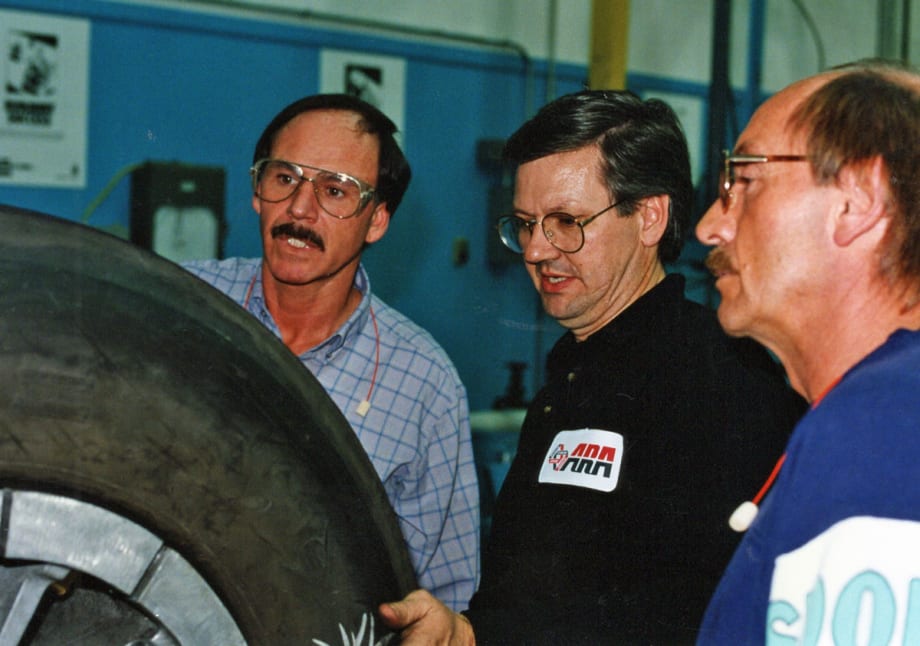
In the early 1990s, the American Retreaders Association, which preceded ITRA, believed that hands-on training led by an experienced instructor was the best way to teach what was then a much more manual retread process.
Photo courtesy Kevin Rohlwing
6 min to read
This year marked my 37th in the tire industry. I started at age 15, stacking tires when I wasn’t cleaning whitewalls at our family tire dealership. By the time I was 18, I was running road service calls all over the Chicagoland area.
Just a few years later, the service manager position at our dealership opened up, and my whole life changed. Suddenly I had the responsibility of keeping service trucks, salesmen, and three bays running and profitable every day. Then in 1996, I joined the old International Tire & Rubber Association (ITRA) as the new director of commercial tire service.
Retreading required a lot of effort in the 1990s. It was a physically demanding job that required a high level of skill. Some equipment and machines made the process a little easier or a little faster, but the human element still played a major role in the quality and performance of each retread.
You could have five different retreaders using the exact same process and get five different results. Good people in good plants made good retreads, average people in average plants made average retreads, and low-cost retreaders typically produced low-cost retreads.
Computerized buffers were probably the first major technological achievement for the industry. Automatic computer buffers did a much better job while lowering cost and improving the performance of end products.
The reliability of retreads also has increased tremendously with shearography inspection technology. By detecting movement between the belts and belt edges, the retreader can definitively reject a casing with the pictures to show why it wasn’t retreaded. Allowable guidelines are established and the machine provides the information that either falls within or outside those guidelines. With a more stable casing, the benefits are easier to realize because fewer retreads will fail in service.
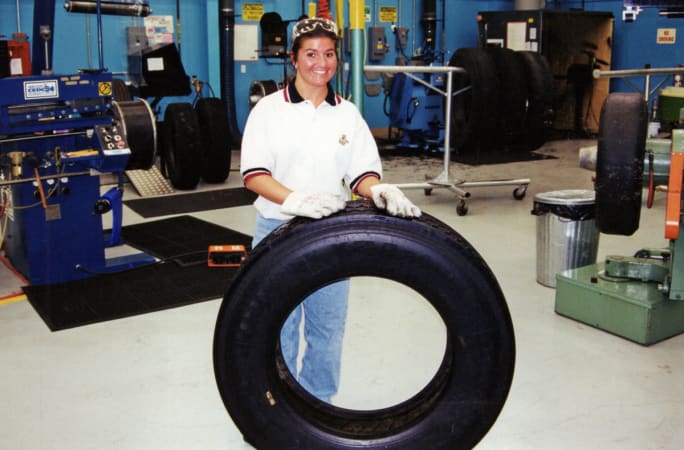
This '90s trainee was so proud of her retread that she wanted her own picture with it.
Photo courtesy Kevin Rohlwing
With the growth in automation, computerization and advanced inspection technologies, the need for skilled retread plant workers started to decrease. In 1996, most of the retread plant workers in North America were still craftsmen, to some degree. Now workers let the machines do most of the work.
How Retreading Has Changed
To say retreading has changed over the last 23 years is an understatement. There were probably 2,000 to 3,000 retread plants producing 15 million to 16 million retreads a year back then. Annual retread production has stayed relatively the same, with a slight drop to the current 14 million to 15 million-unit range, but the number of plants has dwindled to less than 800. Combine continued consolidation with more production improvements, and you are going to get a growing number of plants that retread more than 1,000 tires a day, which was unheard of back in the mid-1990’s.

This is a classic example of a student in the 1990s “eyeballing” the tread to see if it is centered and straight on the casing during the precure building process.
Photo courtesy Kevin Rohlwing
Retreading today is as modern of a manufacturing process as you will see, and I believe technology is only going to get better.
The other side of the business is the industry itself. I’ve always said that marketing and giveaways sell passenger and light truck tires, while math sells commercial truck tires. For a lot of fleets, it’s cost versus price. With most wheel positions on the cost side, tire and retread manufacturers must continue to deliver the best cost-per-mile in order to compete. I believe that the economic advantages to retreading will become harder to ignore as new truck tire raw material and manufacturing costs continue to rise.
Because technology will continue to play a major role in the evolution of retreads and the retreading process, I reached out to Edd Burleson, the president of Central Marketing Inc. in Colonial Heights, Virginia, and a member of the Tread Rubber and Tire Repair Material Manufacturers’ Group, for his thoughts on retreading equipment. Burleson was a pioneer in bringing automated retread technology from Europe to the North American market in the early 1990s.
“Retreading advances are a little like Thomas Jefferson, not inventing things but continuing to improve existing things," he said.
I asked him to weigh in on the ways retreading equipment has changed and will continue to change:
On inspection: “I feel shearography is a major technological advance that has become affordable at the retreading level. Today, these systems offer bead-to-bead inspection with automatic grading of the casing based on the parameters given for each tire. The grading can split the tire into zones so different parameters can be used in different zones. Also, 3D mapping of the tire is now available, which makes the results more understandable for the operator.”
On buffing: “We installed our first computer buffer in 1994, and if we compare what we have today to what we had then, the advancements in this technology are unbelievable. The latest innovations include automatically profiling the tire and calculating all the parameters needed to buff the casing. Also, the machine will automatically adjust the buff profile to a set distance over the steel belt, adjusting each section of the tire and making sure the shoulder circumferences are the same. In addition to technology advances, there are also productivity improvements with twin hub buffers, so mounting, inflating, demounting and deflation time is reduced.”
On AZ Cushion Applicators: “This is one of the machines that has had a major impact on the industry. The AZ machine has improved quality and saved waste from cutting the sides of calendared cushion off to fit the casing, plus filling the skives. Normal improvements have been many, including decreasing cycle time, but the latest advance is the automatic setting of the wing formers with a laser camera to gauge the thickness of the cushion applied to the casing.”
On building: “This involves different types of machines, as there are different systems being used in the industry today, so they need to be addressed separately.
Precure. “Major improvements have been in the areas of tread pattern matching and tread tensioning that improves balance. These machines measure the tire circumference and measure the correct tread length to apply at an even tension with a splice that matches the tread pattern.”
Spliceless. “This type of tread is cured in one piece so there is no splice, providing an optimal amount of tension with no need for a tread match.”
Mold cure. “There are new extruder builders that automatically measure the casing and apply the correct amount of rubber based on the exact mold for the retread. Also, new extruders can extrude tougher rubber compounds that are required to be competitive in today’s retreading industry.”
On curing: “We still cure tires the same way by using a chamber or a press for mold cure, but there have been many improvements that have resulted in shorter cure times, with automatic controls that alert and prevent improper cures.”
On final inspection: “The major change in this area is technology that can quickly and efficiently inflate the retreaded tire to operating pressure and check it for any quality issues before the tires leave the retread plant.”
No matter how future products or services are delivered, there is a strong likelihood they will depend on vehicles with tires. In an age where e-commerce is exploding, the Transportation Research Board estimated that the number of city truck trips may double by 2022.
In many cases, tires on these urban delivery trucks may have a higher degree of retreadability. As more of them are needed to solve the challenge of the “final 50 feet,” it could mean more use of retreads.
Kevin Rohlwing is the Tire Industry Association’s senior vice president of training. A longer version of this article appeared in HDT sister publication Modern Tire Dealer.
Subscribe to Our Newsletter
More Maintenance
Mack Expands Extended Coverage With Four Chassis System Plans
Mack Trucks' new system-specific coverage options allow heavy-duty fleets to select protection for driveline, cab, HVAC, electronics, and advanced safety components.
Read More →
What an Out-of-Service Order Really Costs, and How to Plan for One
The repair invoice is the first number you see — and often one of the smallest. Here’s what else an out-of-service order can cost a fleet, and how planning can reduce the damage.
Read More →
International Launches Online Truck Parts Store
Fleetrite.com lets fleets and repair shops find OEM and all-makes parts, check prices and availability, and order without calling a parts counter.
Read More →

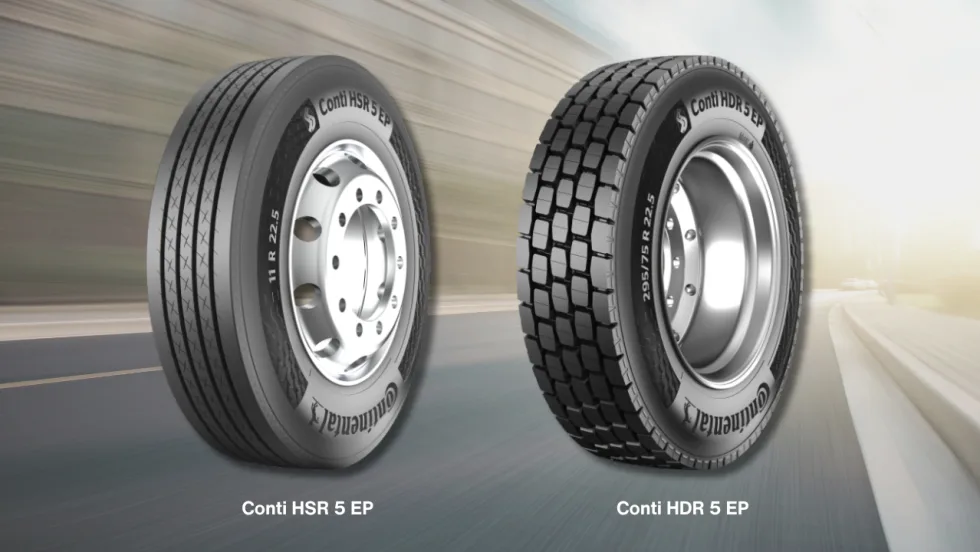
Continental Introduces New Regional Truck Tires
Continental says its new Generation 5 steer and drive tires for regional operations offer longer tread life, with estimated mileage gains of 22% and 19%, respectively.
Read More →
Sponsored•October 1, 2026
How AI Can Help Your Techs’ Efficiency
The technician shortage isn't going away, and no single fix can close the gap on its own. Trent Broberg makes the case that AI's real job in the shop is protecting the billable hours and job satisfaction of the techs you already have, not asking them to work faster.
Read More →
Sponsored•September 16, 2026
Color Match Smarter: Tools That Restore & Perform
For fleet managers and collision repair professionals keeping heavy-duty trucks on the road, getting the color right the first time isn't just about appearance — it's about efficiency, turnaround time, and bottom-line results. Discover how today's digital color tools are transforming the repair process from guesswork to precision.
Read More →
Wrong Repair Prompts Recall of Freightliner, Western Star 4x2 Trucks
DTNA is recalling more than 2,400 trucks that received an incompatible software fix instead of the hardware repair required to address brake valve corrosion.
Read More →
Truck Drivers Need More Than Another Alert
Fleets have more visibility into truck health, safety events, and driver activity than ever. The next challenge is turning all that information into useful guidance for the person who has to decide what to do next.
Read More →
The Maintenance Checks Trucking Fleets Should Prioritize Before Fall Freight Picks Up
Making it through August isn’t the same as being ready for the next several months of operation. Find out what systems may have suffered from summer heat and need to be checked out before fall.
Read More →
What Three Fleets Are Doing Differently When Buying Truck Parts in 2026
With freight improving but costs still climbing, fleet maintenance executives explain how they're balancing price, quality, and supplier relationships.
Read More →