




How to Get the Most from Your Truck Batteries
No matter what type of battery you buy, poor maintenance can shorten its life. What’s the right battery for your trucking fleet?

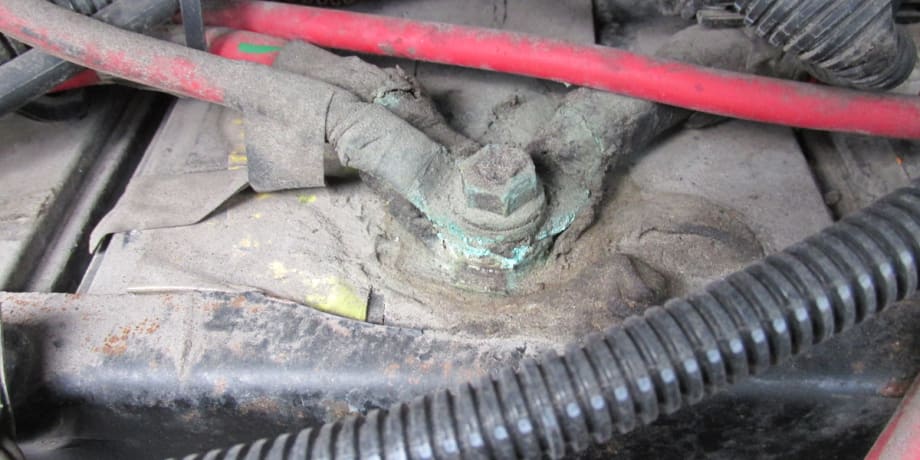
How long has it been since this battery was inspected? If you look after your batteries, your batteries will look after you.
Photo: Purkeys
Battery maintenance should be more than checking the connectors for tightness and signs of corrosion. That should be part of the routine, but apparently even that is often overlooked.
“I’ve got pictures of batteries that you could grow corn on, they are so dirty,” says Larry Rambeaux, sales application engineer at Purkeys Electric. “The cables are probably loose, too, but you’d never know it for all the junk on top of the batteries.”
Rambeaux says fleets are often lulled into complacency by the term “maintenance-free,” compounded by the assumption that premium batteries somehow can survive without basic maintenance.
“Low-maintenance batteries still need proper care,” says Alan Kohler, marketing manager for Odyssey Battery at EnerSys. “Even though they do not require the monthly electrolyte level checks that flooded lead acid batteries do, they must be properly installed, cleaned and charged for reliable service and long life.”
What’s the Right Battery for You?
“People still ask me if there’s any value in buying premium batteries,” Purkeys’ Rambeaux says, “and I tell them, well, yes, there is — but if you don’t fix your maintenance practices, you’ll end up throwing away $400 batteries instead of $100 batteries,” he says, only half-jokingly.
Purkeys no longer sells batteries, so he’s free to espouse his honest opinion.
“Back when we did sell batteries, people would think I was just trying to upsell them when I’d recommend a premium AGM [absorbed glass mat] over a flooded-cell battery,” Rambeaux says. “The truth is, with good maintenance, a premium battery will last the full trade-cycle of a truck.”
Some maintenance people, on the other hand, take another tack on the premium-battery question and prefer to lower their expectations and mitigate the risk of failure.
Maintenance consultant Bruce Stockton of Stockton Solutions has lately been advising fleets to replace all three or four batteries at about the 24-month time frame in their own shop during scheduled preventive maintenance.
“That has been paying dividends for fleets in reducing their no-start situations,” Stockton says. “If they have ‘sale’ equipment, they can use the removed batteries that still test good to place in those trucks until sold.”
What Truck Batteries are Right for Your Operation?
Randy Cornell, vice president of maintenance at CFI, compared the lifecycle cost of AGM and lead-acid batteries and found the overall cost of AGMs was higher than the lead-acid batteries.
“We took 40 brand-new trucks and left lead-acid batteries in 20 of them and replaced 20 of them with AGM batteries,” Cornell says. (He runs a four-battery system.) After 38 months in service, the AGM battery cost per unit per month has been about $3 higher. The cost analysis included the initial cost of the AGMs, any work related to batteries, any warranty credits, jump starts, etc.
So, 38 months into the test, even with replacing all the lead-acid batteries at least once, the lead-acid batteries cost less.
“As of today, I just don’t see the advantage of the AGM batteries for our operation,” he says.
“Our operation” is the operative word here. In a different application with different duty cycle, alternators of different outputs, basic maintenance practices, etc., such a comparison could produce different results.
Get the Most from Your Truck Batteries
Battery failures often result from external factors. Failures may be due more to the inability to recharge completely after deep discharging, weak alternators, or poor cables and connections, than any shortcoming in the battery itself.
Incomplete recharging has profound implications for both battery life and performance. John Cathey, manager of OEM field sales support at East Penn Manufacturing (Deka Batteries), likens a battery to a long-distance runner.
“If we take a champion Olympic runner and put them in a hospital bed for a few weeks, they will no longer have what they had to begin with,” he explains. “If we do that several times over several years, they might still be amazing athletes, but not Olympic contenders.”
To get the most out of a battery, you have to use it and refill the depleted charge. If the vehicle is idle for more than a few weeks, the battery should either be disconnected from any electrical loads or connected to a trickle charger, says Odyssey’s Kohler.
“A trickle charger will keep the battery charged and ready for use,” he says. “This will help ensure that onboard accessories, such as the radio and other electronic components, don’t drain the battery.”
Kohler warns that the trickle charger must be designed for the particular chemistry of the battery. Flooded and AGM batteries have different charge settings.
Batteries that are cycled frequently and fully recharged will last longer and not be as badly impacted by cold weather. For example, Cathey says a battery at 12 volts might freeze at 30 degrees below zero, while a battery at 12.6 or 12.8 volts for AGMs won’t freeze at even 80 below.
“Battery maintenance is no longer about cleaning the posts and filling it with water,” Cathey says. “Today, it’s about keeping it fully charged every day and using it. If you do that, you’ll get the maximum number of cycles that battery was designed for, as defined by the SAE J2185 standard.”
Providing proper pathways for the current to flow from alternators to batteries involves keeping terminal posts clean, connections tight and minimizing parasitic loads.
This article first appeared in the Jan/Feb 2022 issue of Heavy Duty Trucking.
More Maintenance

Color Match Smarter: Tools That Restore & Perform
For fleet managers and collision repair professionals keeping heavy-duty trucks on the road, getting the color right the first time isn't just about appearance — it's about efficiency, turnaround time, and bottom-line results. Discover how today's digital color tools are transforming the repair process from guesswork to precision.
Read More →
Wrong Repair Prompts Recall of Freightliner, Western Star 4x2 Trucks
DTNA is recalling more than 2,400 trucks that received an incompatible software fix instead of the hardware repair required to address brake valve corrosion.
Read More →
Truck Drivers Need More Than Another Alert
Fleets have more visibility into truck health, safety events, and driver activity than ever. The next challenge is turning all that information into useful guidance for the person who has to decide what to do next.
Read More →
The Maintenance Checks Trucking Fleets Should Prioritize Before Fall Freight Picks Up
Making it through August isn’t the same as being ready for the next several months of operation. Find out what systems may have suffered from summer heat and need to be checked out before fall.
Read More →
What Three Fleets Are Doing Differently When Buying Truck Parts in 2026
With freight improving but costs still climbing, fleet maintenance executives explain how they're balancing price, quality, and supplier relationships.
Read More →
Paccar Recalls 2027 Trucks Built This Summer for Possible Electrical Problem
The nearly 6,000 Kenworth and Peterbilt trucks in the recall could potentially lose engine power, among other things.
Read More →
Could New Engine Oils Mean Longer Drain Intervals?
New CL-4 and FB-4 engine oils are coming in 2027. Foodliner wants to know whether they could support longer oil drains, but it won’t change its maintenance schedule without data from its own trucks.
Read More →
Brake Safety Week to Focus on Drums and Rotors
Commercial vehicle inspectors are focusing on truck brakes during CVSA's Brake Safety Week, August 23-29.
Read More →
Possible Battery-Cable Fires Prompt Recall of 15,000+ International MV and HV Trucks
On the recalled vehicles, manufacturing variations can cause the battery interconnect cable to contact the auxiliary stud and hold down the bracket.
Read More →
Rush, MCT Team Up to Grow Refrigeration Service Network
The joint venture will operate MCT's network of Carrier Transicold dealerships and mobile service locations, with the companies promising greater service capacity and uptime for refrigerated fleets.
Read More →