




How Speed, Weight and Grades Affect Brakes
Understanding the operational factors that boost -- or degrade -- braking performance is critical for reliable, safe stops on the road.


It's not enough to simply inspect your brakes regularly. To insure top performance, you need to understand how operational factors impact brake performance.
Photo: Jim Park
We are all familiar with brakes. We use them to stop. That's their function, but in engineering terms, a brake is a device used to convert kinetic energy (motion) into thermal energy (heat) through friction between stationary parts (brake linings) and moving parts (brake drums or rotors). The brake drum and the lining material are designed to dissipate that converted energy, but too much heat that cannot dissipate quickly enough will eventually overwhelm the brakes design capacity rendering them less and less effective, and eventually useless.
The normal operating temperature of a properly functioning brake is about 500°F. A hot brake that produces a distinctive odor usually accompanied by white or blue smoke is about 800°F. Dangerously overheated brakes can reach temperatures of 1,800°F or higher. These will glow cherry- to bright-red and there's serious risk of a wheel-end or tire fire.
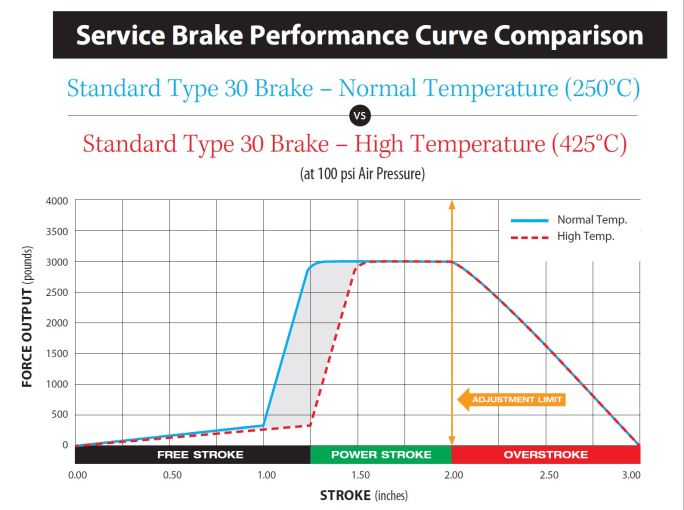
Several things happen to hot drum brakes that will reduce their stopping ability--a condition often referred to as brake fade. Most lining materials lose some frictional capability at high temperatures. Poor quality linings may lose up to a third of their effectiveness at temperatures above 600°F.
On top of that, cast iron brake drums expand as they get hot. The diameter of the drum can increase by as much as forty thousandths (.040) of an inch when it's really hot. An accepted rule of thumb suggests that for every .020 of an inch the drum expands, the push-rod has to travel an additional 1/4 inch to maintain lining-to-drum contact. If a brake was not properly adjusted to begin with, things can go downhill (sorry about that pun) pretty fast.
The laws of physics work against truck brakes in other ways too. It's accepted that if truck weight is doubled, stopping power must be doubled. But if speed is doubled, stopping power must be increased four times. If both weight and speed are doubled, stopping power must be increased eight times.
In practical terms, that means a fully loaded truck descending a hill at 60 mph will require eight times the stopping power of a lightly loaded truck traveling at 30 mph. Or, the brakes on the faster heavier truck will be doing eight times as much work as the brakes on the slower lighter truck. In other words, the brakes must absorb or dissipate eight times as much heat.
Even small increases in speed can make a big difference to the demands on the brakes.
Chart: Jim Park
Even small increases in speed can make a big difference to the demands on the brakes. An increase in speed from 50 mph to 60 mph --an increase of 25%--would increase the stopping distance on level ground by 56%. You can guess what happen on steep hills at high speed.
*Much of the technical detail here comes from a book called "Air Brakes from the Driver's Seat" by Allan C. Wright, published in 1999. It's now out of print, but in 2004 he assigned the book’s copyright to the Insurance Corporation of British Columbia, and it’s since been incorporated into the ICBC publication “Driving Commercial Vehicles”.
More Safety & Compliance

FMCSA Pauses Biennial-Update Enforcement Amid Motus Transition
Carriers whose updates were due on or after June 1 have more time, while FMCSA works to stabilize its new registration system and warns of phishing sites impersonating its new carrier registration system, Motus.
Read More →
ZF Expands Commercial Vehicle Push in North America
ZF is expanding its North American commercial-vehicle presence with new transmission applications, electrification, trailer technology and autonomous-driving systems.
Read More →
Truck Drivers Need More Than Another Alert
Fleets have more visibility into truck health, safety events, and driver activity than ever. The next challenge is turning all that information into useful guidance for the person who has to decide what to do next.
Read More →
Tesla Wants a Self-Driving Semi. Are Cameras Enough?
Could Tesla’s camera-only autonomous driving technology work on an 80,000-pound Semi? In this commentary, HDT's Deborah Lockridge takes a look at Tesla, Cybercab, and how autonomous trucks see the road.
Read More →
What DOT’s Automated Vehicle Strategy Means for Trucking
The U.S. Department of Transportation issued a new automated-vehicle strategy that outlines plans for driverless-truck regulations, cross-state freight corridors, and federal safety standards.
Read More →
NYC Expands Speed, Pedestrian Safety Tech Across Fleet
New York City is expanding intelligent speed assistance and pedestrian-alert systems across its municipal fleet, moving the technologies from pilot programs into vehicle procurement and retrofit requirements.
Read More →
FMCSA Removes 110 Truck Driver Training Schools from Certified ELDT List
Federal regulators also are targeting more than 160 additional training providers and launching a nationwide audit of third-party CDL skills testers as part of a broader crackdown on trucking fraud.
Read More →
Beyond DOT Compliance: What Makes a Trucking Fleet Truly Safe?
A trucking fleet can follow every rule and still make unsafe decisions. The real test comes when safety conflicts with freight, productivity, or cost.
Read More →
Hours of Service Pilot Programs: FMCSA Readies for 2027 Rollout
Two pilot programs could eventually reshape hours-of-service rules, giving truck drivers options to pause their 14-hour clock or use longer split sleeper rest periods.
Read More →
New Guide Offers Pet Safety Tips for Truck Drivers
Hundreds of thousands of pets travel in truck cabs. A new safety guide from Volvo Trucks and the Center for Pet Safety offers practical advice for truck drivers who bring dogs and cats along for the ride.
Read More →