




How Smart Trailers Can Prevent 'BLT' Headaches
The three most common and costly trailer problems – brakes, lights, and tires (BLTs) – are said to account for more than 80% of all unplanned trailer downtime. Find out how smart trailers can help.
December 23, 2020

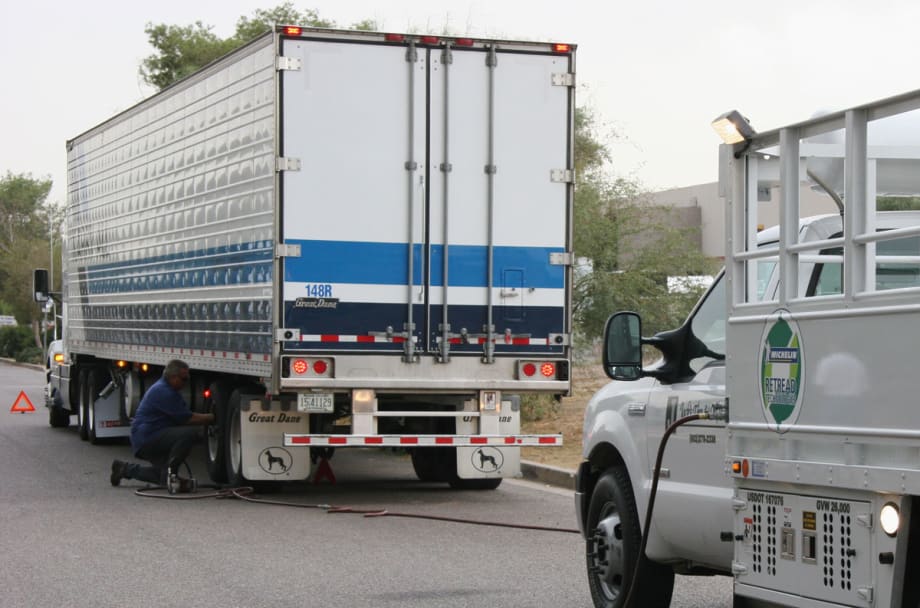
Brakes, tires, and lights cause a lot of maintenance headaches. Smart trailers could help.
Photo: Michelin
3 min to read
Who hasn’t had a call from a driver at 2 a.m. saying the hot load he just pinned up to in the customer’s yard has a flat tire, or no lights?
The three most common and costly trailer problems – brakes, lights, and tires (BLTs) – are said to account for more than 80% of all unplanned trailer downtime, and a high percentage of CSA violations. Smart trailer technology can vastly reduce those unpleasant events through notification of the trailer’s condition.
“If you talk to fleet managers who are on top of their game, what they would like to do is be able to pre-check a trailer before they send the tractor over to it,” says Dave McKean, executive vice president of business development, and general manager of Clarience Technologies’ Road Ready telematics division. “If you’re able to run your smart trailer untethered from the tractor, you can do a pre-check. When the driver arrives, they can find the trailer and it’s ready to roll. The lights all work and the tires are inflated. No more surprises.”
McKean says it was the ability to pre-check and locate untethered trailers that first brought fleets onboard with the smart trailer concept. Data are collected by battery-powered sensors on board the trailer, and sent, when requested, through a telematics gateway on the trailer to fleet managers.
“The return on investment on the system was immediately obvious,” he says. “Once fleets realized what that visibility could do for them, they were all over the idea.”
But smart trailers don’t stop with identifying flat tires. Systems are coming to market now or in the near future that can monitor wheel-ends for high-temperature conditions that could cause wheel-end and tire fires, and even excessive vibration that could warn of imminent bearing failure.
Using predictive analytics and data analytics, the Road Ready systems monitor historic vibration levels and wheel-end temperatures and send alerts when they creep into higher-than normal-ranges. “With that information, you can predict when you need to actually do maintenance on a bearing, and thus prevent that roadside issue where the bearing has disintegrated and [possibly] created a thermal event,” McKean says.
Hendrickson says it will add Watchman sensor technology to its Tiremaax Pro tire pressure control systems in mid-2021 to monitor and report tire pressure and wheel-end temperature at each wheel position.
“Watchman communicates this data to other smart trailer devices to provide specific, actionable alerts to the fleet in real time,” says Hendrickson’s business unit director, Matt Wilson. “With Watchman, tires are actively maintained and monitored to ensure that potential tire and wheel-end problems may be addressed quickly and efficiently.”
Bill Hicks, director of product planning at SAF-Holland, hinted recently that the company’s Smar-te Tire Pilot intelligent tire management system will soon be able to deliver more than just tires that are properly equalized and inflated for the load they carry.
“The Smar-te Tire Pilot will adjust tire pressure based on predetermined load curves published by the tire manufacturers based on the load on the axles,” he says. “At this time, it does not have the capabilities to monitor or detect a potential wheel-off situation, but that’s what we’re looking at for some point in the future.”
Subscribe to Our Newsletter
More Maintenance

Sponsored•September 16, 2026
Color Match Smarter: Tools That Restore & Perform
For fleet managers and collision repair professionals keeping heavy-duty trucks on the road, getting the color right the first time isn't just about appearance — it's about efficiency, turnaround time, and bottom-line results. Discover how today's digital color tools are transforming the repair process from guesswork to precision.
Read More →
Wrong Repair Prompts Recall of Freightliner, Western Star 4x2 Trucks
DTNA is recalling more than 2,400 trucks that received an incompatible software fix instead of the hardware repair required to address brake valve corrosion.
Read More →
Truck Drivers Need More Than Another Alert
Fleets have more visibility into truck health, safety events, and driver activity than ever. The next challenge is turning all that information into useful guidance for the person who has to decide what to do next.
Read More →
The Maintenance Checks Trucking Fleets Should Prioritize Before Fall Freight Picks Up
Making it through August isn’t the same as being ready for the next several months of operation. Find out what systems may have suffered from summer heat and need to be checked out before fall.
Read More →
What Three Fleets Are Doing Differently When Buying Truck Parts in 2026
With freight improving but costs still climbing, fleet maintenance executives explain how they're balancing price, quality, and supplier relationships.
Read More →
Paccar Recalls 2027 Trucks Built This Summer for Possible Electrical Problem
The nearly 6,000 Kenworth and Peterbilt trucks in the recall could potentially lose engine power, among other things.
Read More →
Will API PC-12 Oil Change Trucking Fleet Maintenance?
The new API PC-12 heavy-duty engine oil category reflects the changing demands of modern diesel engines. But fleets like Foodliner are looking to getting their own data before making decisions on adopting the new oils and questions such as extending oil drain intervals.
Read More →
Brake Safety Week to Focus on Drums and Rotors
Commercial vehicle inspectors are focusing on truck brakes during CVSA's Brake Safety Week, August 23-29.
Read More →
Possible Battery-Cable Fires Prompt Recall of 15,000+ International MV and HV Trucks
On the recalled vehicles, manufacturing variations can cause the battery interconnect cable to contact the auxiliary stud and hold down the bracket.
Read More →
Rush, MCT Team Up to Grow Refrigeration Service Network
The joint venture will operate MCT's network of Carrier Transicold dealerships and mobile service locations, with the companies promising greater service capacity and uptime for refrigerated fleets.
Read More →