





Related: Trucking Through the Pandemic
How HR Needs to Approach COVID-19
In a session packed with information for HR professionals, Katharine Weber, a principal with law firm Jackson Lewis, offered a breakdown of how to plan and brace for COVID-19's continuing effect on the trucking industry’s human resources departments.
October 22, 2020

Image: Gerd Altmann via Pixabay
3 min to read
In a session packed with information for HR professionals, Katharine Weber, a principal with law firm Jackson Lewis, offered a breakdown of how to plan and brace for COVID-19's continuing effect on the trucking industry’s human resources departments.
“You need to take all the responsible steps to reduce the spread of COVID at your company,” said Weber, highlighting a number of applicable federal and state laws that are being pulled into the coronavirus conversation during the hour-long session for the American Trucking Associations' 2020 Management Conference & Exhibition Virtual event. “Wage and hour violations are a real hot spot right now.”
Planning Your Approach
Before you deal with the virus itself and the effect it might have on your workforce, you need to plan how you and your team can reduce the possible spread of the disease. This begins with a virtual walkthrough of your business.
“Are there opportunities where you could take action to reduce the spread of COVID for each department in your business?” questioned Weber, who then reminded attendees that although Centers for Disease Control (CDC) guidelines should be followed to keep employees and their families safe from infection, everything the CDC says is guidance, not law.
And planning means constantly reviewing these guidelines, which are being updated as the medical community learns more about the virus. Previously, the CDC defined close contact as being within 6 feet of an infected individual for 15 minutes. That has been recently updated by the CDC to:
Someone who was within 6 feet of an infected person for a cumulative total of 15 minutes or more over a 24-hour period starting from two days before illness onset (or, for asymptomatic patients, two days prior to test specimen collection) until the time the patient is isolated.
This means that the culminative 15 minutes could affect two days, if someone is in close contact with the infected individual at both the end of one workday and the beginning of the next.
Keeping Employees Informed, Healthy
Weber went on to stress the need for HR reps to keep the questionnaires coming.
“Employees should be filling out health questionnaires every day, including the new language from the close contact update, as well as following the three basic CDC rules: clean it, screen it and mean it,” said Weber, further explaining the need to clean all work environments, ensure that masks are being worn, and make sure everyone is following all the guidelines. “Masks are not just for Halloween anymore.”
Some of the CDC’s guidelines, like the temperature threshold of at least 100.4 degree for sending home an employee, can be superseded by state and local orders — some states/local agencies have lowered the threshold to 99.5 degrees. But the current CDC symptoms — like chills, fever, cough, shortness of breath, loss of taste or smell, and so on — should be used to determine whether or not you should be worried about one of your employees.
Relying on rapid COVID tests is not recommended, she said.
“The rapid tests people are using are not terribly reliable,” said Weber, adding, “A COVID test is not the same as a metal detector. Just because someone is negative today, they could be positive tomorrow.”
Protocols for Positive Test Outcomes
When you get a call from an employee informing you that he or she has tested positive, react with sympathy first and foremost.
“You want to make sure you are offering them the right amount of support and empathy,” said Weber. “Thank them for reaching out to you in a timely fashion, which will go a long way in determining close contact and risk of exposure.”
And when it comes time to perform contact tracing and reaching out to those individuals that may have been exposed, be sure to keep the identity of the infected employee confidential. Also, reminded Weber, “14 is the magic number,” explaining that employees that have been in contact with the infected employee need to isolate for 14 days before returning to work.
Subscribe to Our Newsletter
More Safety & Compliance

FMCSA Pauses Biennial-Update Enforcement Amid Motus Transition
Carriers whose updates were due on or after June 1 have more time, while FMCSA works to stabilize its new registration system and warns of phishing sites impersonating its new carrier registration system, Motus.
Read More →
ZF Expands Commercial Vehicle Push in North America
ZF is expanding its North American commercial-vehicle presence with new transmission applications, electrification, trailer technology and autonomous-driving systems.
Read More →
Truck Drivers Need More Than Another Alert
Fleets have more visibility into truck health, safety events, and driver activity than ever. The next challenge is turning all that information into useful guidance for the person who has to decide what to do next.
Read More →
Tesla Wants a Self-Driving Semi. Are Cameras Enough?
Could Tesla’s camera-only autonomous driving technology work on an 80,000-pound Semi? In this commentary, HDT's Deborah Lockridge takes a look at Tesla, Cybercab, and how autonomous trucks see the road.
Read More →
What DOT’s Automated Vehicle Strategy Means for Trucking
The U.S. Department of Transportation issued a new automated-vehicle strategy that outlines plans for driverless-truck regulations, cross-state freight corridors, and federal safety standards.
Read More →
NYC Expands Speed, Pedestrian Safety Tech Across Fleet
New York City is expanding intelligent speed assistance and pedestrian-alert systems across its municipal fleet, moving the technologies from pilot programs into vehicle procurement and retrofit requirements.
Read More →
FMCSA Removes 110 Truck Driver Training Schools from Certified ELDT List
Federal regulators also are targeting more than 160 additional training providers and launching a nationwide audit of third-party CDL skills testers as part of a broader crackdown on trucking fraud.
Read More →
Beyond DOT Compliance: What Makes a Trucking Fleet Truly Safe?
A trucking fleet can follow every rule and still make unsafe decisions. The real test comes when safety conflicts with freight, productivity, or cost.
Read More →
Hours of Service Pilot Programs: FMCSA Readies for 2027 Rollout
Two pilot programs could eventually reshape hours-of-service rules, giving truck drivers options to pause their 14-hour clock or use longer split sleeper rest periods.
Read More →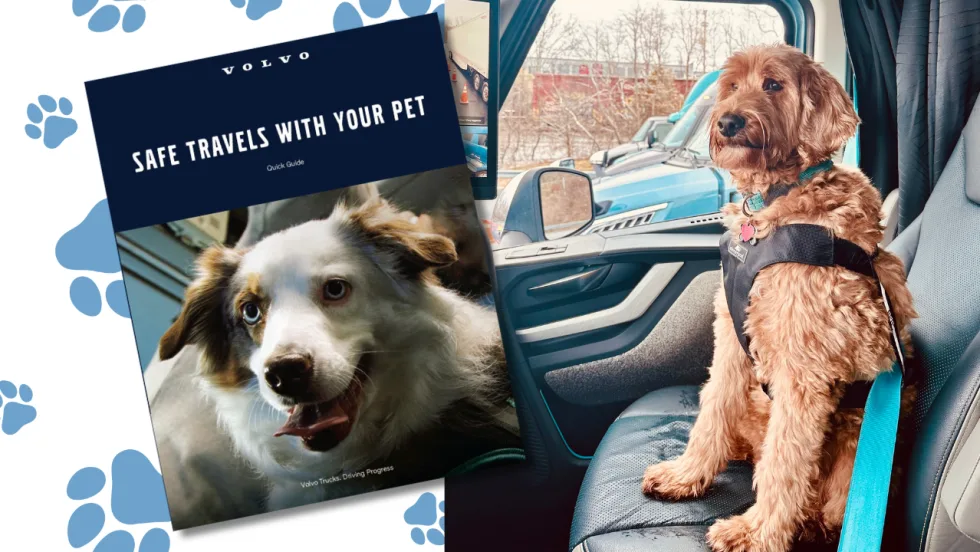
New Guide Offers Pet Safety Tips for Truck Drivers
Hundreds of thousands of pets travel in truck cabs. A new safety guide from Volvo Trucks and the Center for Pet Safety offers practical advice for truck drivers who bring dogs and cats along for the ride.
Read More →