




Fleets Find Benefits in Factory-Installed Inverters
In Joe Egan’s office, a framed picture shows a long-haul tractor, or more precisely, its charred remains. “It’s not one of our trucks, but it illustrates what can happen when an electrical fire is caused by a bad inverter installation,” he says. “It gives a visual reminder to any driver who comes into my office what can happen if an inverter isn’t installed correctly.”
In Joe Egan’s office, a framed picture shows a long-haul tractor, or more precisely, its charred remains.
“It’s not one of our trucks, but it illustrates what can happen when an electrical fire is caused by a bad inverter installation,” he says. “It gives a visual reminder to any driver who comes into my office what can happen if an inverter isn’t installed correctly.”
As director of maintenance for Richmond, Va.,-based Abilene Motor Express, a 350-tractor fleet, Egan says inverters have long been a popular addition to the fleet’s trucks.
“Drivers have always wanted the comforts of home and AC power is at the top of the list. If you’re on the road, you want to be able to plug in a TV, laptop or microwave,” he explains. “Plus, several of our drivers use CPAP machines.
"Prior to 2009, we were allowing our drivers to install their own inverters, but that became an increasingly difficult situation for our company. We were worried about poor installations – thus the picture on my wall – plus when they moved to another truck they would want to pull out the inverter and reinstall it in the new truck. That was a headache for them as well as for us. So, in 2009, we changed our policy and decided to have inverter/chargers factory-installed with each new truck order. That ensured a proper installation and gave drivers what they wanted. It’s been a great decision.”
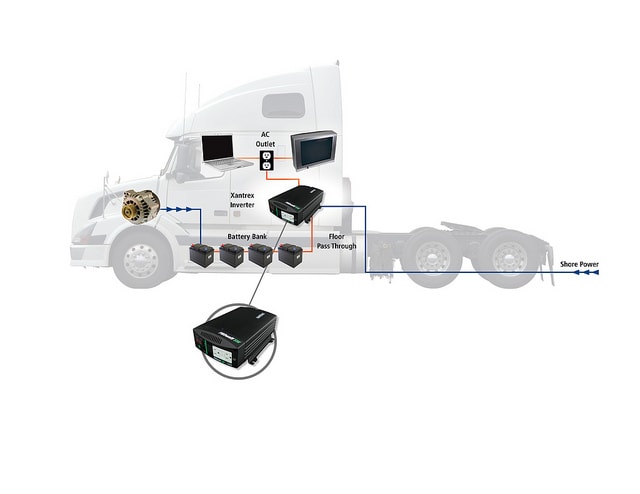
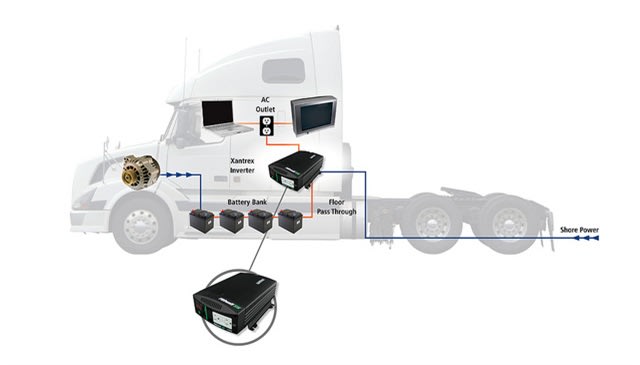
The company runs a mix of tractors – Volvo VN780s, the new Kenworth T680, some Freightliners and Macks. Each truck maker offers Xantrex inverter and inverter/chargers ranging in power from 1,000 to 1,800 watts. Each is rated at double their power for “surge” power (the power needed for the initial load when a microwave turns on for example). Plus, they are equipped with a low-voltage disconnect (LVD) to shut down the inverter, once the system detects low-battery power. This safeguard preserves the starting power in the battery.
According to Steve Carlson, OEM sales manager for inverter supplier Xantrex, when it comes to getting even more from inverters, many fleets are gaining extra “staying-on” power by installing dedicated deep-cycle batteries.
“They’ll add additional cost, but unlike a starting battery, they can be deep discharged with no less impact on battery life, and the LVD can be set to 10.5 volts versus 11.8,” he says. “In many cases, the driver can go a full rest-period without worry of running out of power. We also recommend the dedicated batteries when drivers are using medical equipment, such as CPAP machines. to ensure they have enough power for their sleep schedule.”
Gordon Trucking, based in Pacific, Wash., uses Thermo King TriPac APUs on all its long-haul trucks to provide auxiliary heating (via bunk heater) and air conditioning. The APU also features a Xantrex 1800-watt system, for hotel power loads.
“A quality inverter is very important within that system,” says Kirk Altrichter, vice president of Gordon Trucking. “In earlier APUs we were running, an off-shore brand inverter was used, and it gave us nothing but trouble. When the inverter went out, that meant our drivers couldn’t use hotel loads in the cab and sleeper. So, we were very pleased that our new TriPac units were equipped with the Xantrex inverter – we haven’t had a problem whatsoever and that’s been big for us, and for our drivers. I can tell you that offering AC power to our drivers is a huge retention factor for us. It does make a difference.”
With the TriPac APU, Gordon Trucking uses four AGM batteries which the inverter converts to AC power for all the truck’s hotel loads. Once the system detects the battery bank needs recharging, the APU automatically fires up to recharge the batteries. Once the batteries are topped off, the APU shuts down.
Because Gordon Trucking’s inverters come with the TriPac system, the long-haul trucking company is set for power conversion. But for fleets that don’t have inverters integrated into their APUs, Altrichter has some words of wisdom.
“With inverters, you truly get what you pay for,” he says. “Installation is also critical. You have to have the right wiring to match the amperage draw -- it doesn’t take much to burn down a truck. In the early days, we saw the problem with drivers installing inverters themselves, so we decided back in 2006 that our trucks should have inverters – we wanted to provide them with AC power and we wanted the installation done professionally.”
Carlson says proper installation and a quality inverter go hand-in-hand. “Most inverters you find at a truck stop are not UL approved,” he said. “And that’s where most inverters are purchased. I can tell you unequivocally, that it is worth the extra cost to buy an inverter with a ‘Regulatory Listed’ approval – such as UL or ETL with UL458 rating. This means the inverter was inspected and approved by an independent agency, which safeguards against issues with electricity. UL458 is the listing for inverters and chargers in mobile applications. They must meet strict vibration, environmental, and thermal requirements to be approved for that listing.”
More Drivers

Truck Drivers Need More Than Another Alert
Fleets have more visibility into truck health, safety events, and driver activity than ever. The next challenge is turning all that information into useful guidance for the person who has to decide what to do next.
Read More →
FMCSA Removes 110 Truck Driver Training Schools from Certified ELDT List
Federal regulators also are targeting more than 160 additional training providers and launching a nationwide audit of third-party CDL skills testers as part of a broader crackdown on trucking fraud.
Read More →
Hours of Service Pilot Programs: FMCSA Readies for 2027 Rollout
Two pilot programs could eventually reshape hours-of-service rules, giving truck drivers options to pause their 14-hour clock or use longer split sleeper rest periods.
Read More →
Medical Cards, English Proficiency Reshape Roadcheck Violations
Medical-card violations jumped to the top of the driver out-of-service list during CVSA’s 2026 International Roadcheck, while English-language proficiency violations appeared among the leading violations for the first time.
Read More →
Driver Trust Can Make or Break the Success of Fleet Safety Technology
New Teletrac Navman research suggests that onboarding, transparency about driver data, and positive feedback can play a significant role in how commercial drivers respond to safety and coaching technology.
Read More →
EEOC Sues KLLM Over Alleged Sex Discrimination in Driver Training
KLLM is facing a federal sex-discrimination lawsuit over policies the EEOC alleges put female truck driver trainees at a disadvantage.
Read More →
FMCSA Moves to Codify English Language Requirements for Commercial Drivers
By changing regulations on English-language proficiency requirements for commercial drivers, rather than relying on a guidance memo, the FMCSA said future administrations won't be able to walk back the Trump administration's stricter enforcement with just a memo.
Read More →
Drivers Put Western Star Trucks to the Test at Star Nation Experience
Watch to get an inside look at the Western Star trucks, technology, and community behind the Star Nation Experience 2026!
Read More →
Trump Administration Looks to Put More Veterans Behind the Wheel
The Freedom Haulers program pulls together existing and expanded programs at several federal agencies to recruit veterans to drive commercial heavy-duty trucks and cut the red tape for them to get a CDL, training, and employment.
Read More →
Putting Mack’s Command Steer to the Test
A test drive of Mack’s Command Steer active steering system evaluates how it can make truck driving easier and less tiring.
Read More →